
Commercial ductwork design uses AutoCAD to create accurate HVAC layouts that control airflow, reduce energy waste, support compliance standards, and coordinate building systems across large facilities such as hospitals, offices, hotels, and manufacturing plants.
Commercial buildings operate with complex heating, ventilation, and air conditioning systems. Large facilities contain multiple floors, mechanical rooms, fire zones, and occupancy categories. HVAC engineers use AutoCAD to organise duct routes, calculate spacing, coordinate ceiling systems, and produce installation drawings that contractors follow during construction.
Ductwork layouts affect indoor air quality, occupant comfort, operational costs, and energy efficiency. Poorly designed systems increase static pressure, create airflow imbalance, and raise maintenance costs. Businesses experience higher electricity consumption and lower equipment lifespan when duct systems are not planned correctly.
AutoCAD supports technical drafting by allowing HVAC professionals to create 2D and 3D layouts with measurable dimensions. Engineering teams use layers, blocks, annotations, and coordinated references to manage mechanical infrastructure within commercial projects. Industries like healthcare, retail, logistics, and education rely on structured HVAC drafting processes because ventilation standards directly affect compliance and operational continuity.
Corporate engineering teams integrate AutoCAD into broader building workflows. Mechanical, electrical, and plumbing departments coordinate designs before construction begins. This coordination reduces clashes between duct systems, electrical conduits, and plumbing networks.
How does AutoCAD support ductwork layout design in commercial HVAC projects?
AutoCAD supports commercial HVAC drafting through scaled drawings, airflow path planning, duct sizing, collision detection, annotation management, and coordinated documentation used by engineers, consultants, contractors, and facility management teams during project execution.
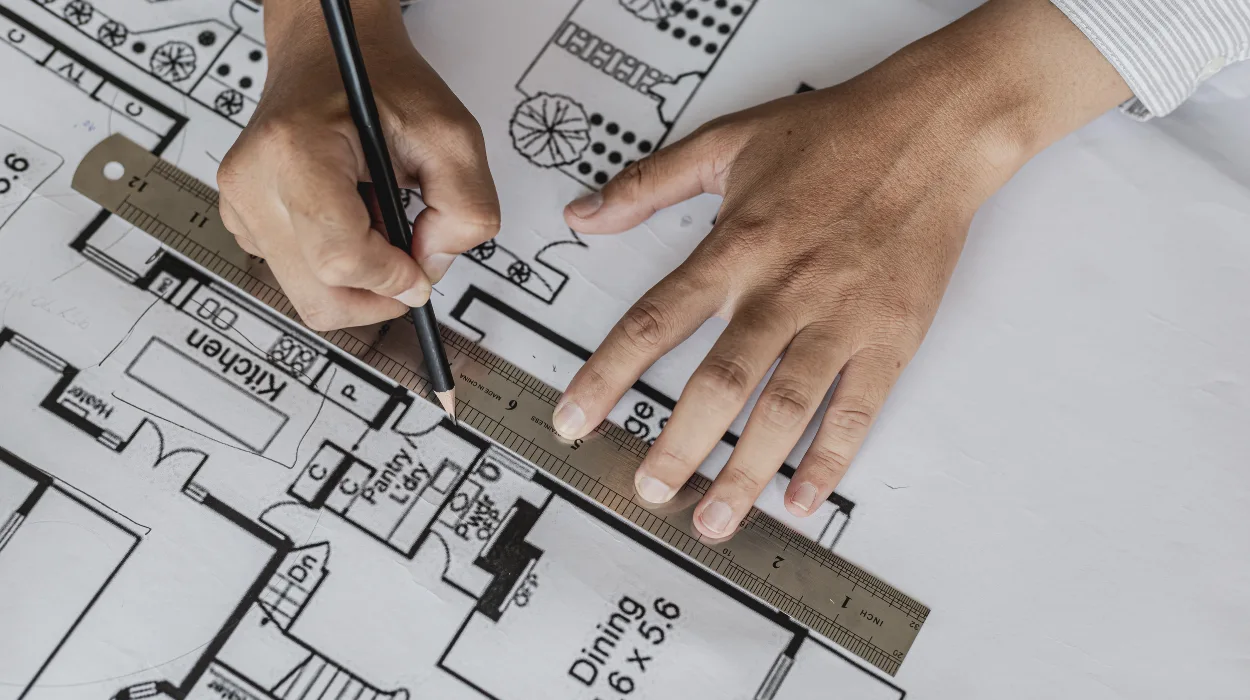
HVAC designers begin with architectural floor plans. These plans include room dimensions, wall placements, ceiling heights, and occupancy details. AutoCAD enables engineers to overlay mechanical systems directly onto building layouts.
The process starts with zoning analysis. Engineers divide buildings into thermal zones based on occupancy, equipment heat loads, and ventilation requirements. Office meeting rooms, server rooms, laboratories, and cafeterias each require different airflow capacities.
Designers then establish duct routing paths. Main supply ducts carry conditioned air from air handling units. Branch ducts distribute airflow to individual rooms. Return ducts circulate used air back into the HVAC system. AutoCAD allows precise alignment of these routes within ceiling spaces and service corridors.
Layer management plays a critical role in commercial projects. Separate layers organise supply ducts, return ducts, exhaust ducts, dampers, diffusers, and annotations. Teams review systems independently without visual confusion.
HVAC engineers also use AutoCAD to maintain dimensional accuracy. Commercial duct systems require exact spacing to meet fire codes, maintenance access requirements, and structural limitations. Incorrect clearance planning creates installation delays and redesign costs.
Construction documentation represents another major function. AutoCAD drawings include duct dimensions, airflow indicators, material specifications, insulation details, and installation references. Contractors depend on these drawings during fabrication and site installation.
What steps do engineering teams follow when designing ductwork layouts in AutoCAD?

Engineering teams follow a structured process that includes load calculation, zoning analysis, duct routing, airflow balancing, equipment placement, clash coordination, documentation, and quality review before construction and installation begin.
Building assessment and HVAC load calculation
HVAC planning begins with load calculations. Engineers evaluate building size, occupancy density, lighting systems, solar exposure, and equipment heat generation. These calculations determine cooling and ventilation requirements measured in British Thermal Units (BTUs) and cubic feet per minute (CFM).
Commercial buildings require different airflow rates depending on usage. Hospitals need higher air exchange rates than office buildings. Manufacturing plants require specialised exhaust systems to remove heat and contaminants.
Space planning and duct routing
Engineers study ceiling voids, beam positions, and service shafts before routing duct systems. AutoCAD allows planners to visualise spatial constraints early in the design stage.
Designers prioritise efficient airflow paths. Shorter duct routes reduce pressure losses and improve energy performance. Long or sharply angled ducts increase resistance and raise fan energy consumption.
Diffuser and grille placement
Supply diffusers distribute conditioned air into occupied spaces. Return grilles collect used air. Engineers position these components based on airflow coverage and occupant comfort requirements.
Poor diffuser placement creates uneven temperatures and airflow dead zones. AutoCAD drafting helps designers optimise placement accuracy.
Coordination with other disciplines
Mechanical systems share space with electrical cable trays, sprinkler systems, plumbing pipes, and structural components. Coordination meetings use AutoCAD drawings to identify clashes before construction begins.
This coordination reduces project delays and change orders. Large commercial projects often involve 5 to 10 engineering disciplines working simultaneously.
Final documentation and review
The final stage includes drawing verification, annotation review, and standards compliance checks. Engineers produce shop drawings, installation details, and duct schedules for contractors and fabrication teams.
Organisations often implement multi-level quality assurance processes. Senior engineers review airflow calculations, equipment specifications, and drafting accuracy before project approval.
What skills are required to design ductwork layouts effectively in AutoCAD?
Effective HVAC drafting requires technical drawing skills, airflow calculation knowledge, spatial coordination abilities, standards compliance understanding, and proficiency with AutoCAD tools used in commercial engineering environments.
HVAC drafting combines engineering principles with technical software operation. Professionals must understand airflow dynamics, pressure losses, and ventilation standards alongside drafting procedures.
Technical drawing skills form the foundation of HVAC drafting. Designers work with layers, scaling systems, annotations, dimensions, and plotting standards. Accurate drawings prevent construction errors and reduce rework costs.
Airflow calculation knowledge remains essential. Engineers calculate duct sizes based on airflow velocity, pressure drop, and equipment capacity. Oversized ducts waste ceiling space. Undersized ducts create noise and airflow restrictions.
Spatial awareness improves coordination efficiency. Commercial buildings contain dense infrastructure systems. Designers must visualise how ducts interact with beams, piping systems, lighting fixtures, and access panels.
Compliance knowledge also affects project outcomes. HVAC systems must meet local building regulations, fire safety codes, and indoor air quality standards. Industries like healthcare, aviation, and pharmaceuticals operate under stricter environmental requirements.
Training programmes such as the AutoCAD HVAC and Plumbing Design Training Course often use practical learning models, including simulations, drafting exercises, design assessments, and case-based workflows. Corporate learning departments favour these methods because measurable skill application improves workplace performance.
What components are included in commercial ductwork layouts?
Commercial ductwork layouts include supply ducts, return ducts, exhaust systems, dampers, diffusers, insulation specifications, airflow controls, mechanical equipment connections, and coordinated annotations for construction and maintenance teams.
Supply ducts deliver conditioned air from HVAC equipment into occupied spaces. These ducts form the primary airflow network throughout the building.
Return ducts recirculate indoor air back to air handling units. Proper return airflow maintains pressure balance and improves system efficiency.
Exhaust ducts remove contaminated or heated air. Commercial kitchens, laboratories, and industrial facilities rely heavily on exhaust systems to maintain safe operating environments.
Dampers regulate airflow within duct systems. Fire dampers prevent smoke spread during emergencies. Volume control dampers adjust airflow distribution between zones.
Diffusers and grilles affect occupant comfort. Ceiling diffusers distribute air evenly across workspaces. Return grilles support airflow circulation and pressure stability.
Insulation specifications are also included in AutoCAD drawings. Insulated ducts reduce thermal losses and prevent condensation. Energy-efficient buildings use detailed insulation planning to support sustainability targets.
Annotations provide operational clarity. Engineers label duct sizes, airflow directions, equipment references, and installation instructions. Clear documentation improves contractor productivity and maintenance accuracy.
How do organisations implement AutoCAD HVAC training in workforce development strategies?
Organisations implement AutoCAD HVAC training through structured learning pathways, blended delivery formats, technical assessments, project simulations, and performance measurement frameworks aligned with operational engineering requirements.
Engineering skill gaps create operational risks. Many organisations struggle with drafting inconsistencies, coordination errors, and inefficient documentation processes. Training programmes address these gaps through standardised learning frameworks.
Corporate training delivery commonly follows blended formats. Teams complete instructor-led workshops, online drafting modules, and practical simulation exercises over 20 to 60 training hours. Hybrid learning improves scheduling flexibility for technical departments.
Case-based learning improves knowledge retention. Participants work on commercial building layouts including office towers, healthcare facilities, and retail centres. Real-world project scenarios strengthen drafting accuracy and problem-solving capability.
Performance assessments measure competency development. Organisations evaluate drafting speed, coordination accuracy, standards compliance, and calculation precision before certifying employee readiness.
Many businesses also integrate mentoring systems into technical training. Senior engineers review trainee projects and provide structured feedback. This approach improves knowledge transfer and reduces onboarding time for junior drafting professionals.
Training outcomes are measured using operational KPIs. Companies track reductions in design revisions, construction clashes, project delays, and documentation errors after workforce upskilling initiatives.
When organisations evaluate drafting standards and implementation methods, technical references about HVAC drafting symbols and reusable design components become relevant.
Readers exploring implementation details often continue with resources discussing standard AutoCAD HVAC drafting practices such as:
What Symbol Libraries and Standard Blocks Are Used in AutoCAD HVAC Drafting?
What measurable business outcomes result from accurate ductwork drafting?
Accurate ductwork drafting improves project coordination, reduces rework costs, increases installation efficiency, supports energy optimisation, strengthens compliance management, and enhances long-term facility maintenance performance across commercial operations.
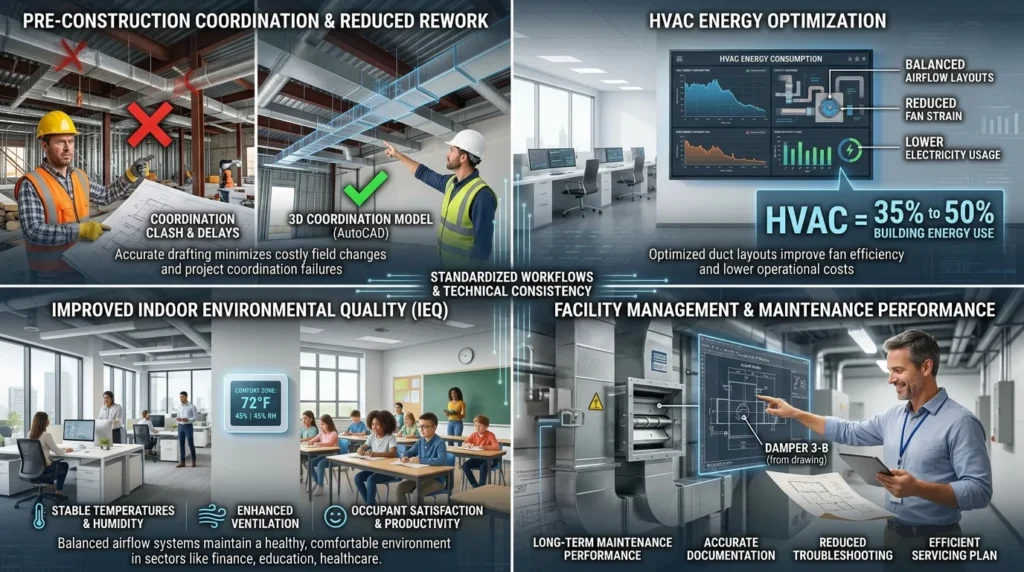
Construction rework represents a major operational expense in commercial projects. Coordination failures between mechanical and structural systems create delays and increase labour costs. Accurate AutoCAD drafting reduces these issues during pre-construction planning.
Energy efficiency also improves with optimised duct layouts. Balanced airflow systems reduce fan strain and lower electricity consumption. Commercial facilities monitor HVAC efficiency because HVAC operations account for 35% to 50% of total building energy use in many sectors.
Maintenance efficiency increases when documentation remains accurate. Facility management teams use AutoCAD drawings to locate dampers, inspect duct sections, and plan equipment servicing. Clear documentation reduces troubleshooting time during operational disruptions.
Indoor environmental quality improves as well. Balanced airflow systems maintain stable temperatures, humidity levels, and ventilation performance. This stability supports workplace productivity and occupant satisfaction in sectors like finance, education, and healthcare.
Project delivery timelines become more predictable. Contractors work faster when drawings include accurate dimensions and coordinated installation details. Reduced ambiguity lowers communication breakdowns between engineering and construction teams.
Organisations also benefit from standardised workflows. Technical consistency improves collaboration between branches, contractors, and external consultants working across multiple projects.
What common problems affect HVAC drafting projects in commercial environments?
HVAC drafting projects commonly fail because of poor coordination, outdated symbol usage, inconsistent standards, insufficient training, inaccurate airflow calculations, and disconnected communication between engineering, construction, and facilities management teams.
One major issue involves inconsistent drafting standards. Different engineers often use varying layer structures, naming conventions, and annotation styles. This inconsistency reduces collaboration efficiency.
Insufficient coordination creates another major problem. Mechanical layouts frequently clash with structural beams, plumbing systems, or electrical infrastructure. Late-stage redesigns increase project costs and delay construction schedules.
Many organisations also rely on outdated drafting libraries. Old blocks and symbols reduce documentation clarity and create confusion during installation. Standardisation improves communication between stakeholders.
Skill shortages affect drafting quality as well. Junior engineers sometimes lack practical understanding of airflow principles, duct sizing calculations, and compliance standards. Organisations address this issue through structured technical training and supervised project work.
Generic training programmes also fail to deliver operational impact. Effective learning requires project-based exercises, measurable assessments, and real-world engineering workflows. Training without applied drafting practice produces limited workplace improvement.
Another misconception involves software dependency. AutoCAD improves drafting accuracy, but successful HVAC design still depends on engineering knowledge, calculation accuracy, and interdisciplinary coordination. Software alone does not replace technical expertise.
Why does AutoCAD remain relevant in modern commercial HVAC design?
AutoCAD remains relevant because it supports precise drafting, cross-disciplinary coordination, scalable documentation, compliance management, and operational consistency required in complex commercial construction and facility management projects.
Commercial construction projects demand precision and repeatability. AutoCAD provides structured drafting systems that engineering teams standardise across projects and departments.
The platform also integrates effectively with broader construction workflows. Mechanical drawings support procurement, fabrication, installation, inspection, and maintenance activities throughout the building lifecycle.
Discover More from Our Guide Library:
What Are the Most Common HVAC Design Mistakes That AutoCAD Training Can Prevent?
How Does AutoCAD HVAC Training Help Engineers Work on Large Infrastructure Projects?
Training and workforce development continue to shape AutoCAD adoption. Organisations require employees who understand drafting standards, HVAC principles, and collaborative engineering processes. Technical capability directly influences project efficiency and operational reliability.
Modern corporate learning strategies prioritise measurable outcomes. Engineering departments evaluate drafting accuracy, coordination performance, and project delivery metrics when assessing training effectiveness. Practical learning models align technical education with operational requirements.
As commercial buildings become more energy-focused and regulation-driven, accurate HVAC drafting remains essential. Businesses depend on structured ductwork layouts to maintain operational performance, sustainability targets, and workplace safety standards.
What does the Imperial Corporate Training Institute AutoCAD HVAC and Plumbing Design Training Course cover?
The course covers duct and pipe layout principles, AutoCAD drafting techniques, block and symbol libraries, coordination workflows, and documentation standards. It emphasises practical drafting, clash detection, and production of construction-ready drawings.
Who should attend the AutoCAD HVAC and Plumbing Design Training Course?
The course is for MEP drafters, HVAC designers, site engineers, and project coordinators who produce or review duct and plumbing drawings. It suits teams in engineering consultancies, contractors, and facilities departments needing improved drawing accuracy and coordination.
What measurable outcomes should organisations expect after this training?
Organisations should expect reduced drawing error rates, fewer on-site clashes, faster drawing turnaround, and more accurate material takeoffs. Typical targets include a 40–70% clash reduction and a 20–30% faster drawing completion.
How does the course integrate with existing CAD standards and project workflows?
The course teaches layer conventions, block attributes, Xref usage, and revision control to align with company CAD standards. It includes project-based assignments that mirror real workflows and guidance for embedding standards into handover and procurement processes.