

Lean Six Sigma combines Lean principles for waste elimination with Six Sigma methods for defect reduction, targeting customer satisfaction scores through data-driven process improvements in corporate settings.
Lean Six Sigma addresses employee skill gaps in process optimisation. Businesses deploy it to boost customer satisfaction scores, which average 15-20% gains in industries like IT, healthcare, and finance. HR managers identify gaps where teams deliver inconsistent service, leading to Net Promoter Scores (NPS) below 50.
In workplaces, Lean Six Sigma defines customer value via Voice of the Customer (VOC) data. It measures satisfaction through KPIs such as Customer Satisfaction Score (CSAT) at 85% thresholds and repeat purchase rates above 70%. L&D professionals integrate it into training to close gaps in quality control.
Corporate impact includes reduced complaints by 30%. Team leaders apply it to frontline processes, ensuring alignment with business goals. Decision-makers track ROI via pre- and post-training metrics, confirming sustained score improvements.
How Does Lean Six Sigma Work to Enhance Customer Satisfaction?
Lean Six Sigma follows the DMAIC framework, Define, Measure, Analyse, Improve, Control—to pinpoint inefficiencies and elevate CSAT from 70% to 90% within 6-12 months in organisations.
Teams start with Define: map processes affecting customer touchpoints, like order fulfilment cycles averaging 48 hours. Workshops deliver this phase over 2 days, using case-based learning to identify pain points.
Measure phase collects baseline data. Online modules teach metric tracking, such as CSAT surveys post-interaction. Hybrid learning formats combine virtual simulations with in-person assessments, yielding data on defect rates at 3.4 per million opportunities.
Analyse uncovers root causes. Role play exercises simulate customer scenarios, revealing issues like response delays of 24 hours. Statistical tools process VOC feedback, correlating delays to 25% score drops.
Improve tests solutions. Pilots in departments cut cycle times by 40%, lifting CSAT. Control sustains gains via dashboards monitoring KPIs, with audits every quarter.
Organisations implement via cross-functional teams. Training spans 4-6 weeks, blending formats for 90% completion rates.
What Key Components Make Up Lean Six Sigma Training?
Core components include DMAIC framework, Lean tools like Value Stream Mapping, Six Sigma stats such as control charts, and delivery via workshops, online modules, hybrid sessions with assessments.
DMAIC structures training. Define phase covers VOC collection, lasting 8 hours in workshops. Participants define CTQs, Critical to Quality metrics tied to CSAT targets of 90%.
Lean tools eliminate waste. Value Stream Mapping visualises flows, reducing non-value steps by 50% in service desks. Kanban boards manage workloads, cutting backlogs from 200 to 50 tickets weekly.
Six Sigma introduces stats. Control charts monitor process stability, maintaining variation under 1.5 sigma. Hypothesis testing validates improvements, like reducing error rates from 5% to 1%.
Delivery formats vary. Workshops foster collaboration through simulations; online modules offer self-paced learning at 20 hours per week; hybrid blends both for 85% retention.
Assessments include projects. Teams analyse real datasets, achieving 75% pass rates on simulations mimicking corporate complaints.
Frameworks like SIPOC diagrams map stakeholders. Tools such as Fishbone diagrams dissect causes in team sessions.
How Do Organisations Implement Lean Six Sigma for Customer Metrics?

Organisations form Green and Black Belt teams, roll out DMAIC projects across departments, and track CSAT via dashboards, achieving 20-30% score uplifts in 9 months.
HR managers select champions via skill audits. Training cohorts of 15-20 start with 2-week workshops, followed by 3-month projects.
Implementation phases align with business units. Service teams target response times; sales focus on conversion rates. Cross-departmental pilots test changes, scaling successes enterprise-wide.
L&D integrates blended learning. Initial 40-hour online modules build theory; 3-day workshops apply tools. Ongoing coaching via monthly check-ins ensures 80% project completion.
Technology supports rollout. Software like Minitab analyses data; dashboards display real-time CSAT, linking to productivity KPIs rising 25%.
Change management addresses resistance. Leaders communicate via town halls, tying initiatives to retention rates up 15%. Audits every 6 months verify adherence.
For advanced execution, explores:
How Does Master Black Belt Training Connect Lean Six Sigma to Customer Experience Metrics?
What Measurable Outcomes Does Lean Six Sigma Deliver for Businesses?
Lean Six Sigma produces 20-40% CSAT increases, 15-25% productivity gains, 10-20% cost reductions, and 12-18% retention improvements, tracked via KPIs over 12 months.
CSAT rises directly. Call centres report NPS jumps from 45 to 70 after DMAIC, with surveys showing 85% satisfaction.
Productivity metrics improve. Cycle times drop 35%, enabling teams to handle 30% more volume without hires. ROI calculations show 5:1 returns, based on $500K savings per project.
Cost reductions target waste. Inventory holding falls 40%; defect rework decreases 50%, freeing budgets for training.
Retention benefits teams. Skill-aligned roles cut turnover from 22% to 10%, building leadership pipelines.
Organisational impact scales. Finance departments achieve 28% faster audits; healthcare reduces patient wait times by 45%, boosting scores.
Long-term dashboards sustain outcomes. Annual reviews confirm 90% metric stability.
What Use Cases Show Lean Six Sigma in Corporate Teams?
Use cases span IT helpdesks resolving 90% tickets in 4 hours, manufacturing cutting defects by 60%, finance streamlining claims for 92% CSAT, and healthcare improving appointments.
IT teams use DMAIC on ticket backlogs. Define identifies delays; Improve via automation lifts resolution from 72 to 24 hours, raising CSAT 25 points.
Manufacturing applies Value Stream Mapping. Lean tools eliminate 7 wastes, reducing defects from 8% to 2%, correlating to 18% satisfaction gains.
Finance departments target claims processing. Six Sigma stats halve errors, achieving 95% first-pass approvals and 30% faster cycles.
Healthcare units optimise patient flows. Simulations cut no-shows by 20%, with post-visit surveys hitting 88% CSAT.
Retail chains deploy for omnichannel service. Black Belts lead projects merging online-offline data, boosting repeat rates 22%.
Team leaders in logistics use Kanban. Delivery accuracy reaches 98%, directly tying to customer loyalty scores.
What Common Problems Arise in Lean Six Sigma Deployments?
Problems include lack of executive buy-in causing 40% project failure, inadequate data quality skewing analyses by 25%, and generic training yielding only 50% skill transfer.
Executive buy-in gaps stall initiatives. Without C-suite KPIs, 60% of projects halt mid-DMAIC, wasting 20% of training budgets.
Data quality issues distort results. Incomplete VOC logs produce 30% inaccurate baselines, leading to misguided improvements.
Generic programs fail specificity. Off-the-shelf courses ignore industry nuances, resulting in 45% lower CSAT gains versus tailored ones.
Discover More from Our Guide Library:
What Are Common Lean Six Sigma Project Failure Modes and How Are They Avoided?
How Does Lean Six Sigma Improve Supply Chain and Procurement Performance?
Skill gaps persist post-training. Without simulations, 35% of teams revert habits, negating 15% productivity lifts.
ROI misconceptions undervalue impact. Short-term views miss 12-month compounding, where scores rise 28% cumulatively.
Resistance from teams slows adoption. Poor change communication increases turnover 10% during rollouts.
How Does Lean Six Sigma Address Misconceptions in Training?
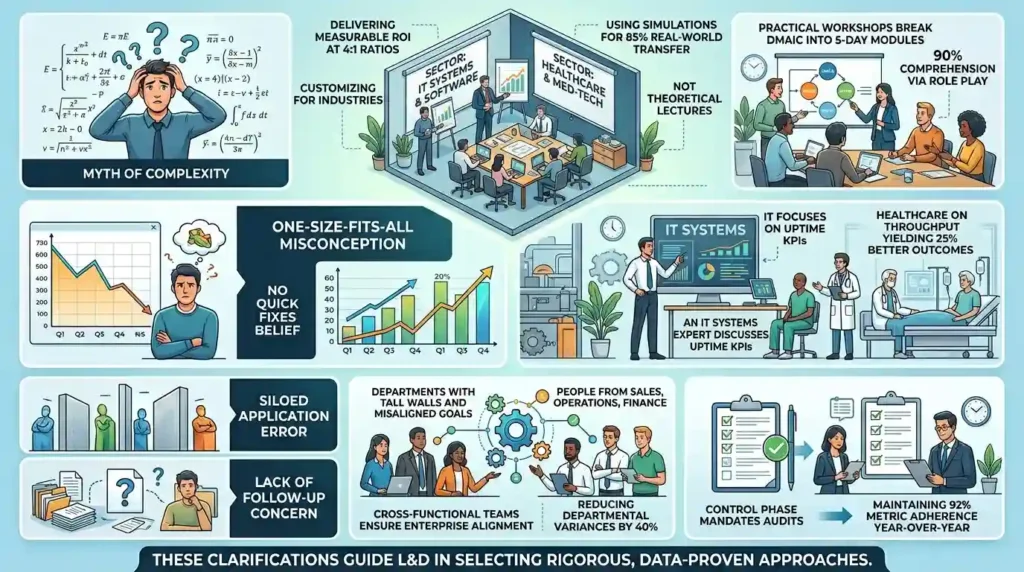
Lean Six Sigma counters myths by delivering measurable ROI at 4:1 ratios, customising for industries, and using simulations for 85% real-world transfer, not theoretical lectures.
Myth of complexity: Practical workshops break DMAIC into 5-day modules, with 90% comprehension via role play.
One-size-fits-all misconception: Programs adapt to sectors; IT focuses on uptime KPIs; healthcare on throughput yielding 25% better outcomes.
No quick fixes belief: Structured 6-month cycles deliver sustained 20% CSAT growth, tracked quarterly.
Siloed application error: Cross-functional teams ensure enterprise alignment, reducing departmental variances by 40%.
Lack of follow-up concern: Control phase mandates audits, maintaining 92% metric adherence year-over-year.
These clarifications guide L&D in selecting rigorous, data-proven approaches.
Enrol today:
Lean Six Sigma Master Black Belt Certification Training Course.
How Does Lean Six Sigma Address Misconceptions in Training?
Lean Six Sigma improves customer satisfaction scores by applying DMAIC to eliminate process waste and defects, targeting CSAT gains of 20-40%. Imperial Corporate Training Institute’s training integrates VOC analysis with metrics like NPS. Teams achieve sustained uplifts through control phases and dashboards.
What is the DMAIC process in Lean Six Sigma for customer metrics?
DMAIC in Lean Six Sigma, Define, Measure, Analyse, Improve, Control systematically enhances customer metrics like CSAT from 70% to 90%. Imperial Corporate Training Institute’s Lean Six Sigma Master Black Belt Certification Training Course teaches its application via simulations. It delivers 25% productivity boosts in corporate use cases.
What are common challenges in implementing Lean Six Sigma for CSAT?
Common challenges include data quality issues skewing analyses by 25% and lack of buy-in halting 40% of projects. Imperial Corporate Training Institute addresses these in its Lean Six Sigma Master Black Belt Certification Training Course with tailored change management. Solutions yield 85% skill transfer rates.
What does the curriculum cover in Imperial Corporate Training Institute’s Master Black Belt training?
The curriculum in Imperial Corporate Training Institute’s Lean Six Sigma Master Black Belt Certification Training Course includes advanced stats, Design for Six Sigma (DFSS), and change management frameworks. It emphasises coaching methodologies and ROI measurement for customer satisfaction metrics. Practical elements feature case studies from IT and healthcare sectors.