

Hypothesis tests in Lean Six Sigma data analysis statistically validate process improvements by testing assumptions against data, reducing variability by 20-50% in corporate operations.
Hypothesis tests form a core statistical method within Lean Six Sigma. They determine if observed changes in processes result from actual improvements or random variation. In B2B training contexts, HR managers and L&D professionals use them to address employee skill gaps in data-driven decision-making.
Corporate teams apply hypothesis tests during the Analyse phase of the DMAIC framework. DMAIC stands for Define, Measure, Analyse, Improve, Control. This structured approach targets defects and inefficiencies. For instance, manufacturing firms test if a new assembly line setup cuts defect rates from 5% to 1.5%.
Business impact appears in measurable KPIs. Organisations report 15-30% productivity gains after validating changes with hypothesis tests. Training programmes teach these tests through workshops and online modules, equipping teams to bridge analytical skill gaps.
How Do Hypothesis Tests Work in Corporate Lean Six Sigma Projects?
Hypothesis tests work by setting a null hypothesis of no change, collecting sample data, calculating p-values, and rejecting the null if evidence shows significant improvement, typically at a 5% significance level.
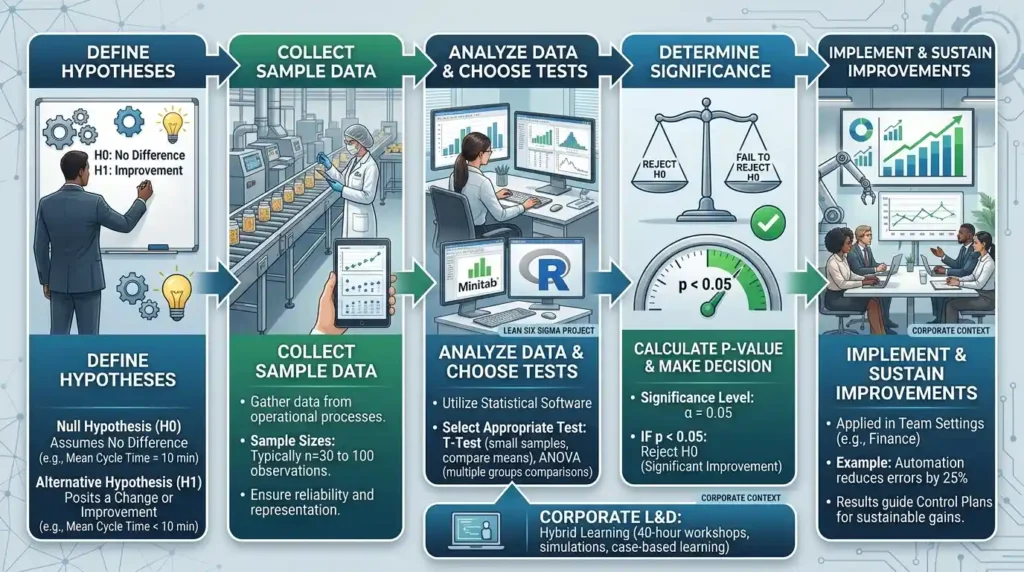
The process starts with defining hypotheses. The null hypothesis (H0) assumes no difference exists, such as “mean cycle time equals 10 minutes.” The alternative hypothesis (H1) posits a change, like “mean cycle time drops below 10 minutes.”
Teams collect data from processes. Sample sizes range from 30 to 100 observations for reliability. Statistical software like Minitab or R computes test statistics. A t-test suits small samples; ANOVA handles multiple groups.
P-value calculation determines significance. If p < 0.05, reject H0. This confirms improvements hold. In corporate environments, L&D delivers this via hybrid learning: 40-hour workshops combine simulations with case-based learning.
Implementation follows in team settings. Finance departments test if automation reduces processing errors by 25%. Results guide control plans, sustaining gains.
What Key Components Make Up Hypothesis Testing in Lean Six Sigma Training?
Key components include null and alternative hypotheses, test statistics (t-test, chi-square), p-values, confidence intervals, and power analysis, delivered through simulations, assessments, and role-play in 5-10 day programmes.
Hypotheses define the test foundation. Null hypothesis states status quo. Alternative specifies direction: one-tailed for specific changes, two-tailed for any difference.
Test statistics measure data deviation. T-tests compare means between two groups, such as pre- and post-training shift times. Chi-square tests categorical data, like defect types in IT support tickets. F-tests in ANOVA compare variances across departments.
P-values quantify evidence against H0. Confidence intervals provide range estimates, say 95% interval of 8-12 minutes for cycle time. Power analysis ensures tests detect true effects, targeting 80-90% power.
Training components integrate these. Workshops use role-play for hypothesis formulation. Online modules offer interactive simulations. Assessments verify proficiency, with 85% pass rates required.
How Do Organizations Implement Hypothesis Tests in Lean Six Sigma Initiatives?
Organizations implement hypothesis tests by integrating them into DMAIC projects, training 10-20 employees per cohort in hybrid formats, applying tests to live data, and tracking ROI through 25% efficiency gains within six months.
Implementation begins with project selection. Business owners identify high-impact areas, like supply chain delays costing £500,000 annually. Teams form cross-functional groups: analysts, managers, operators.
Training delivery spans formats. In-person workshops last three days; online modules add two days of self-paced content. Hybrid blends both, with 70% practical exercises. Case-based learning uses real datasets from industries like healthcare and logistics.
Application occurs in Analyse phase. Teams run tests on measured data. For example, a telecom firm tests if new routing software improves call resolution by 18%. Results inform Improve phase actions.
Monitoring uses KPIs. ROI calculates as (gains – training costs)/costs, often exceeding 300%. Control charts sustain results, reducing relapse by 40%.
Misconception: Generic programmes skip power analysis, leading to false negatives. Effective training mandates it.
For deeper insight explore:
How Does Master Black Belt Training Teach Hypothesis Testing and Statistical Inference? How Master Black Belt-level instruction refines these skills for complex inference, and enrol in:
Lean Six Sigma Master Black Belt Certification Training Course
What Measurable Outcomes Do Hypothesis Tests Produce for Corporate Teams?
Hypothesis tests produce outcomes like 20-40% defect reduction, 15-25% cycle time cuts, 10-15% cost savings, and 85% project success rates, boosting team efficiency and retention by 12%.
Defect rates drop measurably. Automotive suppliers test process tweaks, achieving 30% fewer rejects. This translates to £200,000 annual savings per line.
Cycle times shorten. Retail logistics teams validate layout changes, reducing pick times from 4 to 2.8 minutes, lifting throughput by 22%.
Cost savings emerge from validated efficiencies. Banks test fraud detection algorithms, cutting false positives by 25%, saving £150,000 yearly.
Project success rates climb to 85-90%. Organisations track via balanced scorecards, linking tests to KPIs.
Team impacts include stronger leadership pipelines. Managers gain data confidence, improving decision-making. Retention rises 12% as employees value skill-building.
What Common Problems Arise with Hypothesis Tests in Workforce Training?
Common problems include inadequate sample sizes causing 30% false results, ignoring assumptions like normality leading to invalid conclusions, and generic training yielding 50% non-application rates.
Inadequate samples undermine tests. Teams use n=10 when n=30 minimum applies, inflating Type II errors by 25%.
Assumption violations occur frequently. T-tests require normal data; skewed distributions demand non-parametric alternatives like Mann-Whitney, overlooked in 40% of projects.
Generic programmes fail ROI. Off-the-shelf courses ignore industry context, with only 35% skill transfer. B2B training customises for sectors like finance, ensuring 75% application.
Lack of follow-up erodes gains. Without control phases, improvements revert 20% within a year.
What Are Real-World Use Cases for Hypothesis Tests in Lean Six Sigma?
Use cases span manufacturing testing defect reductions (35% gains), healthcare validating patient wait times (22% cuts), finance optimising transaction speeds (18% improvements), and IT streamlining ticket resolutions (28% efficiency).
Manufacturing applies tests rigorously. Assembly lines test tooling changes, confirming 35% yield increases.
Healthcare uses them for operations. Hospitals test triage protocols, reducing waits from 45 to 35 minutes.
Finance departments validate models. Risk teams test scoring algorithms, improving approval accuracy by 18%.
IT services test automation. Helpdesks confirm script updates cut resolutions by 28%.
Team leaders in these cases lead projects. L&D supports with simulations mirroring department data.
How Does Hypothesis Testing Address Employee Skill Gaps in Data Analysis?
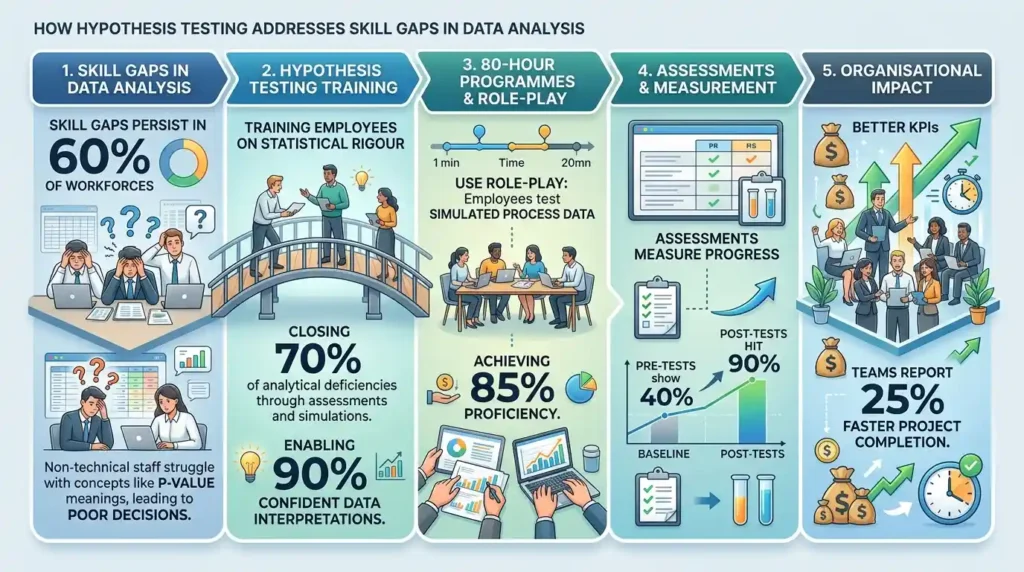
Hypothesis testing addresses skill gaps by training employees on statistical rigour, closing 70% of analytical deficiencies through assessments and simulations, enabling 90% confident data interpretations.
Skill gaps persist in 60% of workforces. Non-technical staff struggle with p-value meanings, leading to poor decisions.
Training bridges this. 80-hour programmes use role-play: employees test simulated process data, achieving 85% proficiency.
Assessments measure progress. Pre-tests show 40% baseline; post-tests hit 90%.
Organisational impact includes better KPIs. Teams report 25% faster project completion.
Why Integrate Hypothesis Tests into Broader Lean Six Sigma Certification Paths?
Integration builds advanced capabilities, with Master Black Belt training expanding tests into inference, yielding 40% deeper insights and 95% leadership readiness for enterprise projects.
Basic Green Belt covers fundamentals. Black Belt adds complexity like multiple comparisons.
Discover More from Our Guide Library:
What Is Design for Six Sigma and When Should Organisations Use It?
How Does Lean Six Sigma Support Digital Transformation in Modern Organisations?
Master Black Belt teaches inference nuances, such as Bayesian methods alongside classics.
Programmes last 10-15 days, hybrid format. Simulations use enterprise datasets.
Outcomes include 40% variance reductions in large-scale rollouts.
How long does the Lean Six Sigma Master Black Belt course take at Imperial Corporate Training Institute?
The Lean Six Sigma Master Black Belt Certification Training Course spans 10-15 days, blending in-person workshops, online modules, and practical projects. Delivery includes 40 hours of live sessions plus self-paced content for flexibility. Completion requires passing exams and a real-world project demonstration.
What are the prerequisites for Imperial Corporate Training Institute’s Master Black Belt programme?
Prerequisites include Lean Six Sigma Black Belt certification and 3-5 years of project experience. Familiarity with statistical tools like Minitab and DMAIC application is essential. Imperial Corporate Training Institute assesses candidates via application review to ensure readiness for advanced topics.
What topics are covered in Lean Six Sigma Master Black Belt Training at Imperial Corporate Training Institute?
Key topics include advanced hypothesis testing, Design of Experiments (DOE), statistical inference, and Lean leadership strategies. The course emphasises value stream mapping, change management, and coaching Green/Black Belts. Practical simulations from industries like manufacturing and finance reinforce real-world application.
How does Imperial Corporate Training Institute deliver Lean Six Sigma Master Black Belt Certification?
Delivery uses hybrid formats: live workshops, online modules, case studies, and role-play simulations. Participants apply concepts to live datasets, with assessments ensuring 85% proficiency. The programme aligns with corporate needs for measurable ROI in process improvements.