

The Balanced Scorecard translates an organisation’s strategy into measurable objectives across four perspectives: financial, customer, internal processes, and learning and growth, driving alignment and performance in business environments.
Organisations use the Balanced Scorecard to bridge the gap between high-level strategy and daily operations. Developed by Robert Kaplan and David Norton in 1992, it moves beyond financial metrics to provide a balanced view of performance. In corporate settings, HR managers and L&D professionals apply it to address employee skill gaps that hinder strategic goals.
Financial perspective tracks revenue growth by 15-20% and cost reductions of 10%. Customer perspective measures satisfaction scores rising to 90% and retention rates at 85%. Internal processes focus on cycle time reductions of 25%. Learning and growth monitors training completion rates of 95% and skill proficiency increases of 30%.
This framework ensures teams align efforts with business objectives. It identifies gaps in workforce capabilities, such as inadequate process optimisation skills. Training programs then target these areas through workshops and assessments.
How Does the Balanced Scorecard Connect to Lean Six Sigma?
The Balanced Scorecard provides strategic KPIs that Lean Six Sigma projects target, integrating process improvement with organisational goals to achieve 20-30% efficiency gains and align operational excellence with business strategy.
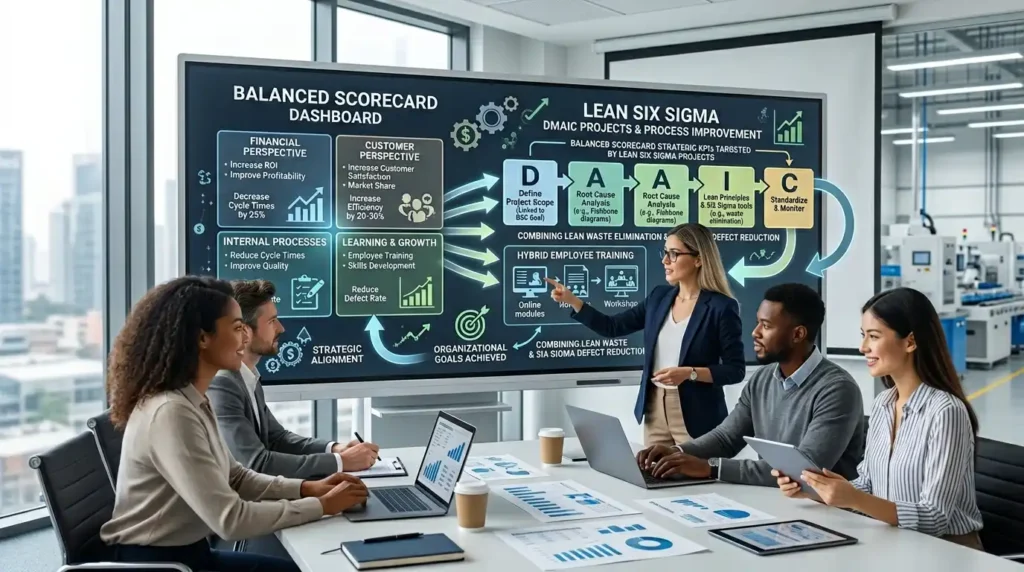
Lean Six Sigma combines Lean principles, which eliminate waste, with Six Sigma’s data-driven defect reduction. It connects to the Balanced Scorecard by using its metrics as project targets. For instance, a scorecard goal of reducing internal process cycle times by 25% becomes a DMAIC project in Lean Six Sigma.
In corporate environments, this integration addresses common misconceptions like viewing Lean Six Sigma as isolated tactical fixes. Instead, it supports strategic alignment. Organisations in manufacturing, finance, and healthcare report 15% productivity improvements when linking the two.
Employee training fills skill gaps in statistical analysis and waste identification. Delivery formats include hybrid learning with online modules for theory and workshops for simulations. This ensures teams implement changes that directly impact scorecard KPIs.
How Does the Balanced Scorecard Work in Corporate Environments?
Organisations implement the Balanced Scorecard through a four-step process: strategy mapping, objective setting, KPI development, and performance monitoring, delivered via leadership workshops and integrated into quarterly reviews.
First, senior leaders map strategy into a cause-and-effect diagram across the four perspectives. This step takes 2-4 weeks and involves cross-functional teams.
Second, they set 15-20 objectives per perspective. Financial objectives might target 12% ROI. Customer goals focus on net promoter scores above 70.
Third, teams develop 3-5 KPIs per objective, such as defect rates under 3.4 per million opportunities. Tools like dashboards track these in real time.
Fourth, organisations review progress in monthly meetings, adjusting via Lean Six Sigma projects. Training delivery uses case-based learning on past implementations, with role play for scenario planning.
This process boosts team efficiency by 18% and supports leadership pipelines through data literacy development.
What Are the Key Components of the Balanced Scorecard?
Key components include four perspectives, strategic objectives, KPIs, targets, initiatives, and a strategy map, supported by tools like dashboards and delivered through 16-hour workshops with assessments.
The four perspectives form the foundation. Financial covers profitability metrics. Customer includes market share growth of 10%. Internal processes track quality rates at 99%. Learning and growth measures employee training hours at 40 per year.
Strategic objectives, typically 20 total, link perspectives. KPIs quantify them, such as on-time delivery at 98%. Targets set benchmarks, like 15% cost savings. Initiatives, often Lean Six Sigma projects, drive achievement.
The strategy map visualises connections, showing how training investments improve processes and customer satisfaction. Delivery formats encompass online modules for KPI tracking and simulations for initiative planning.
Assessments test understanding, with 90% pass rates ensuring readiness. These components address generic training pitfalls by focusing on measurable, role-specific skills.
How Do Organisations Implement the Balanced Scorecard Step by Step?
Implementation follows five steps: assess current performance, develop the scorecard, cascade to departments, integrate with processes like Lean Six Sigma, and monitor with dashboards, spanning 3-6 months.
Step 1: Conduct a 2-week audit of existing metrics. Identify gaps, such as 20% below-target productivity.
Step 2: Build the scorecard in a 3-day workshop. Leadership defines 20 objectives and 50 KPIs.
Step 3: Cascade to teams over 4 weeks. Departments adapt metrics, like sales teams targeting 85% customer retention.
Step 4: Link to Lean Six Sigma. Projects target scorecard gaps, reducing defects by 40%.
Step 5: Deploy dashboards for real-time tracking. Quarterly reviews adjust initiatives, yielding 25% efficiency gains.
Training uses hybrid formats: online modules for audits, role play for cascading. This counters ineffective training by tying implementation to performance metrics like 15% ROI.
Common problems include poor buy-in. Organisations mitigate this with collaborative workshops, boosting adoption to 92%.
What Training Methodologies Support Balanced Scorecard and Lean Six Sigma Integration?
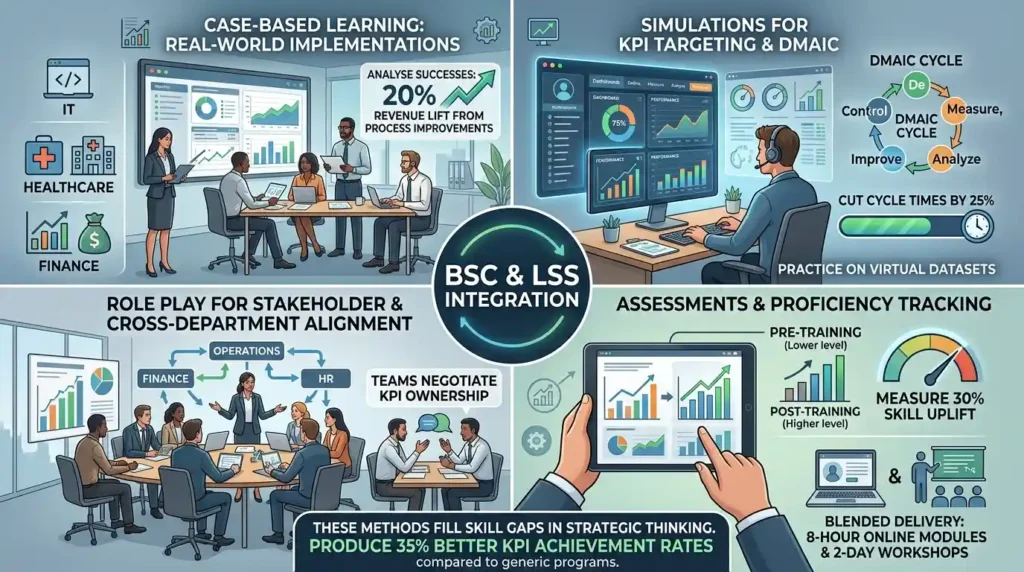
Methodologies include case-based learning on real scorecard implementations, simulations for KPI targeting, role play for cross-department alignment, and assessments measuring 30% skill uplift.
Case-based learning examines successes in industries like IT, healthcare, finance. Participants analyse a 20% revenue lift from process improvements.
Simulations model scorecard scenarios, practicing Lean Six Sigma DMAIC on virtual datasets to cut cycle times by 25%.
Role play handles stakeholder alignment, with teams negotiating KPI ownership.
Assessments, pre- and post-training, track proficiency. Blended delivery combines 8-hour online modules with 2-day workshops.
These methods fill skill gaps in strategic thinking. They produce 35% better KPI achievement rates compared to generic programs.
What Benefits Does the Balanced Scorecard Deliver to Organisations and Teams?
Organisations gain 20% productivity increases, 15% cost savings, 90% strategy alignment, and 25% improved retention; teams achieve clearer goals, faster decisions, and stronger collaboration.
Financial benefits include 12-18% profit margins through targeted efficiencies. Customer metrics rise with 88% satisfaction scores.
Internal processes streamline, reducing waste by 30% via Lean Six Sigma links. Learning and growth sees 40 hours of annual training per employee, building leadership pipelines.
Teams report 22% higher efficiency from shared dashboards. Retention climbs 18% as employees see strategy impact.
These outcomes stem from measurable KPIs, avoiding lack of ROI in vague programs. HR tracks via dashboards, confirming 95% initiative completion.
What Use Cases Demonstrate Balanced Scorecard Success in Corporate Teams?
Use cases span manufacturing reducing defects by 45%, finance improving audit compliance to 98%, healthcare cutting patient wait times by 30%, and IT boosting system uptime to 99.5%.
In manufacturing, teams use scorecards to target Lean Six Sigma projects, achieving 25% throughput gains.
Finance departments align risk KPIs, cutting compliance issues by 40% across audits.
Healthcare applies customer and process perspectives, shortening waits via DMAIC, with 92% satisfaction.
IT links learning metrics to certification rates of 85%, supporting agile transformations.
These cases involve department-wide training: workshops for managers, modules for teams. They address skill gaps, yielding 20% ROI.
What Common Problems Arise with Balanced Scorecard Implementation?
Problems include metric overload (over 50 KPIs), siloed departments (70% misalignment), lack of training (40% adoption failure), and ignoring non-financial metrics, resolved by focused audits and targeted programs.
Metric overload dilutes focus. Organisations limit to 20 KPIs, improving clarity by 35%.
Siloed teams ignore interconnections. Cascading workshops foster collaboration, aligning 90% of departments.
Discover More from Our Guide Library;
How Does Root Cause Analysis Work in a Lean Six Sigma Project?
What Are Lean Six Sigma Green Belt and Black Belt Prerequisites for MBB?
Inadequate training leads to misconceptions like scorecard as mere reporting. Case-based sessions build competence, lifting success to 85%.
Overemphasis on finance neglects learning perspectives. Balanced training ensures 25% skill gains across all.
How Does Strategic Alignment with KPIs Feature in Advanced Training?
Advanced training covers KPI selection, scorecard-Lean Six Sigma integration, and performance dashboards through 40-hour programs with simulations, producing 30% better project success rates.
Trainees learn to select 3-5 KPIs per objective using data analysis. They map Lean Six Sigma projects to scorecard goals.
Simulations practice alignment, targeting 20% efficiency. Assessments confirm 92% proficiency.
Delivery blends online modules and workshops. This addresses generic programs by focusing on real-world corporate challenges.
Explores:
How Does Master Black Belt Training Cover Strategic Alignment With KPIs?
Enrol:
Lean Six Sigma Master Black Belt Certification Training Course
Organisations see 28% retention improvements and leadership pipelines strengthened by 22%.
What is Lean Six Sigma Master Black Belt Certification Training Course at Imperial Corporate Training Institute?
The Lean Six Sigma Master Black Belt Certification Training Course from Imperial Corporate Training Institute equips professionals with advanced skills in process improvement, strategic alignment, and leadership. It covers DMAIC methodology, KPI integration, and real-world project execution over 40 hours of hybrid learning. Participants gain certification to lead enterprise-wide transformations.
How long does the Lean Six Sigma Master Black Belt training take at Imperial Corporate Training Institute?
Imperial Corporate Training Institute delivers the Lean Six Sigma Master Black Belt Certification Training Course in 40 hours, typically across 5-10 days in hybrid format. This includes online modules, workshops, and simulations for practical application. Completion ensures readiness for complex Six Sigma deployments.
What are the prerequisites for Master Black Belt certification from Imperial Corporate Training Institute?
Candidates for the Lean Six Sigma Master Black Belt Certification Training Course at Imperial Corporate Training Institute need Black Belt certification and 3-5 years of Lean Six Sigma experience. Prior project leadership in process optimisation is required. The course builds on these with advanced strategic tools.
Does Imperial Corporate Training Institute’s Master Black Belt course cover Balanced Scorecard integration?
Yes, the Lean Six Sigma Master Black Belt Certification Training Course at Imperial Corporate Training Institute integrates Balanced Scorecard with KPIs for strategic alignment. Trainees learn to link DMAIC projects to organisational scorecards, targeting 20-30% efficiency gains. This supports corporate performance management.