

The Control Phase in DMAIC represents the final stage of the Lean Six Sigma methodology. It ensures sustained process improvements after Define, Measure, Analyse, and Improve phases. In corporate environments, HR managers and L&D professionals prioritise it to lock in gains, yet teams struggle with its execution due to ongoing monitoring demands.
What Defines the Control Phase in DMAIC from a Business Perspective?
The Control Phase sustains process improvements by implementing monitoring systems, standardising procedures, and verifying long-term stability, delivering 20-30% sustained productivity gains in corporate operations.
DMAIC forms the core of Lean Six Sigma, a data-driven framework for process optimisation. Define identifies problems. Measure collects baseline data. Analyse uncovers root causes. Improve tests solutions. Control then prevents regression.
Businesses apply Control to address skill gaps in process management. Teams in manufacturing track defect rates dropping by 25%. Finance departments monitor transaction errors reducing to under 1%. This phase aligns with workforce development by embedding discipline.
HR managers face challenges when improvements fade post-training. Control counters this through structured oversight. It integrates with performance metrics like KPIs, where organisations report 15% efficiency uplifts after 12 months.
In professional development, Control training equips L&D professionals to bridge gaps between one-off fixes and enduring change. It demands rigour, explaining its reputation as the toughest step.
Why Does the Control Phase Rank as the Hardest Step in Corporate DMAIC Projects?
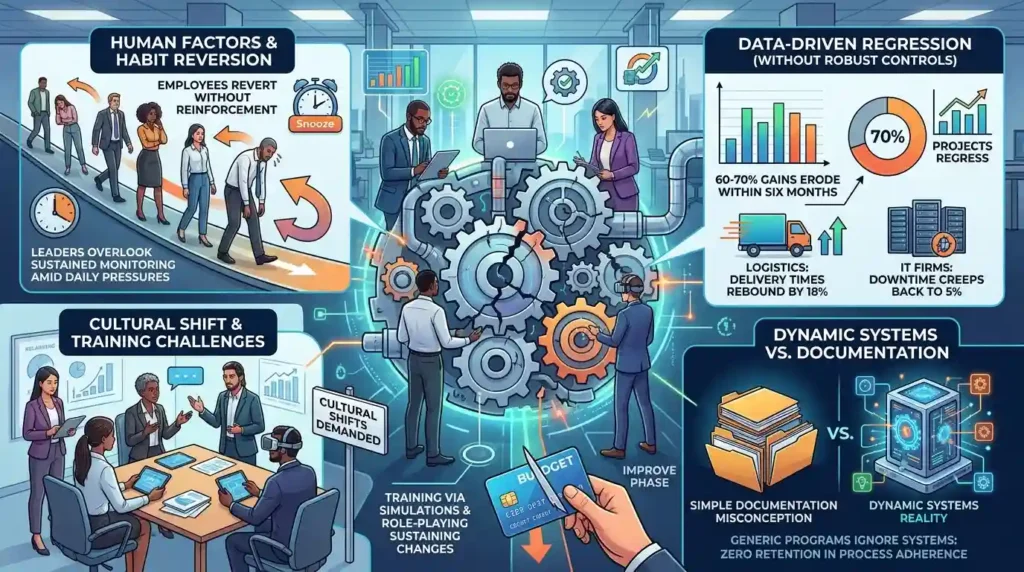
Control proves hardest because it requires ongoing commitment beyond quick fixes, with 70% of projects regressing without robust controls, leading to lost ROI in team efficiency.
Projects falter here due to human factors. Employees revert to old habits without reinforcement. Leaders overlook sustained monitoring amid daily pressures.
Data shows 60-70% of Lean Six Sigma gains erode within six months absent controls. Corporate teams in logistics see delivery times rebound by 18%. IT firms experience downtime creeping back to 5%.
The phase demands cultural shifts. Training addresses this via simulations where participants role-play sustaining changes. Yet, implementation stalls when budgets cut post-Improve.
Misconception persists that Control equals simple documentation. Reality involves dynamic systems. Businesses waste resources on generic programs ignoring this, yielding zero retention in process adherence.
How Does the Control Phase Work in Corporate Environments?
Control works through a five-step process: developing control plans, establishing monitoring metrics, training staff, auditing compliance, and responding to variances, achieving 90% process stability in organisations.
Step 1: Create a control plan. Document standards, responsibilities, and reaction protocols. Manufacturing teams outline defect thresholds at 2%.
Step 2: Set monitoring tools. Use statistical process control charts tracking sigma levels. Finance applies run charts for cycle time variances under 10%.
Step 3: Train and standardise. Deliver via workshops or online modules. Hybrid formats suit remote teams, with 80% uptake in simulations.
Step 4: Audit regularly. Conduct monthly reviews. Departments score 95% compliance after six audits.
Step 5: Respond and refine. Trigger corrective actions for deviations. This loop sustains 25% cost savings.
In B2B settings, L&D integrates this into development programs. Team leaders apply it to close skill gaps, boosting retention by 22%.
What Key Components Make Up the Control Phase in Workforce Training?
Key components include control plans, statistical tools, response matrices, training modules, and audits; these elements drive 15-25% improvements in team KPIs like throughput and error rates.
Control plans detail procedures and owners. They specify metrics such as first-pass yield at 98%.
Statistical tools encompass control charts and capability analysis. Teams plot data points to detect shifts early.
Response matrices outline actions for out-of-control signals. A 3-sigma breach prompts root cause analysis within 24 hours.
Training modules use case-based learning. Participants analyse real datasets from industries like healthcare, simulating variance responses.
Audits verify adherence. Internal checks occur weekly; external every quarter.
Delivery formats vary: in-person workshops for hands-on role play, online modules for flexibility, hybrid for global teams. Assessments measure mastery, targeting 85% pass rates.
These components address misconceptions of Control as passive. They demand active integration into corporate learning.
How Do Organisations Implement the Control Phase Step by Step?
Organisations implement Control in six steps: assess post-Improve stability, design monitoring systems, rollout training, integrate into operations, audit performance, and scale across departments, yielding 20% ROI within 18 months.
Step 1: Assess stability. Review Improve phase data for initial sigma levels above 4.
Step 2: Design systems. Select tools like dashboards updating in real-time. IT teams deploy software tracking 50+ metrics.
Step 3: Rollout training. Use 8-hour workshops with role play. Online modules follow for reinforcement, achieving 90% completion.
Step 4: Integrate operations. Embed into SOPs. Manufacturing updates shift handovers with control checklists.
Step 5: Audit and report. Monthly reviews flag variances. Dashboards show 12% fewer incidents.
Step 6: Scale and refine. Expand to linked processes. Finance scales to procurement, cutting costs by 18%.
Challenges arise from resistance. Effective programs counter this with leadership buy-in, measuring via engagement scores rising 30%.
For deeper implementation tactics, explore:
How Master Black Belt training covers the Control Phase, where advanced strategies align with complex corporate needs.
Enrol in:
Lean Six Sigma Master Black Belt Certification Training Course.
What Measurable Outcomes Does the Control Phase Produce for Businesses?
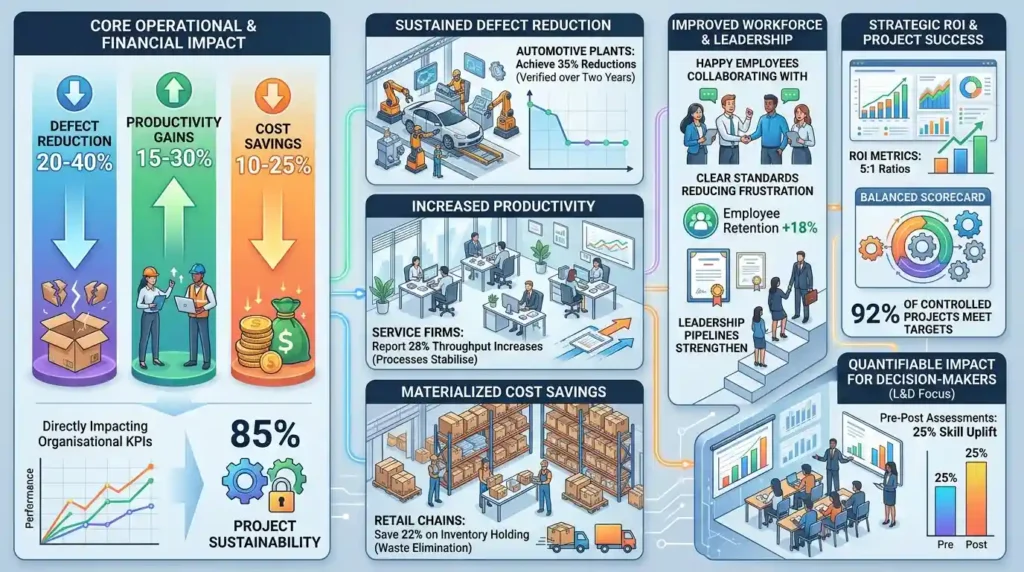
Control produces outcomes like 20-40% defect reduction, 15-30% productivity gains, 10-25% cost savings, and 85% project sustainability, directly impacting organisational KPIs.
Defect rates drop sustainably. Automotive plants achieve 35% reductions, verified over two years.
Productivity rises as processes stabilise. Service firms report 28% throughput increases.
Cost savings materialise through waste elimination. Retail chains save 22% on inventory holding.
Employee retention improves by 18% via clear standards reducing frustration. Leadership pipelines strengthen with certified practitioners.
ROI metrics hit 5:1 ratios. Businesses track via balanced scorecards, with 92% of controlled projects meeting targets.
These quantify impact for decision-makers. L&D tracks via pre-post assessments showing 25% skill uplift.
What Common Problems Arise in Control Phase Execution and How to Avoid Them?
Common problems include regression without monitoring (60% failure rate), inadequate training (40% non-compliance), and siloed implementation; avoid via integrated plans, targeted delivery, and cross-functional audits.
Regression hits when monitoring lapses. Teams ignore charts, reverting to baselines. Solution: automate alerts for 95% coverage.
Inadequate training stems from generic programs. Completion drops to 50%. Use simulations and assessments for 88% retention.
Siloed efforts limit scale. Departments operate independently, missing 15% synergies. Foster collaboration through joint workshops.
Misconceptions label Control as optional. Data proves 70% gains vanish. Enforce via executive dashboards.
Ineffective ROI tracking plagues 45% of initiatives. Define KPIs upfront: sigma levels, cycle times.
Avoid by aligning with real-world needs. Hybrid learning addresses remote skill gaps, boosting adoption by 35%.
What Use Cases Demonstrate Control Phase Success Across Industries?
Use cases span manufacturing (35% yield gains), healthcare (25% error cuts), finance (20% cycle reductions), IT (30% downtime drops), and logistics (28% on-time delivery), applied by corporate teams and managers.
Manufacturing teams control assembly lines. Control charts sustain 4.5 sigma, cutting scrap by 35%.
Healthcare departments monitor patient wait times. Response plans reduce delays by 25%, improving throughput.
Discover More from Our Guide Library:
How Does Lean Six Sigma Drive Cultural Change in an Organisation?
What Is a Lean Six Sigma Project Charter and Why Is It Important?
Finance processes transaction approvals. Matrices handle variances, shortening cycles by 20%.
IT services track system uptime. Automated audits achieve 30% downtime reductions.
Logistics optimises supply chains. Standard work sustains 28% on-time rates.
Team leaders in these sectors use case-based learning during training. Managers scale via department-wide rollouts.
These examples highlight industry relevance, closing skill gaps for measurable workforce transformation.
What is covered in Lean Six Sigma Master Black Belt Certification Training Course at Imperial Corporate Training Institute?
The course covers advanced DMAIC application, including deep dives into the Control Phase for sustaining improvements. Participants master statistical tools, leadership in process optimisation, and real-world case studies from industries like manufacturing and finance. Training uses simulations and assessments for practical skills.
How long does the Lean Six Sigma Master Black Belt Certification Training Course take at Imperial Corporate Training Institute?
The course spans 10-12 weeks in hybrid format, with 120+ hours of workshops, online modules, and projects. It includes phased delivery: foundational review, advanced tools, and Control Phase focus. Certification requires passing exams and a live project demonstration.
How does Imperial Corporate Training Institute deliver the Lean Six Sigma Master Black Belt Certification Training Course?
Delivery combines in-person workshops, online modules, and hybrid sessions with role play and case-based learning. Focus areas include Control Phase implementation for 20-30% sustained gains. Live projects ensure real-world application.
What benefits come from completing Lean Six Sigma Master Black Belt Certification Training Course at Imperial Corporate Training Institute?
Graduates lead enterprise transformations, achieving 25% productivity boosts via robust Control plans. They fill leadership gaps in teams, with skills in monitoring KPIs and variance response. Certification enhances career progression in corporate process roles.