
Lean Six Sigma combines Lean principles, which eliminate waste, with Six Sigma methods, which reduce variation. In corporate environments, organisations deploy it to streamline processes, cut costs by 20-30%, and boost productivity by up to 50%. HR managers and L&D professionals use it to address skill gaps in operational teams.
What Is Lean Six Sigma in a Corporate Context?
Lean Six Sigma is a data-driven methodology that integrates Lean’s waste elimination with Six Sigma’s defect reduction to optimise business processes and deliver measurable efficiency gains in workplaces.
Organisations apply Lean Six Sigma to tackle inefficiencies that drain resources. Waste types include overproduction, waiting times, unnecessary transport, excess inventory, overprocessing, excess motion, defects, and unused talent. Six Sigma targets variation in processes, aiming for 3.4 defects per million opportunities.
In B2B training, professionals learn to identify these issues through structured belts: White, Yellow, Green, Black, and Master Black Belt. Master Black Belt holders lead enterprise-wide transformations. Businesses in manufacturing, finance, and logistics report 15-25% cycle time reductions after implementation.
Corporate training programmes bridge employee skill gaps by teaching these concepts. Delivery occurs via workshops, online modules, or hybrid formats over 4-6 months. Participants engage in case-based learning and simulations to apply tools in real scenarios.
How Does Lean Six Sigma Work in Organisations?
Lean Six Sigma operates through the DMAIC framework. Define, Measure, Analyse, Improve, Control deployed in phases to diagnose waste, test solutions, and sustain gains across departments.
Teams start with Define: they map processes and set goals, such as reducing production downtime by 40%. Measure follows, collecting data on key metrics like cycle time and defect rates using tools like process maps and histograms.
Analyse phase uncovers root causes via fishbone diagrams and Pareto charts. Improve tests solutions, such as layout changes to cut motion waste by 30%. Control implements monitoring with dashboards and standard work procedures.
In corporate settings, L&D professionals deliver this via 120-hour programmes blending virtual sessions and on-site workshops. Employees practice on live projects, achieving 25% efficiency uplifts. Organisations track ROI through KPIs like cost savings and throughput increases.
What Are the Key Components of Lean Six Sigma Training?
Key components include DMAIC framework, Lean tools (5S, Kaizen), Six Sigma statistical methods (control charts, DOE), and delivery formats like simulations, assessments, and project coaching over 4-6 months.
DMAIC forms the core structure. Lean tools target waste: 5S organises workspaces (Sort, Set in order, Shine, Standardise, Sustain), reducing search time by 50%; Kaizen events drive rapid improvements in 3-5 days.
Six Sigma adds rigour with statistical process control (SPC) charts monitoring variation and design of experiments (DOE) optimising factors. Training incorporates SIPOC diagrams for high-level mapping and value stream mapping (VSM) visualising flows.
Delivery formats suit corporate needs: 40% online modules for flexibility, 30% live workshops for collaboration, 30% hybrid with role play. Assessments include pre/post-tests and project gates. Master Black Belt training spans 160 hours, emphasising advanced stats and change management.
Programmes use case-based learning from industries like IT (reducing ticket resolution time by 35%), healthcare (cutting patient wait times by 28%), and finance (streamlining claims processing by 22%).
How Do Organisations Implement Lean Six Sigma Effectively?
Organisations implement Lean Six Sigma by selecting belt-trained champions, launching cross-functional projects, integrating with ERP systems, and measuring adherence via audits, yielding 20-40% operational gains.
HR and L&D leaders assess skill gaps via audits, then train 10-20% of staff as Green or Black Belts. Implementation begins with pilot projects in high-waste areas, like supply chain (reducing inventory by 25%).
Cross-departmental teams form, led by Black Belts reporting to steering committees. Integration with tools like Minitab for analysis ensures data accuracy. Rollout spans 6-12 months, starting with VSM workshops.
Sustainment uses control plans and monthly reviews. Common pitfalls include poor leadership buy-in, addressed by executive training. Misconception: it’s only for manufacturing finance firms cut reconciliation errors by 60%.
For deeper insights into advanced application, enrol:
Lean Six Sigma Master Black Belt Certification Training Course and explore:
What real-world projects participants tackle during Master Black Belt training, where leaders handle complex deployments.
What Benefits Does Lean Six Sigma Deliver to Businesses and Teams?
Lean Six Sigma delivers 20-50% productivity increases, 15-30% cost reductions, 10-25% improved employee retention, and stronger leadership pipelines through data-backed process excellence.
Productivity rises as waste elimination frees capacity: teams handle 30% more output without hires. Cost savings stem from lower defects (under 3.4 DPMO) and optimised inventory, boosting EBITDA by 5-15%.
Team efficiency improves via standardised processes, reducing errors by 40%. Retention climbs as employees gain certifications, building internal expertise. Leadership pipelines strengthen; Black Belts mentor juniors, filling 70% of supervisory roles internally.
KPIs track impact: ROI averages 5:1, with payback in 6-12 months. In services, call centres achieve 25% faster resolution. Organisational culture shifts to continuous improvement, enhancing agility.
What Use Cases Demonstrate Lean Six Sigma in Corporate Teams?
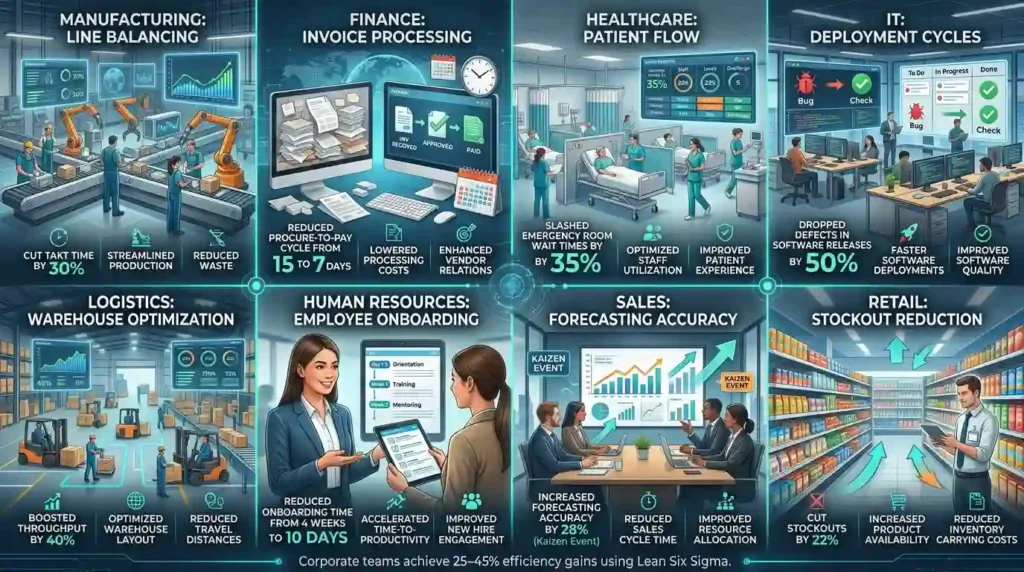
Corporate teams use Lean Six Sigma in manufacturing (line balancing), finance (invoice processing), healthcare (patient flow), IT (deployment cycles), and logistics (warehouse optimisation), achieving 25-45% efficiency gains.
Manufacturing teams balance assembly lines, cutting takt time by 30%. Finance departments streamline procure-to-pay, reducing cycle time from 15 to 7 days.
Healthcare applies it to emergency rooms, slashing wait times by 35%. IT squads optimise software releases, dropping defects by 50%. Logistics firms redesign picking paths, boosting throughput by 40%.
Departmental examples include HR reducing onboarding from 4 weeks to 10 days. Managers lead Kaizen for sales forecasting accuracy up 28%. Industries like retail cut stockouts by 22%.
What Common Problems Arise with Lean Six Sigma Training, and How to Avoid Them?
Common problems include lack of ROI from generic programmes (under 10% sustainment), resistance due to poor delivery, and skill gaps from ineffective formats; avoid by choosing data-focused, project-based training with 80% hands-on components.
Generic off-the-shelf courses fail, delivering only 15% knowledge retention without projects. Solution: select programmes with 70% practical simulations and real audits.
Resistance emerges from top-down mandates; counter with inclusive workshops engaging all levels. Misconception: it’s complex for non-technical staff tailored training builds competence in 80 hours.
ROI suffers from absent metrics; insist on pre/post-KPIs like OEE increases of 20%. Ineffective hybrid formats dilute impact; prioritise 50% live interaction. Organisations see 90% success when aligning training to specific gaps.
How Do You Measure Outcomes from Lean Six Sigma Initiatives?
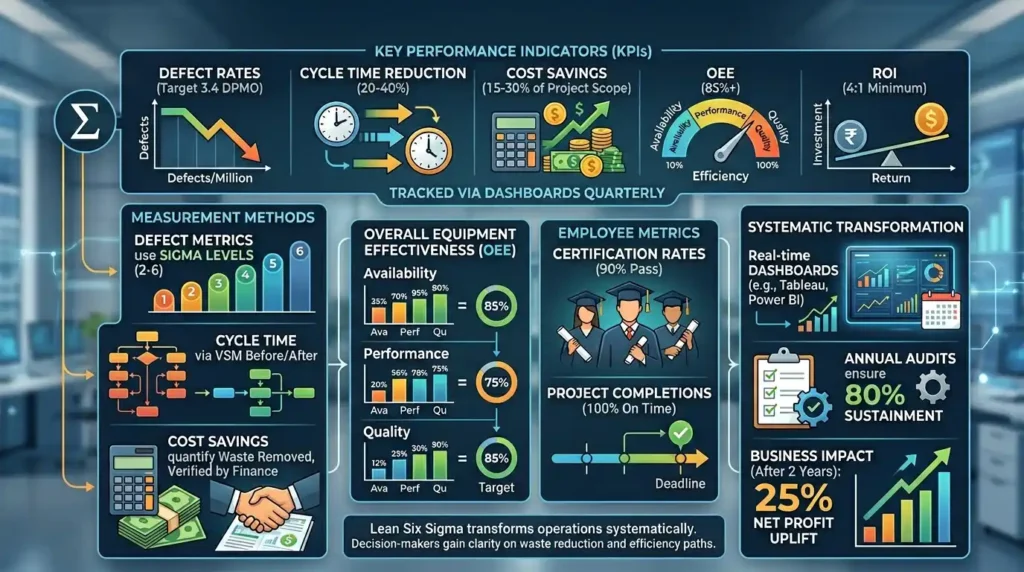
Measure outcomes with KPIs like defect rates (target 3.4 DPMO), cycle time reductions (20-40%), cost savings (15-30% of project scope), OEE (85%+), and ROI (4:1 minimum), tracked via dashboards quarterly.
Defect metrics use sigma levels, progressing from 2-6. Cycle time tracks via VSM before/after. Cost savings quantify waste removed, verified by finance.
Discover More from Our Guide Library:
What Industries Benefit Most From Lean Six Sigma Methodology and Training?
Why Is Lean Six Sigma Considered a Leadership Skill in Modern Organisations?
Overall equipment effectiveness (OEE) combines availability, performance, quality. Employee metrics include certification rates (90% pass) and project completions (100% on time).
Dashboards in tools like Tableau update real-time. Annual audits ensure 80% sustainment. Businesses report 25% net profit uplift after 2 years.
Lean Six Sigma transforms operations systematically. Decision-makers gain clarity on waste reduction and efficiency paths.
What is covered in the Lean Six Sigma Master Black Belt Certification Training Course at Imperial Corporate Training Institute?
The course covers advanced DMAIC application, statistical analysis with DOE and SPC, Lean tools like Kaizen and 5S, and enterprise change management. Participants tackle real-world projects over 160 hours via hybrid workshops and simulations. It equips leaders to drive 20-40% efficiency gains in organisations.
What are the prerequisites for Imperial Corporate Training Institute’s Lean Six Sigma Master Black Belt training?
Candidates need Green Belt certification and 3+ years of process improvement experience. Familiarity with Minitab or similar tools aids advanced stats like regression analysis. This ensures readiness for mentoring teams on DMAIC deployments.
How long does the Lean Six Sigma Master Black Belt Certification Training Course take at Imperial Corporate Training Institute?
The programme spans 160 hours over 4-6 months, blending online modules, live workshops, and project coaching. Flexible hybrid delivery fits corporate schedules while ensuring hands-on practice. Graduates achieve certification after passing assessments and a live project.
Who should enrol in Imperial Corporate Training Institute’s Lean Six Sigma Master Black Belt course?
Black Belts, senior managers, and process excellence leads aiming for enterprise transformations enrol. It suits those with Green Belt experience facing complex waste reduction challenges in manufacturing, finance, or IT. Completion builds skills for 15-30% operational improvements.