
Key Points
- BP has acquired a 40% participating interest in a production sharing agreement (PSA) for six exploration blocks in Uzbekistan’s North Ustyurt region, marking the company’s first upstream project in the Central Asian nation.
- The blocks are Birqori, Boyterak (also spelled Boyterak or Boiterak in some reports), Kharoy (or Khar), Qoraqalpoq (or Qqalpoq or Qalpoq), Qulboy, and Terengquduq (or Terengduqirqori).
- BP obtained 20% stakes from both SOCAR (State Oil Company of the Republic of Azerbaijan) and Uzbekneftegaz (JSC Uzbekneftegaz), leaving each with 30%; SOCAR remains the operator.
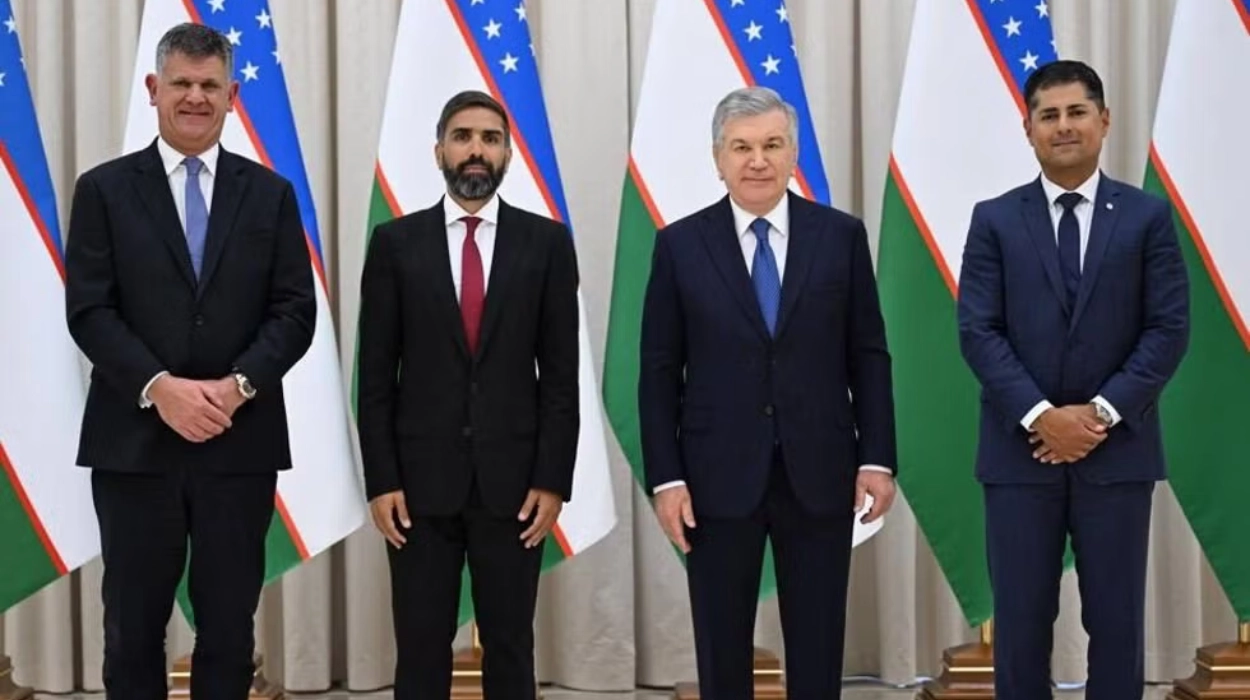
- The deal was formalised in Tashkent during the Oil & Gas of Uzbekistan Conference – 2026, involving signatories including Uzbekistan’s Minister of Energy Jurabek Mirzamahmudov, Uzbekneftegaz chairman Abdugani Sanginov, SOCAR president Rovshan Najaf, and BP’s regional president Gio Cristofoli.
- The PSA was originally signed on 24 July 2025 by SOCAR, Uzbekneftegaz, and Uzbekistan’s Ministry of Energy; the project is in its initial phase with SOCAR conducting seismic activities.
- This entry supports BP’s strategy to grow its exploration portfolio and upstream production to 2.3-2.5 million barrels of oil equivalent per day (MMboed) by 2030, with $10 billion annual investment.
- Key statements highlight Uzbekistan’s resource potential, investor confidence in reforms, and enhanced energy cooperation between Azerbaijan and Uzbekistan.
BP PLC has farmed into Uzbekistan’s North Ustyurt region by acquiring a 40% stake in a production sharing agreement covering six oil and gas exploration blocks, in a move that expands the British supermajor’s footprint in Central Asia. This transaction, announced on 13 May 2026, sees BP purchasing 20% interests from both SOCAR and Uzbekneftegaz, adjusting ownership to 40% for BP and 30% each for the partners, with SOCAR retaining operatorship. The deal underscores growing international interest in Uzbekistan’s energy sector amid ongoing reforms.
What Are the Details of the Agreement?
The production sharing agreement encompasses the Birqori, Boyterak, Kharoy, Qoraqalpoq, Qulboy, and Terengquduq blocks in the North Ustyurt basin. As reported by Jov Onsat of Rigzone, “The project consists of six blocks: Birqori, Boyterak, Kharoy, Qoraqalpoq, Qulboy and Terengquduq.”
The signing ceremony occurred in Tashkent during the Oil & Gas of Uzbekistan Conference – 2026. Signatories included Uzbekistan Minister of Energy Jurabek Mirzamahmudov; Uzbekneftegaz chairman Abdugani Sanginov; SOCAR president Rovshan Najaf; and BP regional president for Azerbaijan, Georgia and Türkiye Gio Cristofoli.
Originally established on 24 July 2025 between SOCAR, Uzbekneftegaz, and Uzbekistan’s Ministry of Energy, the PSA is now in its first phase, with SOCAR undertaking seismic activities as operator. SOCAR and Uzbekneftegaz had advanced a $2-billion energy project in these blocks last year.
Why Did BP Enter This Uzbekistan Project?
As stated by Gio Cristofoli, BP president for Azerbaijan, Georgia and Türkiye, in a company online statement reported by Jov Onsat of Rigzone: “We are pleased to be entering our first project in Uzbekistan, alongside Uzbekneftegaz and our long-standing partner SOCAR. We believe Uzbekistan has significant resource potential and see this as an opportunity to support the exploration and development of the country’s oil and gas resources, delivering long-term benefits to the region. Our entry into this PSA is also a demonstration of BP further growing its exploration portfolio in support of long-term organic growth.”
This aligns with BP’s “reset” strategy announced on 26 February 2025, aiming to grow upstream production to 2.3-2.5 MMboed by 2030 through around $10 billion in annual investments; BP produced 1.53 MMboed last year. As of 2025, BP’s Asia assets (excluding Australasia) contributed 381,000 barrels per day of net crude oil and 1.6 billion cubic feet per day of natural gas, with 63 gross development wells and 1 gross exploratory well.
The move continues BP’s pivot back to oil and gas, seeking profitable opportunities.
What Do Uzbek Officials Say About BP’s Involvement?
Uzbekistan’s Energy Minister Jurabek Mirzamahmudov said in the BP statement, as reported by Jov Onsat of Rigzone: “BP’s accession to the Production Sharing Agreement in the Ustyurt region is not merely a commercial agreement, but a direct testament to international investors’ confidence in the reforms being carried out in Uzbekistan and in our strategic course toward the development of the energy sector.”
Abdugani Sanginov, chairman of Uzbekneftegaz’s management board, commented: “We are confident that combining our experience with the advanced technologies and expertise of BP and SOCAR will enable us to unlock the region’s resource potential with maximum efficiency.”
What Is SOCAR’s Perspective on the Partnership?
SOCAR president Rovshan Najaf said, as quoted in Offshore Technology: “This project, which will make a significant contribution to the development of energy cooperation between Azerbaijan and Uzbekistan, is a clear manifestation of the relations between our brotherly countries based on mutual trust, shared interests and long-term strategic goals. The involvement of bp, which has maintained close and efficient partnership relations with SOCAR for many years, will create broad opportunities to ensure effective joint operations within the project. We believe that the extensive experience of SOCAR and bp in the energy sector, along with the capabilities and efforts of Uzbekneftegaz, will make an important contribution to the successful implementation of the project, as well as to the development of the region’s energy potential.”
SOCAR remains the operator and holds 30% post-transaction.
When and How Was the Original PSA Signed?
The PSA was originally signed on 24 July 2025 by SOCAR, Uzbekneftegaz, and Uzbekistan’s Ministry of Energy. It covered the six blocks in North Ustyurt, with initial seismic operations underway. BP’s farm-in adjusts the structure without altering the core agreement.
What Is the Strategic Context for Uzbekistan?
Uzbekistan’s North Ustyurt region holds significant unexplored hydrocarbon potential, attracting foreign investment amid energy sector liberalisation. The project is part of broader reforms boosting investor confidence, as noted by Minister Mirzamahmudov. This deal follows other regional expansions, such as BP’s recent 60% stake acquisition in three offshore Namibia licences last month.
How Does This Fit BP’s Global Portfolio?
BP’s entry marks its first upstream venture in Uzbekistan, complementing assets in Abu Dhabi, Azerbaijan, China, India, Indonesia, Iraq, Kuwait, and Oman. It supports BP’s goal of portfolio growth for organic production increases. Analysts view it as part of BP’s strategic shift towards high-return oil and gas projects.
This development in Uzbekistan’s energy landscape highlights opportunities for international majors. Professionals seeking to navigate such Oil & Gas deals or advance in Energy Sector Management can benefit from specialised training to analyse PSAs, conduct seismic evaluations, and drive exploration strategies effectively.