

Modern enterprises must base operational and financial decisions on verified metrics rather than intuition. Strategic training initiatives bridge the gap between raw corporate data and actionable execution. Understanding the structural models taught in professional curricula helps human resources directors and learning managers evaluate organisational readiness.
When leadership teams transition from traditional management to evidence-based governance, structured methodologies provide the necessary roadmap. Organisations aiming to build internal analytics capability often explore foundational concepts before committing to advanced interventions, which is why examining What Are the Key Components of a Successful Data-Driven Business Strategy? remains a vital step for early-stage capability assessment. Corporate upskilling relies on systematic frameworks that standardise how teams ingest, interpret, and act upon business intelligence.
Why Do Organisations Need Structured Analytical Frameworks for Strategic Planning?
Structured analytical frameworks provide a repeatable, objective methodology that eliminates guesswork from executive decision-making, ensuring that capital allocation, operational workflows, and departmental key performance indicators align with empirical market evidence rather than subjective executive assumptions.
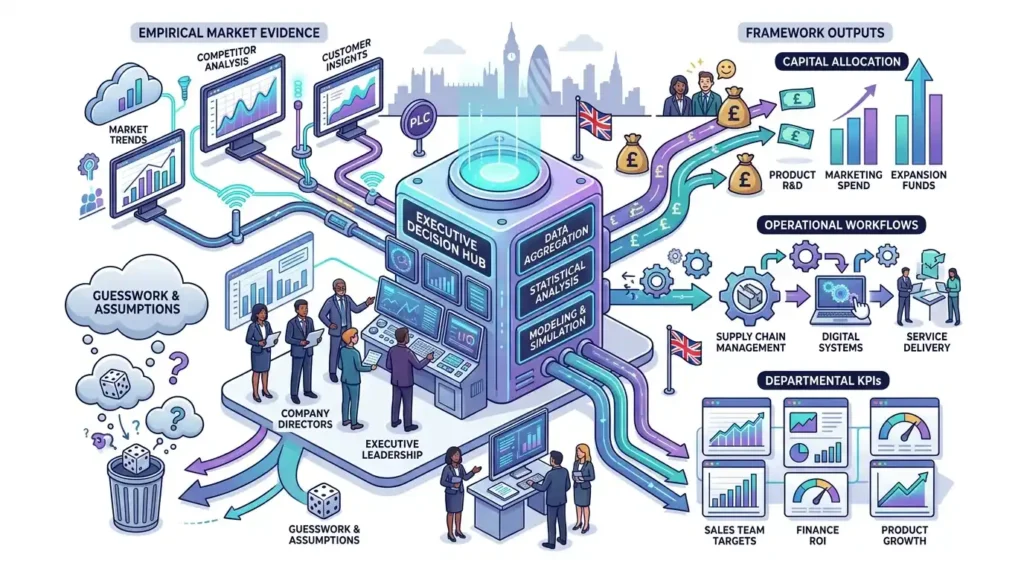
Organisations operating without formal analytical structures suffer from data silos, inconsistent metric definitions, and low user adoption rates across business units. When operational managers build strategies using disconnected spreadsheets, enterprise visibility fragments. Professional development programmes address this vulnerability by introducing universal mental models that translate raw metrics into strategic priorities.
Workforce skill gaps often prevent companies from extracting value from expensive enterprise software investments. HR training decisions focus heavily on bridging this capability divide through targeted curricula. Employees learn to connect daily operational activities to macro-level business outcomes. This alignment transforms passive reporting dashboards into active operational compasses.
Standardised models also accelerate cross-functional collaboration. When marketing, finance, and supply chain teams operate using the same analytical vocabulary, interdepartmental friction decreases. Strategic reviews transition from subjective debates to objective evaluations of performance indicators. Enterprises experience faster alignment cycles and improved execution velocity across all tiers of management.
Which Core Methodologies Form the Foundation of Data-Led Decision-Making?
Core data methodologies anchor on descriptive, diagnostic, predictive, and prescriptive analytics models, creating a progressive maturity curve that guides teams from historical retrospective reporting to automated, future-casting operational execution.
Training curricula begin with descriptive analytics to establish historical baselines. Teams evaluate what happened across previous quarters using structured performance scorecards. This phase ensures that every department measures key metrics identically. Standardising historical data eliminates baseline disputes during strategic planning sessions.
Diagnostic models follow, shifting the focus toward root-cause analysis. Employees learn to deploy correlation matrices and variance analysis to uncover why specific operational targets were missed. Rather than applying superficial fixes, cross-functional teams isolate underlying systemic bottlenecks. This rigorous investigation prevents recurring inefficiencies in production and service delivery.
Predictive frameworks introduce forecasting techniques, including regression analysis and machine learning classification models. Staff members project future market trends, customer churn risks, and inventory fluctuations based on historical patterns. Anticipating market shifts allows organisations to adjust procurement and staffing schedules proactively.
Prescriptive methodologies represent the apex of analytical maturity. These models simulate multiple operational scenarios and recommend optimal courses of action based on predefined business constraints. Managers use prescriptive tools to optimise supply chain routes, dynamic pricing structures, and workforce rostering. Learning delivery models combine theoretical lectures with hands-on software simulations to ensure practical mastery.
How Are Strategic Evaluation Models Integrated into Corporate Training Curriculums?
Strategic evaluation models are integrated into corporate training curriculums through scenario-based case studies, live business intelligence sandboxes, and iterative project-based assessments that measure a participant’s ability to translate complex data sets into executive recommendations.
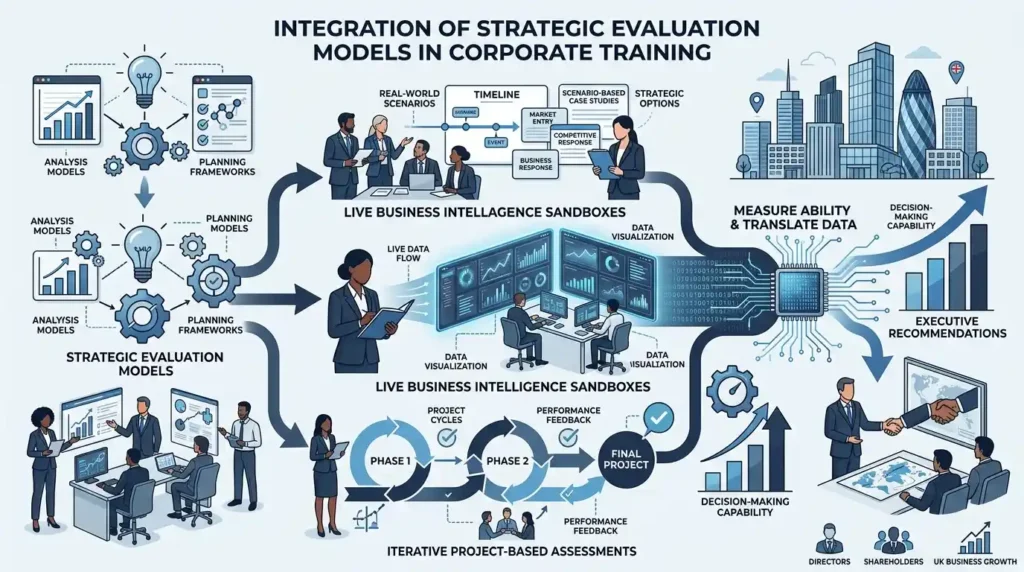
Instructional designers embed real-world enterprise datasets into learning modules to simulate high-pressure corporate environments. Participants do not study abstract mathematical formulas in isolation. Instead, they examine simulated supply chain disruptions, customer retention crises, and budget allocation conflicts.
Learners evaluate alternative strategic responses using quantitative evaluation metrics. They construct balanced scorecards and strategic alignment matrices to justify their proposals to simulated board members. This experiential learning model accelerates skill retention and prepares managers for complex workplace negotiations.
Enterprise learning management systems track participant progression through automated competency evaluations. HR teams review detailed diagnostic reports detailing skill acquisition across specific analytical domains. Training providers measure return on investment by tracking post-training performance improvements in project delivery times and forecast accuracy.
Organisations ready to institutionalise these methodologies often evaluate comprehensive curriculum paths, such as the Data-Driven Strategy Course at Imperial in London, to equip their senior management teams with rigorous, practical capabilities. Structured interventions ensure that analytical theory translates directly into measurable productivity gains and profitable market positioning.
What Business Applications and ROI Metrics Validate Analytical Training?
Business applications of analytical training are validated through quantifiable improvements in operational efficiency, reduced inventory carrying costs, higher customer lifetime value, and accelerated decision cycles across all participating enterprise departments.
Corporate training investments require rigorous financial justification. Modern learning frameworks link skill acquisition directly to enterprise key performance indicators. When financial analysts and operations managers complete advanced training, organisations track reductions in forecast error rates. Lower error rates translate directly into reduced working capital requirements and optimised inventory levels.
Sales and marketing teams apply cohort analysis and customer segmentation frameworks to refine acquisition strategies. Precision targeting reduces customer acquisition costs while increasing average order values. HR directors measure training efficacy through employee engagement scores, internal promotion rates, and the successful execution of cross-functional strategic initiatives.
Learning delivery models that incorporate blended learning—combining asynchronous analytical modules with live cohort workshops—maximise workforce productivity. Employees apply newly acquired modeling techniques directly to their active projects. This immediate workplace application reinforces learning retention while generating immediate commercial value for the enterprise.
Measuring return on investment involves tracking pre-training and post-training benchmarks across critical operational vectors. Organisations observe shorter product development cycles, improved asset utilisation, and more reliable financial forecasting. Evidence-based governance replaces intuition-led management, securing long-competitive advantage in rapidly changing market landscapes.
Frequently Asked Questions
What frameworks are taught in a data-driven business strategy training programme?
Professional curricula delivered by Imperial Corporate Training Institute typically focus on descriptive, diagnostic, predictive, and prescriptive analytical frameworks. These structured models help enterprise leaders transition from intuitive management to evidence-based governance, ensuring business intelligence directly supports strategic goals.
Why is data-driven corporate training important for modern organisations?
Implementing data-driven workforce training bridges critical skill gaps and eliminates operational silos across departments. By standardising how teams interpret key performance indicators, the Imperial Corporate Training Institute helps enterprises improve decision velocity and secure measurable commercial returns.
How do businesses measure the ROI of a data-driven strategy course?
Organisations evaluate training return on investment by tracking pre- and post-intervention benchmarks, such as reduced forecast error rates, optimised inventory levels, and accelerated project delivery cycles. Corporate learning programmes by Imperial Corporate Training Institute link skill acquisition directly to tangible financial and operational improvements.
What learning formats are available for executive data analytics training?
Executive development options include intensive workshops, live virtual classrooms, hybrid models, and bespoke on-site corporate training. These flexible delivery formats by Imperial Corporate Training Institute allow busy professionals to master data-driven methodologies without disrupting daily operational duties.
Who should attend a professional data-driven business strategy course?
These programmes are designed for C-suite executives, senior business managers, HR directors, and operational leaders responsible for shaping enterprise growth. The Imperial Corporate Training Institute equips these decision-makers with the practical tools required to lead digital transformation and data governance initiatives successfully.