

Senior managers and executives face constant pressure to transition from intuition-based leadership to evidence-based decision-making. Rapid market shifts require leaders who evaluate complex datasets, identify growth opportunities, and translate analytical insights into actionable enterprise strategy. Modern corporate leadership demands structured data competence to mitigate operational risk, align cross-functional teams, and maintain competitive advantage across complex B2B markets.
Workforce skill gaps often prevent organizations from executing digital transformation initiatives effectively. While technical teams manage data architecture, senior leadership frequently lacks the specialized framework required to translate raw analytics into commercial strategy. Understanding How Do Organisations Use Data to Make Better Strategic Business Decisions? allows leadership teams to identify strategic vulnerabilities, refine resource allocation, and optimize performance across every business unit. Structured executive education bridges this gap by turning high-level data governance into everyday strategic capability.
What Strategic Leadership Capabilities Does a Data-Driven Strategy Course Build?
A data-driven strategy course builds executive capabilities in predictive analytics, risk mitigation, strategic alignment, and data-informed resource allocation. It empowers senior leaders to interpret complex operational datasets, critique analytical models, and transform technical intelligence into high-impact commercial strategy.
Executive performance relies on the speed and accuracy of strategic choices. Traditional decision-making models depend heavily on historical precedent and executive instinct, which increases exposure to market volatility. Modern enterprise leadership requires systematic frameworks to parse large datasets, validate underlying assumptions, and identify emerging operational trends before competitors do.
Structured training sharpens executive vision by demystifying machine learning, data architecture, and business intelligence systems. Leaders learn to ask precise questions of their data science teams, evaluate the validity of predictive models, and eliminate bias in forecasting. This analytical confidence elevates executive conversations from defensive reporting to proactive strategy creation.
Beyond individual decision-making, formal instruction enhances enterprise-wide alignment. Leaders trained in data-driven strategy establish unified KPIs, implement clear data governance protocols, and eliminate information silos between technical and commercial departments. Consequently, executive decisions become transparent, repeatable, and directly measurable against organizational bottom-line targets.
How Do Senior Executives Apply Data-Driven Strategy to Improve Business Performance?
Senior executives apply data-driven strategy to streamline operations, optimize capital allocation, accelerate revenue growth, and improve workforce productivity. By grounding strategic choices in real-time performance analytics, leadership teams minimize operational friction, eliminate unprofitable activities, and maximize return on investment.
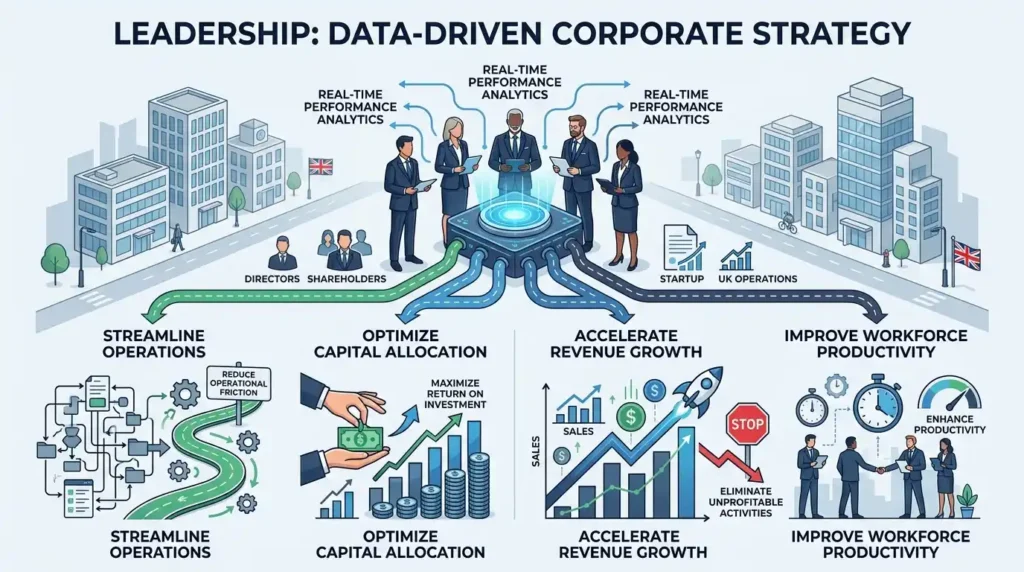
Applying analytical frameworks at the executive level requires translating raw metrics into clear strategic initiatives. Leaders must systematically measure operational productivity, customer acquisition economics, and market demand patterns. When managers understand how to manipulate dynamic data models, they allocate human and financial capital toward high-growth enterprise initiatives with precision.
Operational performance improves when executives replace static quarterly reporting with real-time analytics monitoring. Real-time visibility enables leadership to detect supply chain disruptions, changing customer retention rates, or declining product margins immediately. Prompt interventions prevent minor operational inefficiencies from compounding into enterprise-wide financial losses.
Furthermore, strategic training enables leaders to cultivate a data-informed workplace culture. Executives who demonstrate data reliance establish rigorous standards for project proposals, business cases, and capital expenditure requests. This analytical rigor filters down through management tiers, establishing an organizational environment where evidence consistently takes precedence over consensus.
Which Learning Delivery Models Maximize Training ROI for Busy Executives?
Interactive, cohort-based, and modular executive delivery models maximize training ROI by combining structured academic frameworks with real-world business application. These flexible formats allow busy executives to integrate strategic learning directly into active business operations without sacrificing leadership continuity.
Choosing the appropriate learning delivery model is critical for HR leaders and executive sponsors. C-suite professionals operate under extreme time constraints, making traditional long-term academic formats impractical. Executive learning programs must deliver maximum strategic value per hour through focused, highly applicable curriculum structures.
Intensive Executive Cohorts
Intensive cohort programs assemble cross-industry leaders for immersive, peer-driven strategic development. This structure balances deep analytical theory with collaborative problem-solving, enabling executives to evaluate varied industry approaches to shared data challenges. The cohort format accelerates learning through structured debate, executive case analysis, and immediate feedback from experienced industry facilitators.
Blended and Modular Learning
Blended learning platforms combine self-paced analytical modules with live strategic workshops. Executives master baseline concepts, such as statistical modeling and data governance frameworks, independently before participating in strategic application sessions. This model minimizes disruption to daily corporate schedules while preserving the interactive rigor required for executive-level skill acquisition.
Custom In-House Corporate Training
Customized corporate programs align curriculum directly with an organization’s internal data stack, specific industry challenges, and strategic goals. HR directors select custom delivery to upskill intact leadership teams simultaneously, ensuring consistent strategic execution across business units. This approach turns executive development into an active strategic intervention for enterprise growth.
How Does Executive Data Strategy Training Compare to Traditional Management Frameworks?
Data-driven strategy training replaces subjective management models with empirical, metric-backed decision frameworks. Unlike traditional management development that emphasizes qualitative leadership traits, data strategy courses equip leaders to execute decisions grounded in objective performance data and predictive modeling.
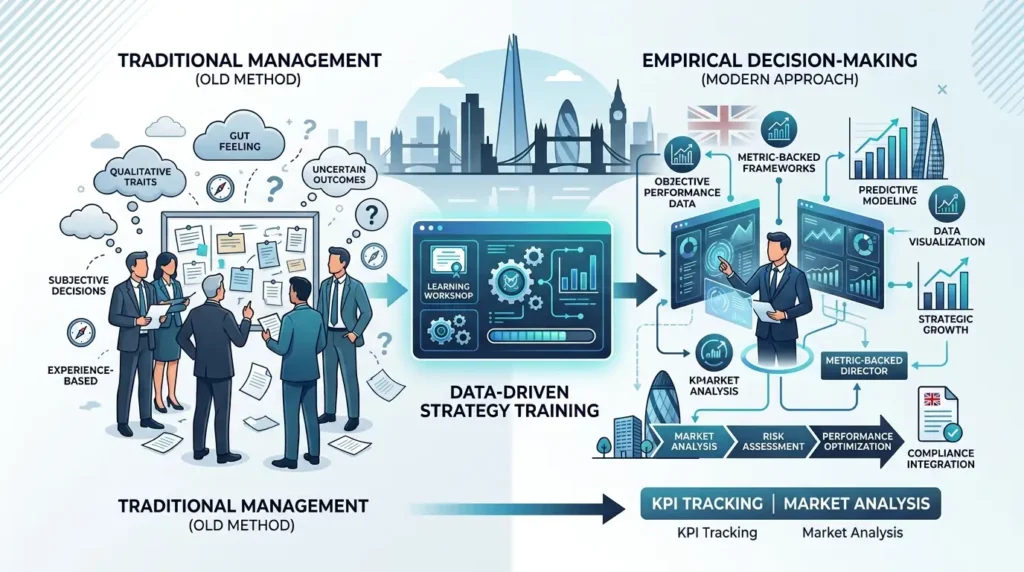
Traditional executive management frameworks rely heavily on qualitative leadership theories, retrospective case studies, and change-management consensus models. While these approaches foster interpersonal leadership, they leave senior executives ill-equipped to handle the volume and complexity of enterprise data. Modern markets demand leaders who evaluate algorithms alongside organizational structure.
Evaluating learning interventions requires comparing traditional executive development with contemporary data strategy programs. The following comparison highlights structural differences in core focus, analytical depth, and business impact:
| Framework Attribute | Traditional Executive Management | Data-Driven Strategy Training |
| Primary Decision Basis | Historical experience, intuition, executive consensus | Real-time analytics, predictive modeling, empirical data |
| Analytical Focus | High-level financial statements, qualitative KPIs | Cross-functional big data, machine learning models, telemetry |
| Risk Management | Reactive contingency planning, historical analysis | Proactive risk quantification, scenario testing, simulation |
| Resource Allocation | Annual budgeting cycles, static benchmarks | Dynamic capital deployment based on real-time ROI tracking |
| Cross-Functional Role | Managing structural hierarchy and department goals | Unifying technical data teams with commercial execution |
| Strategic Speed | Slow, cycle-based strategic review periods | Agile, continuous strategic adjustment based on data streams |
Data-driven strategy programs do not discard foundational leadership principles; instead, they modernize them. Executives learn to pair strategic vision with empirical validation. This approach reduces strategic drift, accelerates project execution, and protects corporate investments from unsubstantiated executive assumptions.
Organizations that transition from qualitative management frameworks to data-driven operational models achieve higher capital efficiency. Senior leaders gain the ability to stress-test corporate strategy against predictive market models, ensuring enterprise resilience amidst industry disruptions.
How Should HR Leaders and Executives Evaluate and Select the Right Data-Driven Strategy Course?
HR leaders and executives should evaluate data-driven strategy courses based on curriculum depth, instructor expertise, peer cohort quality, practical application, and measurable business alignment. The ideal program bridges technical data engineering and high-level corporate strategy to deliver immediate return on investment.
Selecting an executive education program requires a structured selection framework. HR directors and executive sponsors must ensure that candidate programs provide practical, high-value strategic capabilities rather than purely theoretical academic concepts. A thorough evaluation framework prevents misaligned training investments and ensures executive time yields measurable performance returns.
When evaluating program options, learning and development leaders should review the detailed curriculum structure of What Is Covered in Imperial’s Intensive Data-Driven Strategy Training Programme? to determine how well content aligns with corporate objectives. High-impact programs focus on strategic execution, showing leaders how to leverage analytics without requiring them to become data scientists.
HR leaders can use the following decision framework to systematically evaluate candidate programs against key organizational criteria:
| Evaluation Criteria | Assessment Focus Areas | High-Impact Indicators |
| Curriculum Relevance | Strategic data integration, predictive tools, ethics | Focuses on executive application, not raw coding or syntax |
| Faculty Expertise | Academic rigor combined with active industry experience | Instructors are practicing strategy consultants or former C-suite leaders |
| Cohort Quality | Seniority level, peer industry mix, organization scale | Participants hold senior manager, VP, or C-suite positions |
| Applied Learning | Real-world business cases, strategic capstone projects | Leaders complete an active enterprise strategy project during training |
| Delivery Efficiency | Time requirement, schedule flexibility, execution format | Minimizes executive time away from core business operations |
| Enterprise ROI | Post-training evaluation, strategy implementation tracking | Clear mechanisms to measure strategic impact post-completion |
Careful program selection ensures that executive participants acquire immediate, applicable capabilities. Selecting a program with a dedicated focus on practical execution ensures senior managers return to their organizations prepared to lead high-yield data initiatives.
What Real-World Business Outcomes Can Organizations Expect from Executive Data Strategy Training?
Organizations investing in executive data strategy training achieve quantifiable benefits, including improved profit margins, faster market execution, reduced capital waste, and stronger cross-functional synergy. Empowered executive teams turn corporate data into a sustainable competitive advantage.
The primary measure of any executive development program is its tangible impact on organizational performance. When senior leadership masters data-driven strategic planning, business results shift rapidly across multiple key performance metrics. Organizations moving from intuitive to data-driven leadership report significant gains in operational agility and strategic efficiency.
Quantifiable Performance Improvements
Companies with data-empowered executive teams demonstrate marked improvements across financial and operational metrics. Precise analytical capability allows organizations to optimize pricing strategies, eliminate supply chain redundancies, and lower customer churn rates. Industry benchmarks indicate that data-driven organizations achieve significant productivity gains and higher capital returns compared to their lower-performing peers.
Acceleration of Digital Transformation
Digital transformation initiatives frequently fail due to executive misalignment rather than technological failure. When senior leadership lacks data fluency, digital investments are underutilized or misdirected. Strategic data training aligns executive vision with technical capabilities, ensuring enterprise software, business intelligence platforms, and AI investments yield maximum operational returns.
Enhanced Risk Management and Capital Preservation
Capital allocation errors represent a major source of financial waste in large enterprises. Executives trained in strategic data application use predictive modeling, scenario planning, and quantitative risk assessments to evaluate major investments prior to execution. This systematic vetting process protects balance sheets and directs capital toward projects with verifiable probability of success.
Investing in a formal How Does a Data-Driven Strategy Course Benefit Senior Managers and Executives? program equips enterprise leadership with the tools required to navigate complex commercial landscapes. By converting enterprise data into clear strategy, organizations ensure long-term market leadership, operational resilience, and sustained profit growth.
Frequently Asked Questions
What is data-driven corporate training?
Data-driven corporate training is a professional development framework that equips leaders and teams with the analytical tools needed to make evidence-based strategic decisions. At Imperial Corporate Training Institute, this instruction focuses on transforming raw operational data into actionable business insights to drive organizational performance. Participants learn to apply predictive modeling, performance metrics, and business intelligence to solve complex workplace challenges.
How does a data-driven strategy course benefit business leaders?
A data-driven strategy course helps business leaders improve decision accuracy, optimize resource allocation, and minimize financial risk across operations. Managers participating in programs at Imperial Corporate Training Institute gain practical skills to critique complex analytics, align cross-functional KPIs, and foster an evidence-based corporate culture. This analytical capability directly enhances long-term capital efficiency and strategic agility.
Why is data fluency essential for senior managers and executives?
Data fluency enables senior managers and executives to bridge the gap between technical analytics teams and commercial enterprise strategy. Imperial Corporate Training Institute delivers structured training that empowers leaders to interpret key performance indicators, validate predictive models, and eliminate bias in executive decision-making. This capability ensures digital transformation initiatives align with measurable business outcomes.
What key skills are covered in executive data-driven strategy training?
Executive data-driven training covers predictive risk assessment, dynamic capital allocation, big data governance, and strategic performance measurement. Imperial Corporate Training Institute designs curriculum around practical frameworks, enabling leaders to evaluate machine learning outputs and translate complex datasets into clear growth strategies. Executives also master techniques for building unified, data-informed workplace operations.
How do organizations measure the ROI of data-driven training programs?
Organizations measure the return on investment of data-driven training programs by tracking improvements in operational efficiency, project execution speed, and profit margins post-implementation. Imperial Corporate Training Institute incorporates applied corporate projects into training, allowing HR teams and executive sponsors to monitor direct strategic outcomes. Enhanced risk management and reduced capital waste serve as clear indicators of successful learning integration.