

Senior executives frequently face significant strategic drift when operational decision-making relies on intuition rather than structured visual data metrics and analytical frameworks. Modern enterprise environments generate massive amounts of operational data, yet leadership teams routinely struggle to translate these datasets into coherent corporate strategy. Without formal analytical methodologies, resource allocation becomes reactive, risk exposure increases, and cross-departmental alignment degrades. The Imperial Corporate Training Institute developed this high-impact executive program to bridge the critical gap between raw business analytics and high-level corporate decision-making. Before evaluating specific programmatic structures, executive sponsors should understand the foundational concept of What Is a Data-Driven Strategy and Why Does Every Business need this? to establish a clear baseline for institutional transformation. By addressing systematic gaps in data literacy at the C-suite and director level, organizations ensure that strategic initiatives remain grounded in verifiable performance metrics rather than subjective speculation.
What is Imperial’s Data-Driven Strategy Training Course and what business problems does it solve?
Imperial’s Data-Driven Strategy Training Course is a specialized executive development program engineered to transform leadership decision-making through rigorous quantitative analysis, predictive modeling frameworks, and structured performance governance. The course systematically eliminates strategic misalignment and subjective planning across enterprise functions.
Senior leaders frequently operate at a disadvantage due to an over-reliance on aggregated surface-level dashboards that fail to reveal underlying operational trends. When executive teams lack deep quantitative fluency, they delegate analytical interpretation entirely to technical specialists. This division creates a critical communication breakdown. Technical teams understand the underlying data parameters but lack broad business context, whereas senior leaders possess market vision but lack the analytical precision needed to stress-test technical assumptions.
This communication failure leads directly to strategic drift and misallocated capital expenditure. Organizations routinely invest in expensive business intelligence platforms only to discover that C-suite executives continue making key decisions using historical precedent and gut feeling. Imperial Corporate Training Institute structured this curriculum specifically to resolve this structural defect by training senior managers to interrogate data pipelines, evaluate statistical validity, and convert complex analytical outputs into defensible corporate strategy.
In large enterprise settings, cross-departmental friction often stems from inconsistent operational metrics across business units. The marketing division measures success through customer acquisition cost, finance evaluates raw yield on capital, and operations focuses strictly on throughput speed. Without unified strategic direction, these isolated metrics create competing internal priorities. This course establishes a standardized quantitative language across all management functions, ensuring that every division evaluates performance against identical institutional benchmarks.
Why is Imperial’s Data-Driven Strategy Training Course structured for senior executives?
Imperial’s Data-Driven Strategy Training Course utilizes a scaffolded pedagogical framework that transitions leaders from fundamental statistical literacy to complex predictive modeling, scenario planning, and enterprise governance. The structural sequence ensures immediate tactical application within live corporate governance structures.
Senior executives require a training methodology distinct from general management education or technical coding bootcamps. Executive learning must respect time constraints while offering rigorous conceptual depth. The program structure deliberate skips raw code syntax and low-level script development to focus entirely on strategic architecture, risk assessment, visual data interpretation, and quantitative decision theory.
The pedagogical design follows a four-stage progression that mirrors the actual lifecycle of corporate strategic development. Leaders begin by mastering quantitative literacy, ensuring they can identify statistical fallacies, selection bias, and misleading data visualizations presented in board meetings. They then progress to diagnostic analytics, learning how to isolate the precise operational variables driving financial performance fluctuations.
The third stage introduces predictive modeling techniques tailored specifically for executive evaluation. Leaders learn to stress-test financial projections using Monte Carlo simulations, sensitivity analyses, and probabilistic forecasting models. This step removes optimistic bias from strategic planning and provides realistic probability distributions for capital investments. Detailed module breakdowns and skill mapping can be explored in What Will You Learn in a Professional Data-Driven Strategy Training Course? to understand how these analytical methodologies map directly to executive responsibilities.
The final phase anchors quantitative analysis directly to enterprise change management and operational governance. Imperial Corporate Training Institute incorporates real-world corporate data sets into this phase, requiring leaders to construct comprehensive execution roadmaps backed by objective evidence. This instructional framework guarantees that concepts translate into repeatable workplace behaviors immediately following program completion.
What will participants learn in Imperial’s Data-Driven Strategy Training Course?
Imperial’s Data-Driven Strategy Training Course delivers core competencies in quantitative forecasting, capital resource optimization, data architecture evaluation, and automated performance tracking. Participants acquire precise analytical methodologies necessary to drive measurable performance growth across business operations.
The instructional content breaks down into targeted learning units designed to address specific leadership skill gaps:
Module 1: Quantitative Foundations for Strategic Leadership
- Principles of statistical inference for C-suite decision-making.
- Identifying correlation versus causation in complex business metrics.
- Evaluating data integrity, sampling validity, and source credibility.
- Detecting operational bias in executive reporting dashboards.
Module 2: Diagnostic Business Analytics and Performance Mapping
- Isolating underlying operational drivers using root-cause analysis.
- Mapping cross-functional dependencies across operations, finance, and HR.
- Structuring unified key performance indicators across siloed departments.
- Evaluating customer lifetime value and acquisition efficiency metrics.
Module 3: Predictive Modeling, Risk Assessment, and Resource Allocation
- Building probabilistic models for capital expenditure planning.
- Implementing sensitivity analysis to test strategic resilience.
- Scenario planning for volatile market conditions and supply disruptions.
- Algorithmic resource allocation models for corporate portfolio management.
Module 4: Data Governance, Infrastructure, and Culture
- Evaluating corporate data architecture for executive decision support.
- Establishing institutional compliance, ethics, and security protocols.
- Structuring data-centric performance management frameworks for HR teams.
- Leading institutional change and overcoming cultural resistance to analytics.
Participants gain practical experience in evaluating enterprise data pipelines, ensuring they can determine whether an organization’s technical infrastructure adequately supports high-level strategic goals. Executives leave equipped to audit existing internal reporting systems and demand higher precision from technical business units.
Human resource leaders and department heads learn how to build analytical frameworks directly into workforce talent strategies. By applying quantitative metrics to performance management, talent acquisition, and leadership succession planning, HR teams transition from traditional administrative functions into strategic growth enablers. Imperial Corporate Training Institute ensures that every strategic competency includes practical exercises using realistic enterprise data environments.
How is Imperial’s Data-Driven Strategy Training Course delivered to corporate leaders?
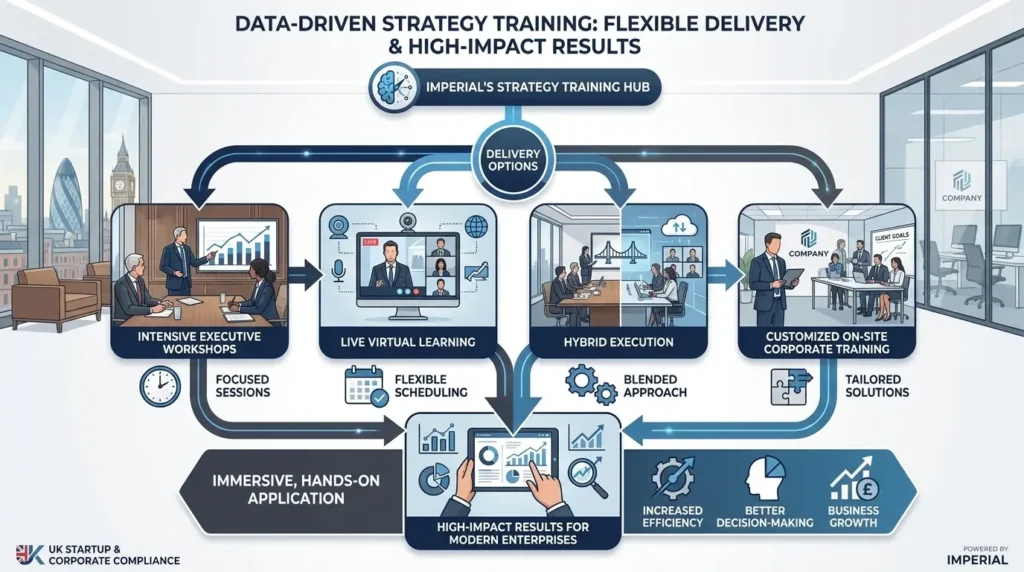
Imperial’s Data-Driven Strategy Training Course offers flexible, high-impact delivery options including intensive executive workshops, live virtual learning, hybrid execution, and customized on-site corporate training. Delivery methodologies emphasize immersive, hands-on application tailored to modern enterprise scheduling constraints.
1. Intensive Executive Workshops
The intensive workshop format condenses the complete curriculum into three consecutive days of immersive, high-density instruction. Designed for senior executives and C-suite leaders who require immediate skill acquisition without extended interruption to operational oversight, this format relies on live case studies, executive peer simulations, and direct syndicate exercises.
2. Live Interactive Virtual Classroom
The virtual classroom format spans six weeks, delivering four hours of live instruction per week. This structured layout allows participants to apply weekly analytical concepts directly to ongoing workplace projects between sessions. Peer discussion boards, live faculty interaction, and digital breakout sessions ensure identical rigor to physical classroom formats.
3. Hybrid Executive Program
The hybrid model combines two days of face-to-face instruction with four weeks of self-paced digital modules and live online review sessions. This option balances the benefits of in-person executive networking with the flexibility of structured remote learning, making it ideal for regional leadership teams.
4. Customized On-Site Corporate Training
For enterprises requiring organization-wide transformation, Imperial Corporate Training Institute delivers fully tailored on-site programs directly at the client’s corporate facilities. This delivery mechanism permits the integration of proprietary corporate data sets, internal strategic objectives, and confidential operational challenges directly into the course assignments.
Assessment throughout the program avoids theoretical academic examinations in favor of rigorous, workplace-driven evaluations. Participants complete diagnostic baseline audits, formulate real-time strategic course corrections for distressed business case scenarios, and execute a comprehensive capstone project.
The capstone project requires participants to apply the complete analytical framework to an actual operational challenge within their current enterprise organization. This ensures immediate tangible ROI for sponsoring institutions before the training engagement concludes.
What measurable results can organizations expect from Imperial’s Data-Driven Strategy Training Course?
Imperial’s Data-Driven Strategy Training Course produces verifiable improvements in capital efficiency, strategic execution speed, risk reduction, and cross-functional performance tracking. Organizations achieve direct financial return on investment through optimized operational decision-making.
When senior leadership teams undergo formal quantitative strategy development, the operational impact extends across the entire institutional hierarchy. Sponsoring organizations routinely experience immediate reductions in misallocated project capital, as leaders learn to terminate underperforming initiatives early using objective performance thresholds rather than sunk-cost fallacies.
HR divisions utilizing Imperial Corporate Training Institute programs report enhanced clarity when aligning talent development frameworks with broader enterprise goals. HR managers construct clear, measurable performance benchmarks that reflect strategic priorities, eliminating ambiguity in executive evaluations and leadership pipeline development.
Consider an enterprise logistics division experiencing margin compression due to fluctuating fuel costs and supply delays. Prior to completing the program, leadership addressed these challenges through generalized cost-cutting measures that inadvertently harmed delivery speed. Following training, the executive team built dynamic predictive models that isolated precise route inefficiencies and optimized fleet usage, restoring profit margins without compromising service standards.
Another enterprise case involves a financial services firm where marketing and operations operated with conflicting performance metrics. By implementing the unified quantitative frameworks taught in the course, the executive leadership team realigned departmental incentives around shared customer retention models. This structural realignment generated a measurable increase in cross-departmental project completion rates within six months of course delivery.
How does enrollment work for Imperial’s Data-Driven Strategy Training Course?
Enrollment in Imperial’s Data-Driven Strategy Training Course follows a structured four-stage evaluation process designed to verify executive candidate eligibility, align organizational learning objectives, and confirm programmatic fit. The admissions process ensures high-caliber cohort peer dynamics across all training cohorts.
Stage 1: Executive Application Submission
Candidates or sponsoring corporate HR teams submit a formal application outlining the candidate’s current leadership role, professional background, and institutional objectives. This step establishes baseline eligibility and ensures candidates possess requisite operational management experience.
Stage 2: Strategic Alignment Consultation
An executive education advisor from Imperial Corporate Training Institute conducts a detailed consultation with the applicant or sponsoring corporate HR team. This session reviews specific organizational challenges, evaluates candidate alignment with course prerequisites, and determines the optimal delivery format.
Stage 3: Candidate Verification and Cohort Placement
The admissions committee reviews application details to ensure balanced, non-competing cohort compositions. Candidates who meet experience requirements receive formal confirmation of acceptance alongside cohort placement details and pre-reading scheduling.
Stage 4: Onboarding and Diagnostic Baseline Assessment
Admitted executives complete a pre-course diagnostic assessment to identify individual skill variations in basic quantitative analysis. This allows instructional staff to tailor practical exercises to address specific knowledge gaps before core instruction begins.
To secure a seat in an upcoming cohort or arrange customized enterprise delivery for your leadership team, corporate sponsors and senior executives should enroll in this program today to initiate the formal candidate evaluation process.
Frequently Asked Questions
What is the role of a data-driven blog in modern corporate strategy?
A data-driven blog produced by Imperial Corporate Training Institute serves as an authoritative resource that translates complex business analytics and market metrics into actionable leadership insights. By leveraging empirical evidence and statistical research, a Data-Driven blog helps executives identify operational inefficiencies, evaluate strategic risk, and make evidence-based decisions. This content format bridges the gap between raw data collection and high-level corporate planning for modern enterprises.
How does reading a Data-Driven blog benefit senior business leaders?
A Data-Driven blog equips senior managers and directors with quantitative frameworks to stress-test their operational strategies against current industry benchmarks. Through expert analysis provided by Imperial Corporate Training Institute, leaders gain clearer visibility into predictive modeling, key performance indicator alignment, and performance governance. This knowledge reduces decision latency and minimizes reliance on subjective planning in competitive corporate environments.
What topics are typically covered in a corporate Data-Driven blog?
A corporate Data-Driven blog covers core competencies including diagnostic business analytics, quantitative forecasting, customer lifetime value modeling, and enterprise resource allocation. Content published by Imperial Corporate Training Institute also explores data governance, performance metrics for human resource development, and digital transformation methodologies. These articles provide structured, practical guidance for teams seeking measurable performance improvement.
How can HR teams use a Data-Driven blog for talent and skill development?
Human resource management teams use a Data-Driven blog to identify systemic skill gaps within executive leadership and functional business units. Insights from Imperial Corporate Training Institute guide HR professionals in designing targeted corporate training programs backed by workforce performance metrics. This quantitative approach ensures learning initiatives directly support broader organizational objectives and yield measurable return on investment.
Why is quantitative content essential for evaluating executive training programs?
Quantitative content within a Data-Driven blog allows decision-makers to evaluate training methodologies based on objective skill outcomes and curriculum rigor rather than promotional claims. Imperial Corporate Training Institute utilizes structured, specification-driven analysis to demonstrate how specific learning modules translate into operational improvements. This transparency enables corporate sponsors to select executive programs that deliver verifiable strategic impact.