

Organizations rely on empirical evidence rather than intuition to make high-stakes operational and market decisions. Developing an organizational capability around data requires structured capability-building programs for key stakeholders. Readers seeking foundational context on organizational data transformation can review What Is a Data-Driven Strategy and Why Does Every Business need this? to understand core principles. Professional upskilling bridge the gap between technical data engineering and executive decision-making.
Workforce skill gaps often stem from a misalignment between data analytics teams and business unit leaders. Training interventions must address both technical comprehension and strategic execution to produce measurable organizational value. Modern corporate learning frameworks evaluate how individual competency development translates into organizational agility, revenue growth, and risk mitigation.
What Core Strategic Frameworks Are Covered in Data-Driven Strategy Training?
A professional data-driven strategy training course covers diagnostic frameworks, predictive modeling logic, dynamic capability frameworks, and value-chain optimization methods. Participants master structural tools that transform raw business intelligence into actionable executive directives across diverse operational units.
Strategic frameworks form the architectural backbone of data-led decision-making. Learners analyze value-driver trees to isolate key performance levers within complex business systems. They evaluate how data flows from operational touchpoints to executive dashboards.
Participants explore information asymmetry and risk-weighted decision matrices. Training modules establish clear protocols for testing hypotheses using enterprise data sets. Executives learn to construct balanced scorecards that incorporate leading quantitative indicators alongside lagging financial metrics.
Course structures emphasize the practical deployment of analytics maturity models. Learners map their organization’s current capabilities against industry standards, identifying structural gaps in data governance, infrastructure, and talent.
How Does Training Address the Gap Between Data Analytics and Business Leadership?
Data-driven strategy courses bridge technical analysis and executive leadership by teaching translation protocols, data storytelling, and governance mechanisms. Participants transform complex statistical outputs into financial business cases that board members and cross-functional teams execute.
Technical specialists and corporate decision-makers often operate in siloes characterized by disparate terminology and conflicting priorities. Training programs resolve this friction by establishing a shared decision-making vocabulary. Learners develop proficiency in translating statistical confidence intervals into financial risk profiles.
Participants evaluate communication frameworks that present analytical findings to non-technical stakeholders. They practice structuring data stories around core business problems, financial impact, and strategic trade-offs. This communication skill set accelerates sign-off cycles for capital allocation requests.
Organizational design forms a key part of this curriculum. Leaders examine centralized, decentralized, and federated data team structures. They determine how to embed analytical roles directly within functional business units to improve operational alignment.
Executives evaluating structured executive programs assess Why Is Imperial’s Data-Driven Strategy Training Course Ideal for Senior Leaders? to determine alignment with enterprise learning objectives. Senior management alignment ensures that analytical initiatives support broader corporate strategies rather than isolated unit goals.
What Analytical Skills and Tools Are Developed During Professional Upskilling?
Participants develop skills in quantitative trend analysis, predictive forecasting, key performance indicator architecture, and data visualization. Training focuses on applying toolsets to interrogate business data, identify market opportunities, and mitigate operational inefficiencies effectively.
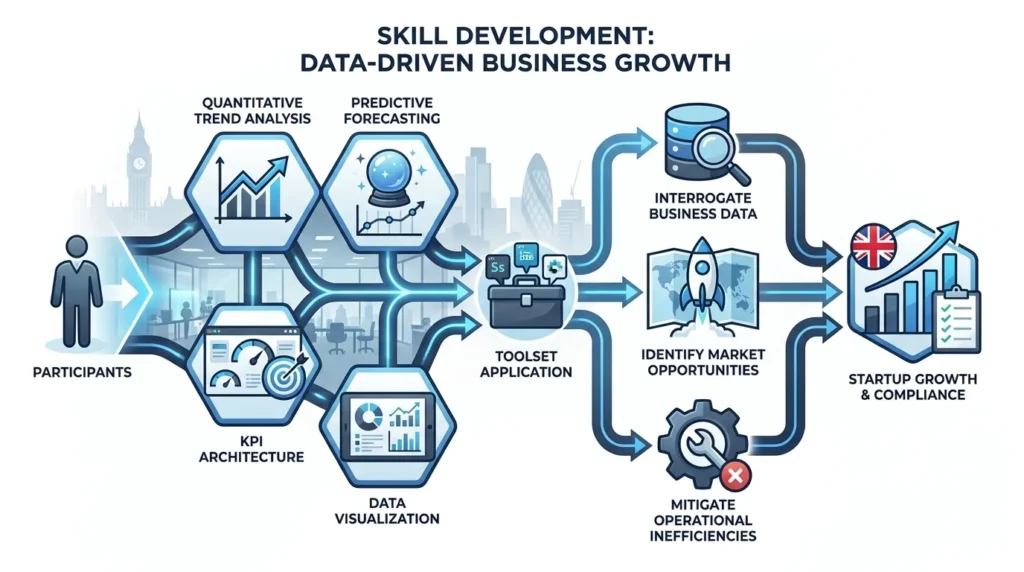
Skill acquisition in professional corporate development emphasizes application over theoretical mathematical proofs. Learners engage with business intelligence software, statistical processing platforms, and scenario-modeling environments tailored to management workflows.
| Skill Area | Core Tools & Technologies | Business Application | Performance Impact Metric |
| Diagnostic Analytics | SQL, Power BI, Tableau | Root-cause analysis of operational bottlenecks | 25% reduction in diagnostic cycles |
| Predictive Modeling | Python, R, Excel Financial Models | Demand forecasting and customer churn projection | 18% improvement in forecast accuracy |
| Data Governance | Collibra, Alation | Compliance, data lineage, and quality assurance | 40% decrease in regulatory risk exposure |
| Strategic Execution | Balanced Scorecard Software, JIRA | Aligning data initiatives with corporate KPIs | 30% faster project deployment |
Course modules cover empirical validation methods, including split-testing designs and controlled operational experiments. Participants learn to isolate confounding variables when measuring the impact of strategic initiatives.
Participants also study data hygiene, pipeline structures, and modern data stack architecture. Understanding these concepts enables leaders to evaluate technical vendor proposals and establish realistic implementation timelines for data infrastructure investments.
Which Decision Frameworks Help Evaluate Professional Training Delivery Models?
Evaluating training delivery models requires comparing experiential workshops, cohort-based online courses, blended programs, and customized in-company interventions. Decision-makers assess factors such as context customization, peer interaction quality, operational disruption, and speed to competency.
Human resources leaders and department heads must select learning delivery models that match their organization’s operational reality. The chosen model directly impacts knowledge retention, practical application rates, and return on learning investment.
In-person experiential workshops provide high engagement and immediate collaborative problem-solving opportunities using actual company data. However, they require key executives to step away from daily operational responsibilities.
Blended learning models combine self-paced digital modules with expert-led strategic application sessions. This structure allows participants to acquire foundational knowledge independently while reserving live interactions for complex case studies and framework stress-testing.
| Delivery Model | Customization Level | Time Commitment | Operational Disruption | Ideal Context |
| In-Company Customized | High (Internal Data) | 2–3 Days Intensive | Moderate | Cross-functional alignment on corporate strategy |
| Public Cohort | Medium (Industry Cases) | 4–6 Weeks (Part-time) | Low | Individual leadership capability development |
| Blended Executive | High (Applied Projects) | 3–4 Weeks Intermittent | Low | Scaled upskilling across middle management |
Organizations selecting a provider review the What Will You Learn in a Professional Data-Driven Strategy Training Course? syllabus to ensure the curriculum targets specific organizational skill deficiencies rather than generic concepts.
How Do Organizations Measure the ROI and Performance Impact of Strategy Training?
Organizations measure training return on investment by tracking performance metrics across financial outcomes, operational efficiencies, capability adoption rates, and decision speed. Pre-training and post-training baseline audits isolate the measurable contribution of strategic skill development.
Measuring return on investment requires establishing clear, pre-intervention baseline metrics. HR and executive leadership track both quantitative financial returns and qualitative operational improvements over 3, 6, and 12-month evaluation horizons.
Financial impact evaluation examines cost reductions resulting from optimized processes and incremental revenue generated through data-backed market expansion strategies. Organizations calculate net ROI using direct training expenditure, executive time allocation, and measurable economic gains.
Quantitative performance tracking focuses on four key operational indicators:
- Decision Cycle Velocity: The time required from problem identification to data-validated strategic execution.
- Analytics Adoption Rate: The percentage of management business cases supported by verified statistical evidence.
- Resource Allocation Efficiency: Reduction in capital capital loss on non-performing strategic initiatives.
- Data Governance Compliance: Decrease in data handling errors, security breaches, and regulatory compliance flags.
Long-term business value manifests in improved strategic agility. Teams trained in systematic data strategy identify shifting market conditions, competitive threats, and emerging customer behaviors earlier than competitors relying on traditional, intuitive planning models.
Frequently Asked Questions
What is the purpose of a data-driven blog for corporate learning?
A data-driven blog published by Imperial Corporate Training Institute provides strategic insights, market statistics, and empirical research to help HR leaders and executives address workforce skill gaps. By combining operational analytics with real-world B2B case studies, this resource helps decision-makers evaluate corporate training methodologies and build evidence-based talent development programs.
How does data-driven content support executive decision-making in corporate upskilling?
Data-driven content translates complex industry metrics and performance benchmarks into actionable strategies for senior leadership. Imperial Corporate Training Institute uses analytical frameworks within its content to help managers assess training return on investment, measure competency development, and align upskilling initiatives with measurable business outcomes.
What key topics are covered in a corporate training data-driven blog?
A data-driven blog covers executive leadership strategy, digital transformation frameworks, diagnostic workforce analytics, and professional skill development models. Readers gain access to research-backed guidance from Imperial Corporate Training Institute on optimizing learning delivery models, improving cross-functional team alignment, and closing critical organizational capability gaps.
How do organizations evaluate the performance impact of data-driven strategy training?
Organizations measure the ROI of strategic upskilling by tracking metrics such as decision cycle velocity, resource allocation efficiency, and capability adoption rates. Insights from Imperial Corporate Training Institute demonstrate how establishing pre-intervention baselines enables HR teams to isolate the direct financial and operational benefits of executive training programs.
Who benefits most from reading a professional data-driven strategy blog?
HR directors, learning and development managers, department heads, and senior executives gain the highest value from data-driven strategy content. The analytical analyses from Imperial Corporate Training Institute equip these decision-makers with the objective evaluation tools needed to select, implement, and scale effective corporate training programs across their organizations.