

A data-driven strategy is an organizational framework that aligns business operations, workforce capabilities, and corporate decision-making with verified statistical insights rather than intuition. It transforms raw enterprise data into measurable performance improvements, optimized resource allocation, and sustained market competitiveness.
Why Do Modern Enterprises Suffer From Critical Operational Inefficiencies Without Data Literacy?
Modern enterprises face operational bottlenecks, misallocated budgets, and stagnant productivity when workforce members make strategic decisions based on subjective assumptions rather than empirical evidence. Without structured data literacy across departments, business units fail to identify market opportunities, miss performance risks, and waste financial assets on unverified initiatives.
Corporate environments generate vast quantities of information every second across customer interactions, supply chain logistics, internal communications, and financial transactions. However, raw information holds zero operational value without structured analysis and execution. When line managers, project leaders, and departmental heads lack the technical ability to interpret key indicators, enterprise execution breaks down completely. Strategic misalignment occurs when different departments evaluate success through conflicting, unverified metrics.
Workforce skill gaps in data literacy create significant financial friction. Organisations that rely on legacy decision-making frameworks lose competitive advantage to agile market competitors. According to industry research, enterprises with low analytics engagement experience 20% to 30% longer project completion timelines and higher rates of customer churn. Addressing this challenge requires moving beyond static reporting software. Business leaders must build a cross-functional workforce capable of converting data trends into concrete operational strategies.
How Does a Data-Driven Strategy Function Within Corporate Environments?
A data-driven strategy functions by embedding empirical analysis, continuous performance monitoring, and objective validation into every phase of corporate planning, execution, and workforce assessment. It standardizes how information is gathered, analyzed, and applied across business units to achieve clear organizational targets.
The execution of an enterprise analytics model follows a strict linear flow from raw data ingestion to operational execution:
Enterprise Data Governance and Infrastructure
Organizations establish unified data pipelines across systems like enterprise resource planning (ERP) platforms, customer relationship management (CRM) software, and human resource information systems (HRIS). This foundation standardizes data hygiene, security parameters, and cross-departmental access protocols. Data governance ensures that legal standards, such as GDPR and CCPA, are met across every operational jurisdiction.
Analytical Processing and Insight Generation
Data teams and trained business analysts process structured and unstructured information using four core methodologies:
- Descriptive Analytics: Evaluates historical trends to determine what occurred during specific operating cycles.
- Diagnostic Analytics: Examines underlying root causes to explain why strategic outcomes succeeded or failed.
- Predictive Analytics: Employs statistical modeling and machine learning algorithms to project future market behaviors.
- Prescriptive Analytics: Recommends precise operational actions based on simulated outcome scenarios.
Strategic Implementation and Operational Alignment
Business leaders translate generated insights into practical operational policies. Departmental heads adjust staffing levels, supply chain commitments, product development roadmaps, and marketing expenditures based on empirical findings. This phase relies on clear communication channels to ensure teams implement recommendations without friction.
Continuous Performance Measurement and Refinement
Organizations monitor real-time key performance indicators (KPIs) through executive dashboards. When empirical feedback demonstrates a variance from targeted parameters, team leaders alter campaign parameters, workflow allocations, or financial investments immediately. This ongoing adjustment cycle eliminates static, annual planning models in favor of real-time operational flexibility.
How Is Data-Driven Capacity Built Through Professional Training Delivery?
Corporate data capacity is built through structured, step-by-step learning programs that combine theoretical principles, practical analytical tools, and real-world business case applications. Professional delivery ensures workforce participants move systematically from foundational literacy to advanced strategic execution.
Professional training institutes structure workforce development programs to bridge the gap between technical data manipulation and business execution. Systematic skill building follows a structured four-phase roadmap:
Phase 1: Foundational Data Literacy and Governance
Participants evaluate core data concepts, data ethics, compliance regulations, and diagnostic terminology. Learners master how data moves through enterprise systems and identify common biases that distort analytical results.
Phase 2: Technical Tool Mastery and Data Ingestion
Employees gain hands-on proficiency with analytical software platforms like SQL, Power BI, Tableau, Python, and advanced Excel modeling tools. Training focuses on querying databases, building dynamic dashboards, and automating recurring reporting workflows.
Phase 3: Strategic Interpretation and Hypothesis Testing
Workforce members learn to formulate precise business questions, test statistical hypotheses, and translate raw data trends into clear operational opportunities. This phase bridges the divide between technical data science and corporate strategy.
Phase 4: Applied Execution and Executive Presentation
Learners apply their skills to real-world corporate challenges using case studies and interactive business simulations. Participants present data-backed strategic proposals to leadership, demonstrating clear operational impact and financial return.
Organizations choose from versatile learning formats based on operational scale, geographic distribution, and scheduling requirements:
- Intensive Corporate Workshops: Concentrated, multi-day instruction ideal for rapid upskilling of immediate teams.
- Structured Online Modules: Flexible, self-paced learning paths designed for distributed workforce teams across multiple time zones.
- Blended Learning Environments: A hybrid framework combining online theoretical study with live, instructor-led practical applications.
What Essential Components Make Up an Effective Enterprise Strategy Framework?
An effective enterprise strategy framework integrates standardized analytics tools, structured management methodologies, core workforce competencies, and clear metric evaluation protocols. These components work together to convert static corporate data into actionable strategic outcomes.
Building an enterprise-wide analytics framework requires four fundamental pillars:
| Strategic Pillar | Core Elements & Tools | Workforce Competencies | Operational Objective |
| Data Governance | Data Cleaning, Metadata Management, GDPR/CCPA Compliance | Data Hygiene, Compliance Auditing, Risk Assessment | Ensures data integrity, security, and enterprise-wide accessibility |
| Analytical Software | SQL, Power BI, Tableau, Python, R, Advanced Excel | Database Querying, Data Visualization, Scripting | Enables technical processing and automated visual reporting |
| Business Methodology | Hypothesis Testing, Root Cause Analysis, Trend Forecasting | Statistical Thinking, Problem Framing, Logic Modeling | Translates statistical outputs into business recommendations |
| Performance Tracking | Dynamic Dashboards, Automated KPI Alerts, Variance Analysis | Metric Selection, Executive Reporting, Agile Adjustment | Evaluates operational outcomes and guides resource re-allocation |
Enterprise success depends on cultivating these components across every management level. Without standardized tools and shared analytical language, departments end up working in silos with incompatible reports. When organizations combine unified tools with structured management, teams move from reactive decision-making to proactive, data-led execution.
What Measurable Benefits Does Empirical Decision-Making Deliver to Organizations?
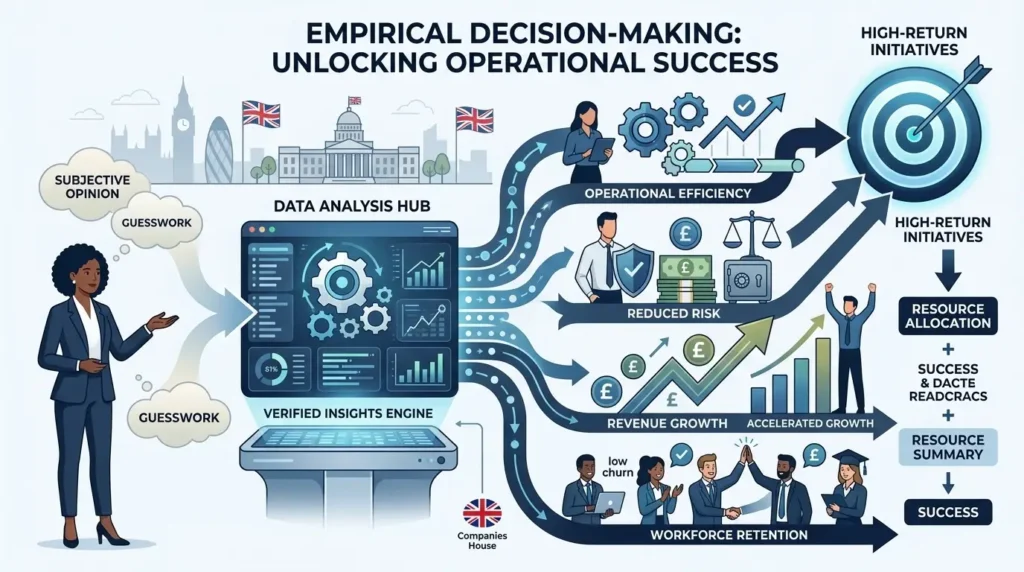
Empirical decision-making delivers higher operational efficiency, reduced financial risk, accelerated revenue growth, and enhanced workforce retention across enterprise environments. Replacing subjective opinion with verified insights ensures resources are allocated to initiatives that yield high returns.
Direct Financial Cost Reduction
Data analysis identifies structural redundancies, operational waste, and underperforming assets across corporate operations. Organisations regularly reduce supply chain overhead by 15% to 25% through predictive inventory management and optimized vendor negotiations.
Accelerated Strategic Velocity
Teams guided by real-time analytics test ideas faster and bring products to market with greater precision. Real-time data validation cuts product development cycles by 30%, allowing companies to adapt quickly to changing market demand.
Improved Talent Management and Employee Retention
Human Resource and L&D leaders utilize workforce analytics to evaluate skill gaps, measure employee sentiment, and predict attrition risks before they impact operations. Data-backed career development frameworks increase retention rates by 12% to 18% across critical roles.
Maximized Return on Investment for Strategic Initiatives
Data-driven validation minimizes costly trial-and-error approaches in capital allocation. Strategic investments backed by empirical scenario modeling deliver up to 40% higher ROI compared to initiatives guided by executive intuition.
How Do Different Corporate Departments Execute Data-Driven Strategies?
Corporate departments execute data-driven strategies by applying specialized analytics frameworks to resolve domain-specific challenges, streamline workflows, and reach target performance metrics. Every function adapts core analytical techniques to match its unique operational responsibilities.
Human Resources and Learning & Development
HR teams implement workforce analytics to optimize recruitment funnels, assess training efficacy, and address skill gaps. L&D professionals evaluate employee participation rates, post-training assessment metrics, and post-course productivity improvements to calculate accurate training ROI.
If you are evaluating how to build structured data capabilities within your workforce, exploring What Will You Learn in a Professional Data-Driven Strategy Training Course? provides a complete breakdown of practical competencies, curriculum modules, and enterprise learning outcomes.
Marketing and Commercial Sales Teams
Commercial departments analyze customer acquisition costs (CAC), customer lifetime value (CLV), conversion rates, and churn probabilities across market segments. Industries like retail, financial services, and telecommunications use predictive models to deliver targeted offerings, cutting customer acquisition costs by up to 30%.
Operations and Supply Chain Management
Logistics leaders use descriptive and predictive analytics to streamline inventory tracking, reduce equipment downtime, and optimize fleet routing. Industries like manufacturing, healthcare, and logistics utilize IoT sensor data to schedule maintenance, preventing costly equipment failures before they disrupt productivity.
Corporate Finance and Risk Management
Finance departments employ predictive financial modeling, automated variance reporting, and real-world scenario analysis to protect corporate capital. Strategic planners evaluate investment options using real-time cash flow analytics rather than static quarterly budget estimates.
What Major Misconceptions Cause Enterprise Data Initiatives to Fail?
Enterprise data initiatives fail when organizations confuse basic software acquisition with strategic transformation, neglect workforce literacy, or treat analytics as a single IT project. True data implementation requires widespread operational alignment, cultural adaptation, and continuous skills training.
Misconception 1: Purchasing Advanced Analytical Software Guarantees Transformation
Organizations often spend substantial budgets on enterprise analytics software like Power BI, Tableau, or Snowflake, expecting instant efficiency gains. Software tools yield zero value without widespread data literacy across line management and execution teams.
Misconception 2: Data-Driven Strategies Belong Exclusively to the IT Department
Treating data execution as an IT initiative isolates analytics from daily business decisions. While IT manages data architecture and system security, operational managers, team leaders, and department heads must drive daily analytical execution.
Misconception 3: Intuition and Domain Experience Are Completely Obsolete
Empirical analysis enhances human leadership experience rather than replacing it. The most effective enterprise strategies pair quantitative data with qualitative management context, ensuring leaders interpret insights correctly within broader industry realities.
Misconception 4: Generic, Out-of-the-Box Training Programs Build Real Capability
Off-the-shelf, theoretical video courses fail to build practical business capability. Effective workforce transformation requires practical, case-based learning, interactive simulations, and industry-specific training tailored to an enterprise’s operational needs.
How Do Organizations Successfully Implement an Enterprise Data Strategy?
Organizations implement an enterprise data strategy by securing executive leadership alignment, establishing robust data governance, upskilling employees through targeted professional development, and establishing continuous feedback loops. Systematic deployment minimizes operational disruption while maximizing performance outcomes.
Successful implementation across corporate environments relies on a structured execution methodology:
Step 1: Executive Alignment and Readiness Assessment
Leadership identifies core business objectives, audits existing data infrastructure, and assigns departmental champions to guide implementation. Clear governance policies ensure security, regulatory compliance, and seamless cross-departmental collaboration.
Step 2: Architecture and Governance Deployment
Technical teams clean legacy databases, integrate disparate software platforms, and establish automated data pipelines. Standardized data protocols ensure employees access accurate, real-time information across all operating units.
Step 3: Targeted Workforce Capability Upskilling
Organizations deploy role-specific training programs to build data literacy across departments. Human Resources and L&D leaders partner with expert corporate training providers to deliver practical, outcome-based learning tailored to real workplace needs.
Step 4: High-Impact Pilot Deployment and Scaling
Teams test analytical strategies on specific, high-priority projects before full-scale rollouts. Validating success in targeted pilot projects demonstrates immediate value, creates cross-departmental buy-in, and provides a clear model for enterprise-wide implementation.
Step 5: Continuous Assessment and Optimization
Business leaders track ROI using automated performance dashboards and strategic KPIs. Department heads adjust operational parameters based on empirical feedback, embedding continuous analytics into the enterprise culture.
Frequently Asked Questions
What is a data-driven strategy in corporate training?
A data-driven strategy in corporate training uses workforce metrics, skill gap assessments, and operational data to design targeted learning initiatives. Programs delivered by providers like Imperial Corporate Training Institute align employee skill development directly with enterprise objectives, ensuring measurable performance improvements. This structured approach replaces subjective training planning with verified statistical evidence to maximize return on learning investment.
How does professional data strategy training benefit enterprise teams?
Data strategy training equips cross-functional teams with the analytical skills needed to interpret enterprise datasets, automate reporting workflows, and make evidence-based decisions. Teams trained through Imperial Corporate Training Institute learn to reduce operational inefficiencies, minimize project risks, and accelerate product development cycles. This collective capability establishes a standardized, data-literate culture across operations, finance, marketing, and human resources.
What core skills are covered in a corporate data strategy course?
A comprehensive corporate data strategy program covers foundational data governance, database querying using SQL, dynamic data visualization in Power BI or Tableau, and predictive analytics modeling. Learners at Imperial Corporate Training Institute also master business hypothesis testing and executive presentation techniques to effectively communicate complex data insights. This combination of technical tool proficiency and strategic thinking bridges the gap between data collection and business execution.
How do organizations measure the ROI of data-driven training programs?
Organizations evaluate training return on investment by tracking pre- and post-assessment scores, employee participation rates, and subsequent workplace productivity metrics. Imperial Corporate Training Institute emphasizes outcome-based learning frameworks where participants apply skills to live operational projects, allowing managers to calculate direct cost savings and efficiency gains. Key indicators include shortened project delivery times, reduced error rates, and higher staff retention.
What is the difference between data literacy training and data science training?
Data literacy training focuses on enabling broader workforce members to understand, analyze, and apply data insights within their daily operational roles without requiring complex coding skills. Conversely, data science training prepares technical specialists to build complex algorithms, data pipelines, and machine learning models. Imperial Corporate Training Institute offers data-driven strategy programs that focus on business data literacy, ensuring managers and team leaders can convert analytical output into actionable commercial decisions.