

Finance departments are under constant pressure to improve accuracy, reduce operational costs, strengthen compliance, and deliver strategic insights. Six Sigma provides a structured methodology for achieving these objectives through data-driven process improvement. While Green Belt and Black Belt practitioners often focus on project execution, Master Black Belts play a broader role in governance, strategy alignment, organisational capability development, and enterprise-wide transformation.
Understanding how Six Sigma functions within financial environments provides important context before evaluating advanced training pathways. Readers unfamiliar with sector-specific applications can first explore how Six Sigma improves banking workflows, transaction processing, risk management, and operational efficiency in financial institutions through:
How Does Six Sigma Apply to Financial Services and Banking Operations?
For finance professionals responsible for leading transformation initiatives, the challenge is not simply completing projects. It is building systems that consistently generate measurable business outcomes. This is where the:
Lean Six Sigma Master Black Belt Certification Training Course becomes relevant as an advanced framework for leadership, coaching, governance, and strategic improvement deployment.
How does Master Black Belt training differ from Black Belt training in finance environments?
Master Black Belt training expands the focus from project execution to enterprise improvement leadership. Finance professionals learn governance structures, deployment strategies, advanced analytics, mentoring techniques, and organisational change management that support multiple Six Sigma projects across departments and business units.
Black Belt practitioners typically lead individual improvement projects. Their responsibilities include data analysis, root cause identification, process mapping, and implementation of corrective actions.
Master Black Belts operate at a different level.
They oversee improvement portfolios rather than isolated projects. Their objective is to ensure projects align with organisational strategy, financial objectives, compliance requirements, and performance targets.
In financial institutions, this distinction becomes significant because process inefficiencies often extend across departments. A loan approval process, for example, involves credit teams, risk management, compliance units, operations departments, and customer service functions.
Master Black Belt training prepares professionals to coordinate improvement efforts across these interconnected systems.
Key competencies include:
- Strategic deployment planning
- Programme governance
- Project selection frameworks
- Executive reporting
- Advanced statistical interpretation
- Organisational coaching
- Benefits realisation management
These capabilities enable finance professionals to move beyond tactical improvements and support enterprise-wide operational excellence.
Why are finance professionals increasingly involved in Six Sigma leadership roles?
Financial organisations depend on measurable performance outcomes, making Six Sigma particularly relevant for professionals responsible for cost control, risk reduction, productivity improvement, and operational efficiency. Master Black Belt training develops the leadership skills required to manage these improvement initiatives systematically.
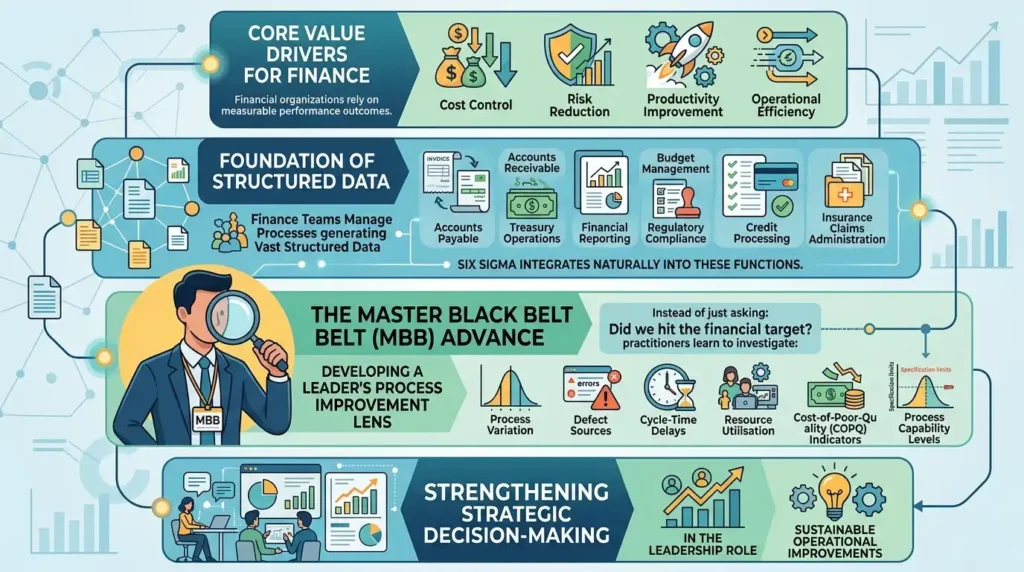
Finance teams manage processes that generate vast amounts of structured data.
Examples include:
- Accounts payable
- Accounts receivable
- Treasury operations
- Financial reporting
- Budget management
- Regulatory compliance
- Credit processing
- Insurance claims administration
Because these functions already rely on measurement and analysis, Six Sigma methodologies integrate naturally into finance operations.
Master Black Belt training helps professionals interpret performance metrics through a process improvement lens.
Instead of asking whether a financial target was achieved, practitioners learn to investigate:
- Process variation
- Defect sources
- Cycle-time delays
- Resource utilisation
- Cost-of-poor-quality indicators
- Process capability levels
This analytical perspective strengthens decision-making while supporting sustainable operational improvements.
Which Six Sigma competencies are most valuable for finance transformation projects?
Advanced statistical analysis, process optimisation, governance design, mentoring capability, and financial benefit validation represent the most important competencies developed through Master Black Belt training for finance-focused improvement programmes.
Finance projects often involve highly regulated processes with substantial operational complexity.
Examples include:
- Fraud detection systems
- Regulatory reporting workflows
- Credit approval procedures
- Insurance underwriting operations
- Treasury transaction processing
These environments require rigorous analysis.
Advanced Statistical Thinking
Master Black Belt programmes strengthen analytical capabilities through advanced statistical methods.
Participants learn to evaluate:
- Process capability
- Hypothesis testing
- Regression analysis
- Design of experiments
- Measurement system analysis
- Predictive performance models
These techniques help finance professionals identify root causes rather than symptoms.
Financial Benefits Validation
Many organisations struggle to quantify improvement outcomes accurately.
Master Black Belt training introduces structured approaches for validating:
- Cost reduction
- Revenue enhancement
- Productivity gains
- Resource optimisation
- Risk reduction impacts
This ensures reported benefits withstand executive and audit scrutiny.
Improvement Governance
Projects often fail because governance structures are weak.
Training addresses:
- Portfolio management
- Escalation frameworks
- Stakeholder engagement
- Project prioritisation
- Risk management controls
These capabilities improve execution consistency across multiple projects.
How does Master Black Belt training improve decision-making in financial organisations?
Master Black Belt training strengthens evidence-based decision-making by teaching finance professionals how to interpret process data, identify variation sources, validate improvement opportunities, and prioritise initiatives according to measurable business impact and organisational objectives.
Financial decisions frequently involve competing priorities.
Examples include:
- Cost versus service quality
- Risk versus growth
- Compliance versus efficiency
- Automation versus workforce allocation
Without structured analysis, improvement decisions often rely on assumptions.
Master Black Belt methodologies provide objective evaluation frameworks.
Professionals learn to distinguish:
- Common-cause variation
- Special-cause variation
- Process constraints
- Systemic inefficiencies
- Measurement errors
This distinction prevents organisations from investing resources in ineffective solutions.
Decision quality improves because improvement initiatives become linked directly to operational evidence rather than anecdotal observations.
What role does Master Black Belt training play in managing large-scale finance projects?

Large-scale finance projects require coordination across departments, governance structures, performance metrics, and stakeholder groups. Master Black Belt training equips professionals with deployment frameworks that support consistent execution and measurable results across complex improvement portfolios.
Finance transformation rarely occurs within a single function.
A digital payment initiative, for example, affects:
- Operations
- Technology
- Compliance
- Finance
- Customer service
- Risk management
Master Black Belt practitioners learn to manage these dependencies systematically.
Portfolio Management
Rather than focusing on individual projects, professionals evaluate project portfolios.
Key considerations include:
- Strategic alignment
- Resource allocation
- Expected benefits
- Implementation risks
- Performance measurement
Stakeholder Management
Large projects involve competing stakeholder interests.
Training develops methods for:
- Executive communication
- Cross-functional alignment
- Change management
- Performance reporting
These competencies help maintain project momentum throughout implementation.
How does Master Black Belt training compare with other professional development approaches for finance professionals?
Master Black Belt training combines statistical analysis, process improvement, leadership development, and organisational transformation methodologies. This integrated approach differs significantly from traditional finance certifications that primarily focus on technical accounting, reporting, or regulatory knowledge.
Finance professionals often compare several development pathways.
| Development Approach | Primary Focus | Improvement Capability |
|---|---|---|
| Accounting Certifications | Financial reporting and compliance | Limited process improvement focus |
| Risk Management Qualifications | Risk identification and control | Moderate operational impact |
| Project Management Training | Project delivery methodologies | Limited statistical analysis |
| Lean Training | Waste reduction | Moderate analytical depth |
| Master Black Belt Training | Enterprise process excellence | High transformation capability |
The distinction lies in organisational impact.
Traditional finance qualifications develop subject matter expertise.
Master Black Belt training develops organisational improvement capability.
This combination supports broader leadership responsibilities.
What business outcomes can finance professionals influence after Master Black Belt training?
Finance professionals trained at Master Black Belt level can influence operational efficiency, cost optimisation, compliance performance, customer experience, process reliability, and enterprise transformation outcomes through structured improvement methodologies and governance frameworks.
Performance improvements vary across organisations, but common targets include:
- Reduced transaction errors
- Lower operational costs
- Faster processing times
- Improved compliance accuracy
- Increased productivity
- Reduced rework
- Enhanced customer satisfaction
Financial institutions frequently measure success using KPIs such as:
- Cost per transaction
- Error rates
- First-pass yield
- Processing cycle time
- Service-level compliance
- Operational productivity
Master Black Belts help ensure these metrics remain linked to strategic business objectives.
Workforce Development Impact
Another important outcome involves capability building.
Master Black Belts serve as mentors and coaches.
They support:
- Green Belt development
- Black Belt development
- Project team capability growth
- Continuous improvement culture
This creates long-term organisational value beyond individual project results.
How should finance professionals evaluate Master Black Belt training options?
Evaluation should focus on curriculum depth, statistical coverage, practical application, mentoring components, deployment methodology, governance frameworks, and relevance to finance-sector improvement challenges rather than certification titles alone.
Not all programmes provide the same level of preparation.
Finance professionals should assess several factors.
Curriculum Scope
Training should address:
- Advanced analytics
- Deployment strategies
- Governance systems
- Leadership development
- Organisational change management
Practical Application
Case studies should reflect realistic business environments.
Relevant examples include:
- Banking operations
- Financial services workflows
- Insurance processes
- Shared service centres
- Corporate finance functions
Organisational Deployment Focus
Enterprise improvement depends on implementation capability.
Strong programmes emphasise:
- Programme governance
- Portfolio management
- Benefits tracking
- Executive engagement
At this evaluation stage, many professionals begin comparing programme suitability and industry relevance. Questions around participant eligibility, financial-sector applicability, and deployment outcomes become increasingly important.
This transition naturally leads readers toward resources such as:
Can Banking and Insurance Professionals Attend Imperial’s Lean Six Sigma MBB Course? which addresses programme-fit considerations from a decision-stage perspective.
How does Master Black Belt training support long-term finance transformation strategies?
Master Black Belt training provides a structured framework for sustaining improvement initiatives, developing internal capability, aligning projects with business strategy, and creating measurable operational performance improvements across financial organisations over extended periods.
Short-term projects often generate isolated gains.
Long-term transformation requires repeatable systems.
Master Black Belt practitioners establish these systems through:
- Governance structures
- Performance measurement frameworks
- Capability development programmes
- Strategic project selection processes
- Continuous improvement roadmaps
The objective is not simply completing projects.
The objective is creating an environment where improvement becomes part of organisational operations.
Discover More from Our Guide Library:
How Is Measurement System Analysis Taught in Master Black Belt Training?
How Does Master Black Belt Training Address the Intersection of Lean and Agile?
For finance professionals, this capability supports increasingly complex business demands involving digital transformation, regulatory compliance, operational resilience, customer experience enhancement, and cost optimisation.
The Lean Six Sigma Master Black Belt Certification Training Course aligns with this requirement because it addresses leadership, deployment, mentoring, governance, and advanced analytical competencies that extend beyond traditional project execution. Organisations seeking sustainable operational excellence increasingly require professionals who can manage improvement systems rather than individual improvement events.
Frequently Asked Questions
Who should attend a Lean Six Sigma Master Black Belt Certification Training Course?
The Lean Six Sigma Master Black Belt Certification Training Course is suitable for experienced Six Sigma professionals, process improvement leaders, quality managers, operational excellence specialists, and senior business professionals. It is designed for individuals responsible for strategic improvement programmes and organisational performance management.
How does Master Black Belt training differ from Black Belt training?
Black Belt training focuses on leading individual Six Sigma projects, while Master Black Belt training emphasises programme governance, advanced analytics, coaching, and deployment strategy. The Imperial Corporate Training Institute course prepares professionals to oversee multiple projects and support organisational transformation.
What skills are developed through a Lean Six Sigma Master Black Belt Certification Training Course?
Participants develop advanced statistical analysis, project portfolio management, leadership, mentoring, change management, and process optimisation skills. These competencies help organisations improve efficiency, reduce process variation, and achieve measurable business outcomes.
How can Master Black Belt certification support business performance improvement?
Master Black Belt professionals use Lean Six Sigma methodologies to identify inefficiencies, improve process capability, and strengthen operational performance. The Lean Six Sigma Master Black Belt Certification Training Course helps organisations build sustainable improvement frameworks supported by data-driven decision-making.