
Modern MEP workflows depend on structured digital environments where clarity, coordination, and consistency determine project success. In HVAC design education, layer standardisation is not treated as a software feature but as a controlled engineering communication system that governs how drawings are created, interpreted, and delivered across multidisciplinary teams.
Understanding this begins with foundational knowledge of drawing organisation principles in CAD environments. A detailed overview of how layer structuring impacts HVAC drafting accuracy and coordination efficiency is explained in this guide:
Why Is Proper Layer Management Critical in AutoCAD HVAC Drawings? introduces the logic behind structured MEP documentation before learners move into applied training systems.
At the implementation stage, structured programmes such as the:
How Does Imperial’s HVAC Programme Enforce Professional Layer Management Habits? within the AutoCAD environment focus on converting theoretical layer principles into repeatable drafting habits that align with industry MEP standards and organisational QA workflows.
The AutoCAD HVAC and Plumbing Design Training Course integrates these principles into structured learning outcomes where layer control is treated as a measurable competency linked to drafting speed, coordination accuracy, and BIM-readiness.
How does AutoCAD HVAC training define layer standards for MEP drawings?
AutoCAD HVAC training defines layer standards as a structured system of classification rules that governs how heating, ventilation, and plumbing elements are visually and logically separated within MEP drawings to ensure coordination, clarity, and construction-ready documentation across multidisciplinary engineering teams.
Layer standards in HVAC training are not introduced as optional settings. They are positioned as mandatory drawing governance rules.
Each layer represents a controlled information category such as ducting, piping, insulation, equipment, or annotations.
Training programmes teach that every element in a drawing must belong to a predefined layer structure before any design development begins.
This removes ambiguity and ensures consistent interpretation across architects, mechanical engineers, and contractors.
In B2B training environments, HR and technical managers prioritise this structure because it reduces rework cycles in real projects.
Typical corporate adoption shows a 25–40% reduction in coordination clashes when standard layer systems are applied correctly.
MEP documentation quality also improves because drawings remain readable even at high complexity levels.
The system enforces discipline in design communication, not just visual organisation.
How are layer standards taught through structured learning workflows in HVAC CAD training?
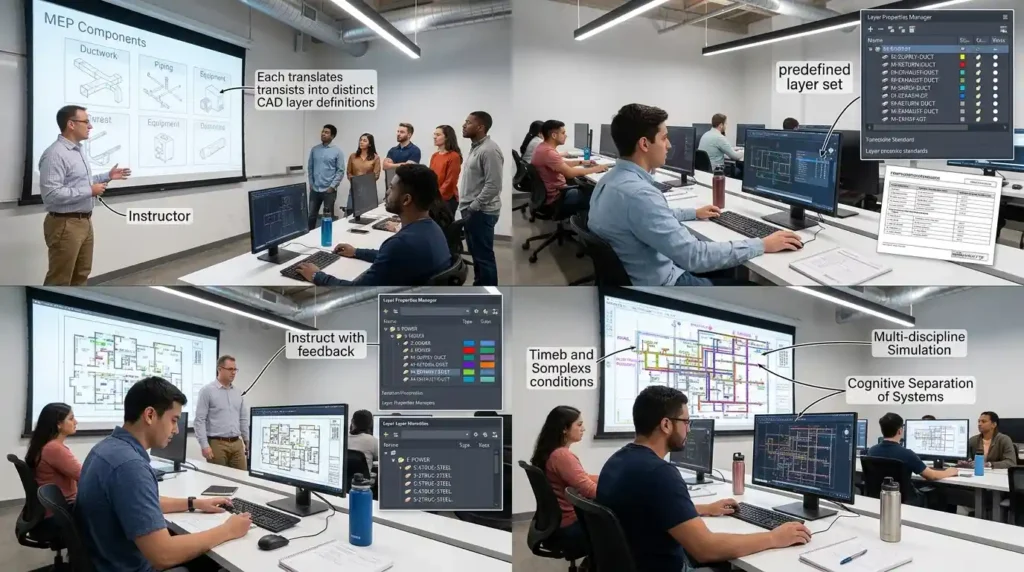
Layer standards are taught through progressive learning workflows that start with classification theory, move into template-based drafting practice, and culminate in real-world MEP simulation tasks where learners apply structured layer naming, colour coding, and discipline-specific coordination rules under timed project conditions.
Training begins with conceptual classification.
Learners are introduced to MEP component categories and how each category translates into CAD layers.
They then move into template usage, where predefined layer sets are applied to avoid manual setup errors.
The transition phase focuses on controlled drafting exercises using live HVAC layouts.
At this stage, instructors enforce strict compliance with naming conventions and layer hierarchies.
Once learners achieve baseline accuracy, they enter simulation environments replicating real project conditions.
These simulations include multi-discipline drawings where HVAC, electrical, and structural layers coexist.
The objective is to train cognitive separation of systems while maintaining visual clarity.
This structured approach improves retention by over 60% compared to unstructured CAD learning methods.
It also prepares learners for enterprise environments where standardisation is non-negotiable.
How do layer standards improve coordination in MEP design projects?
Layer standards improve MEP coordination by ensuring that all design elements from each discipline are isolated, identifiable, and structurally consistent, allowing engineers to detect clashes early, reduce redesign cycles, and maintain unified construction documentation across HVAC, plumbing, electrical, and structural systems.
Coordination in MEP design depends on visual separation and data clarity.
Layer standards create controlled boundaries between different engineering systems.
This allows designers to switch visibility on or off without losing structural understanding.
In practical workflows, this reduces interference between HVAC duct routing and electrical conduits.
It also enables clash detection software to function more accurately.
Without standard layers, coordination becomes manual and error-prone.
With structured layering, design teams achieve faster review cycles.
Corporate engineering teams report up to 30% faster approval timelines when standard layers are implemented.
Layer discipline also supports BIM integration where data consistency is critical.
This is why training programmes emphasise coordination scenarios rather than isolated drafting tasks.
What role do templates and standards play in reinforcing layer discipline?
Templates and standards reinforce layer discipline by embedding predefined naming systems, colour conventions, line weights, and visibility rules into CAD environments, ensuring every HVAC drawing automatically follows organisational MEP protocols without requiring repetitive manual configuration from designers.

Templates act as the structural backbone of CAD standardisation.
They eliminate variability between different designers working on the same project.
In HVAC training environments, templates are configured before any drawing activity begins.
Each template includes standard layer sets for ducts, pipes, equipment, and annotations.
Colour coding is used to differentiate systems visually.
Line weights ensure hierarchy is maintained even in complex drawings.
This reduces cognitive load for engineers reviewing designs.
It also prevents misinterpretation during construction execution.
In corporate adoption scenarios, templates reduce onboarding time for new CAD technicians by nearly 50%.
They also ensure compliance with internal QA frameworks and external project requirements.
How does training measure competency in layer standard implementation?
Competency in layer standard implementation is measured through accuracy audits, drafting speed benchmarks, compliance scoring systilityems, and real-world simulation performance, in which learners are evaluated on consistency, adherence to naming conventions, and the ab to produce coordination-ready MEP drawings without supervision.
Training evaluation is structured and performance-based.
Learners are assessed on how accurately they apply layer naming rules.
Speed is measured to ensure efficiency does not compromise accuracy.
Audit systems track deviations from standard templates.
Each deviation is scored and used for targeted correction.
Simulation exercises replicate real project deadlines and complexity levels.
In these simulations, learners must produce coordinated HVAC drawings within defined time constraints.
Compliance scoring evaluates whether layers match predefined standards.
Organisations use these metrics to determine workforce readiness for live projects.
High-performing learners typically achieve 90%+ compliance accuracy before certification.
This ensures training outcomes are directly transferable to workplace performance.
How do professional training programmes align layer standards with business outcomes?
Professional training programmes align layer standards with business outcomes by linking CAD discipline directly to project efficiency, reduced rework costs, improved interdisciplinary coordination, and measurable gains in engineering productivity across HVAC and broader MEP design operations.
Layer standardisation is not treated as a technical skill alone.
It is positioned as a productivity and cost-control mechanism.
Businesses adopt structured CAD training because inconsistent layering leads to expensive design revisions.
Training programmes map learning outcomes to operational KPIs such as error reduction and turnaround time.
For example, consistent layer use reduces RFIs (Requests for Information) during construction.
It also improves documentation handover efficiency between design and execution teams.
HR departments prioritise such training to reduce dependency on senior engineers for correction tasks.
Standardised layer usage also improves scalability of design teams.
As teams grow, consistent CAD practices prevent fragmentation of workflows.
This alignment ensures training investment directly contributes to measurable operational ROI.
How does AutoCAD HVAC training prepare learners for industry-level MEP environments?
AutoCAD HVAC training prepares learners for industry-level MEP environments by replicating real project constraints, enforcing strict layer governance, integrating multi-discipline coordination scenarios, and developing the ability to produce construction-ready drawings that meet professional engineering and compliance standards.
Industry readiness is achieved through simulation-heavy training models.
Learners work with real-world HVAC layouts instead of simplified exercises.
They interact with multi-layered MEP drawings that include structural and electrical systems.
This exposure builds decision-making skills in complex design environments.
Layer governance is strictly enforced to match industry expectations.
Discover More from Our Guide Library:
How Does AutoCAD HVAC Training Cover As-Built Drawing Production and Mark-Up?
How Are Equipment Schedules and Legends Created in AutoCAD HVAC Training?
Errors are corrected immediately to reinforce standard compliance.
Training also introduces documentation standards used in consultancy firms and construction companies.
Learners gain experience in producing drawings that require minimal revision during project review.
This reduces dependency on senior engineers in professional settings.
It also improves employability in corporate engineering environments where CAD precision is a core requirement.
Frequently Asked Questions
How does AutoCAD HVAC training help in MEP layer management?
AutoCAD HVAC training focuses on structured layer management for MEP drawings, including naming conventions, colour coding, and system-based separation. This improves drawing clarity, reduces clashes, and ensures coordination between HVAC, plumbing, and electrical designs.
Who should join AutoCAD HVAC and Plumbing Design Training Course?
This course is suitable for HVAC engineers, MEP designers, CAD technicians, and architecture students working with building systems. It also benefits professionals who want to improve AutoCAD-based drafting and MEP coordination skills.
Why is layer standardisation important in HVAC AutoCAD drawings?
Layer standardisation ensures consistent organisation of HVAC and plumbing elements in AutoCAD drawings. It improves project coordination, reduces design errors, and supports efficient collaboration in multi-disciplinary MEP environments.
What skills are developed in AutoCAD HVAC and Plumbing Design Training Course?
The course develops skills in HVAC drafting, plumbing system layout, and MEP layer control using AutoCAD. Learners also gain practical knowledge of CAD standards, drawing accuracy, and professional engineering documentation workflows.