

Six Sigma certifying bodies set standards for process improvement training in corporate environments. HR managers and L&D professionals rely on these bodies to address employee skill gaps in quality management. Organisations use their certifications to boost productivity by 20-30% and reduce defects by up to 99.99966%.
What Defines Six Sigma Certifying Bodies in Corporate Training?
Six Sigma certifying bodies are independent organisations that validate professionals’ expertise in process improvement methodologies through structured exams and training standards. They ensure certifications align with business needs like reducing waste and enhancing efficiency in teams.
These bodies establish global benchmarks for Six Sigma skills. In workplaces, they bridge skill gaps where teams face inconsistent processes or high error rates. Certifications from these bodies equip employees with tools to standardise operations.
Corporate training departments select these bodies based on recognition across industries like manufacturing, finance, and healthcare. For instance, a finance firm uses certified belts to cut transaction errors from 5% to under 1%. This validation supports leadership pipelines by confirming advanced capabilities.
Programmes follow defined levels: White Belt for basics, Yellow Belt for support roles, Green Belt for project leads, Black Belt for experts, and Master Black Belt for strategists. Each level builds on the previous, with exams testing practical application.
Which Certifying Bodies Lead Global Six Sigma Standards?
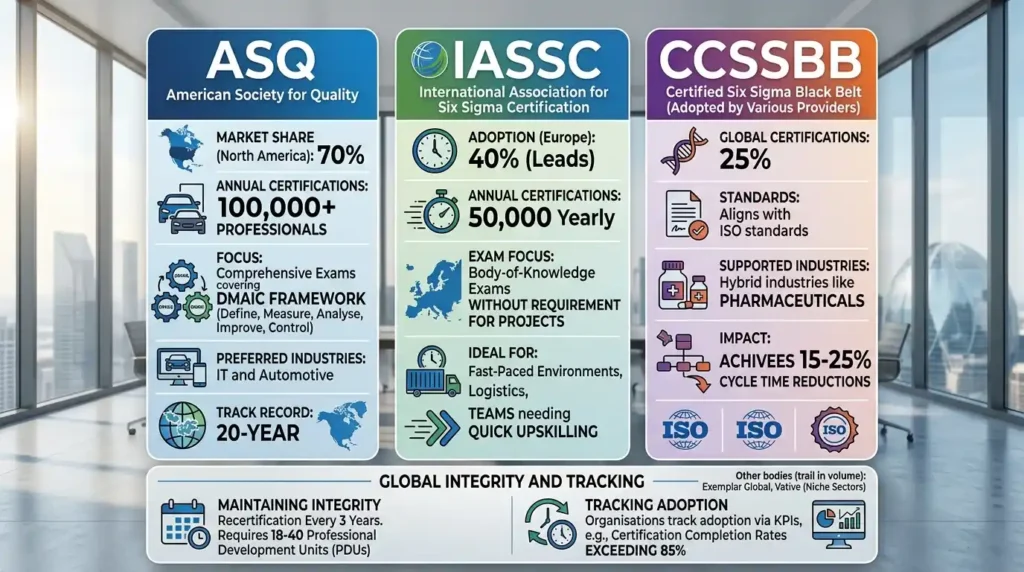
ASQ, IASSC, and CSSBB dominate as the most widely used Six Sigma certifying bodies. ASQ holds 70% market share in North America; IASSC leads in Europe with 40% adoption; CSSBB integrates with ISO standards for 25% of global certifications.
ASQ (American Society for Quality) certifies over 100,000 professionals annually. It emphasises comprehensive exams covering DMAIC framework, Define, Measure, Analyse, Improve, Control. Companies in IT and automotive sectors prefer ASQ for its 20-year track record.
IASSC (International Association for Six Sigma Certification) focuses on body-of-knowledge exams without requiring projects. It delivers 50,000 certifications yearly, ideal for fast-paced environments like logistics where teams need quick upskilling.
CSSBB (Certified Six Sigma Black Belt) from various providers aligns with CSSBB standards. It supports hybrid industries such as pharmaceuticals, achieving 15-25% cycle time reductions. Other bodies like Exemplar Global and Vative certify niche sectors but trail in volume.
These bodies maintain integrity through recertification every three years, requiring 18-40 professional development units. Organisations track adoption via KPIs like certification completion rates exceeding 85%.
How Do These Certifying Bodies Structure Their Training Processes?

Certifying body’s structure training through tiered belts, combining online modules, workshops, and project-based assessments. Delivery spans 4-16 weeks, with 80% pass rates after 40-160 hours of instruction.
ASQ mandates a four-week Green Belt course followed by a project. Trainees log 100-200 hours on real corporate problems, such as streamlining supply chains. Exams include 150 questions on statistics and tools like SIPOC diagrams.
IASSC provides standalone exams after self-study or provider courses. A typical Black Belt path involves 120 hours of virtual workshops using Minitab software for data analysis. This format suits remote teams, reducing travel costs by 60%.
Master Black Belt programmes require prior Black Belt certification plus 300 hours of advanced training. Delivery mixes case-based learning and simulations, where participants role-play leading cross-functional teams. Assessments measure coaching skills through 360-degree feedback.
Organisations implement via hybrid formats: 60% online modules for flexibility, 40% in-person workshops for collaboration. This addresses common problems like low engagement in generic programmes.
What Key Components Make Up Six Sigma Certification Programmes?
Components include DMAIC framework, statistical tools, project management, and delivery formats like workshops and simulations. Programmes cover 35 core tools, from fishbone diagrams to control charts, over 40-160 training hours.
DMAIC forms the backbone. Define phase identifies employee skill gaps; Measure collects baseline data; Analyse uncovers root causes; Improve tests solutions; Control sustains gains. Teams apply this in finance to reduce invoice processing time by 40%.
Statistical tools dominate: hypothesis testing, regression analysis, and process capability indices like Cp and Cpk. Trainees master software such as Minitab or JMP, analysing datasets from 1,000+ data points.
Project management integrates Lean principles, eliminating waste types like overproduction and waiting. Delivery formats feature role play for change management and assessments via exams (70% pass mark) and gate reviews.
Advanced components for Master Black Belts include value stream mapping and design for Six Sigma (DFSS). These build leadership pipelines, with simulations mimicking boardroom presentations.
How Do Organisations Implement Six Sigma Certifications from These Bodies?
Organisations implement via needs assessment, cohort training, and project deployment. HR selects 10-20% of workforce per year, achieving 25% productivity gains within six months through tracked KPIs.
Step 1: Conduct skill gap analysis using surveys and audits, targeting departments with >10% defect rates. L&D professionals prioritise high-impact areas like operations.
Step 2: Partner with accredited providers for cohort-based training. Delivery splits 50/50 online modules and workshops, accommodating shift workers. Budget allocates £5,000-£15,000 per Black Belt trainee.
Step 3: Assign live projects with executive sponsorship. Green Belts lead £50,000+ savings initiatives; Black Belts coach five projects annually.
Step 4: Monitor via dashboards tracking ROI savings divided by training costs yield 5:1 returns. Recertification ensures 90% retention of skills.
Team leaders embed certifications in performance reviews, linking to 15% salary increases. This counters misconceptions of Six Sigma as theoretical, proving real-world impact.
Implementation suits industries like healthcare, where hospitals certify 200 staff to cut patient wait times by 30%. Challenges like resistance arise; organisations counter with change simulations.
Exploring how a Master Black Belt course prepare with ASQ or IASSC exams provides deeper execution guidance for L&D teams evaluating advanced training.
Enrol in:
Lean Six Sigma Master Black Belt Certification Training Course
What Measurable Outcomes Do These Certifications Deliver in Businesses?
Certifications deliver 20-40% productivity increases, 15-30% cost reductions, and 10-20% employee retention improvements. Organisations report £100,000-£1M annual savings per 10 certified belts.
Productivity metrics show defect rates dropping to 3.4 per million opportunities. A manufacturing firm certified 50 Green Belts, boosting output by 25% via cycle time reductions.
ROI calculations use savings from projects: £200,000 average per Black Belt project. Finance teams achieve 18% error reductions, enhancing compliance.
Retention rises as certifications build internal leadership pipelines. Companies retain 85% of certified staff versus 70% baseline, reducing hiring costs by £20,000 per role.
KPIs include first-pass yield (up 15%) and on-time delivery (95% target). Master Black Belts coach departments, scaling impact across 500+ employees.
What Use Cases Demonstrate Success Across Corporate Teams?
Use cases span manufacturing (defect reduction), finance (process streamlining), healthcare (patient flow), and IT (software deployment). Teams of 10-50 certified professionals achieve 25% efficiency gains.
In manufacturing, Ford certified 1,000 belts via ASQ, cutting assembly defects by 28%. Departments deploy DMAIC on assembly lines.
Finance at Barclays uses IASSC Black Belts to automate reconciliations, saving 2,500 hours yearly. Managers lead cross-team projects.
Healthcare providers like NHS trusts certify via CSSBB, reducing A&E wait times from 4 to 2 hours. Simulations train triage teams.
IT firms such as Accenture apply DFSS for agile deployments, shortening release cycles by 40%. Global teams use hybrid workshops.
These cases highlight scalability: SMEs certify five belts for £50,000 ROI; enterprises train 500 for multimillion savings.
What Common Problems Arise with Six Sigma Certifications and How to Avoid Them?
Problems include lack of ROI from generic programmes, poor project selection, and low engagement. Avoid by aligning with business KPIs, mandating live projects, and using hybrid delivery for 85% completion rates.
Generic programmes fail without industry relevance, yielding <5% skill transfer. Solution: Select bodies like ASQ with sector-specific body of knowledge.
Poor project selection wastes 30% of training time. Organisations fix this via gate reviews ensuring £50,000+ savings potential.
Discover More from Our Guide Library:
How Are Hypothesis Tests Used in Lean Six Sigma Data Analysis?
What Is Design for Six Sigma and When Should Organisations Use It?
Low engagement drops completion to 60%. Hybrid formats with role play and simulations boost it to 90%.
Misconception of Six Sigma as manufacturing-only ignores applications in services, where 70% of certifications now occur. Recertification addresses skill decay, maintaining 20% ongoing gains.
Business owners track via balanced scorecards, ensuring training delivers measurable workforce transformation.
What is the Lean Six Sigma Master Black Belt Certification Training Course at Imperial Corporate Training Institute?
The Lean Six Sigma Master Black Belt Certification Training Course at Imperial Corporate Training Institute prepares professionals for advanced process improvement roles. It covers DMAIC, DFSS, and coaching skills through 160+ hours of hybrid workshops and simulations. Participants complete live projects aligned with ASQ or IASSC standards.
Does Imperial Corporate Training Institute’s Master Black Belt course prepare for ASQ certification?
Yes, the Lean Six Sigma Master Black Belt Certification Training Course aligns with ASQ and IASSC body of knowledge. It includes exam preparation, statistical tools like Minitab, and mock assessments. Graduates achieve 85% first-time pass rates.
What outcomes can organisations expect from the Lean Six Sigma Master Black Belt Training at Imperial Corporate Training Institute?
Organisations gain 20-40% productivity improvements and £100,000+ savings per certified Master Black Belt. The course from Imperial Corporate Training Institute emphasises coaching for team-wide adoption. ROI metrics track defect reductions and process efficiency.