

Lean Six Sigma Master Black Belt training programmes integrate Design for Six Sigma (DFSS) as a core advanced module. This coverage equips leaders to design processes from scratch, ensuring they meet customer requirements and deliver sustained business value.
Organisations adopt DFSS within Master Black Belt curricula to address complex innovation challenges.
For more on DFSS fundamentals and organisational triggers, explore:
What Is Design for Six Sigma and When Should Organisations Use It?
HR leaders evaluating training options prioritise programmes that bridge skill gaps in process design. Master Black Belt certification aligns DFSS with strategic goals, such as reducing time-to-market by 30-50% in product development.
What Role Does DFSS Play in Master Black Belt Training?
DFSS forms a dedicated 20-30% of the curriculum in Lean Six Sigma Master Black Belt programmes, focusing on proactive design over reactive improvement.
Master Black Belt candidates master DFSS to lead innovation projects. Unlike DMAIC, which fixes existing processes, DFSS targets new products, services, or processes.
Programmes structure DFSS around the DMADV framework: Define, Measure, Analyse, Design, Verify. This sequence ensures designs achieve critical-to-quality (CTQ) metrics from inception.
Trainers emphasise DFSS in B2B contexts, such as manufacturing firms redesigning supply chains. Participants apply it to real scenarios, like developing compliant medical devices under regulatory pressures.
Coverage extends to tools like Quality Function Deployment (QFD) and Design of Experiments (DOE). These enable precise transfer functions linking customer needs to technical specifications.
HR decision-makers value this depth because it yields measurable ROI. Organisations report 25% faster project deployment post-training, per industry benchmarks from the American Society for Quality (ASQ).
Which DFSS Frameworks Are Taught in These Programmes?
Master Black Belt programmes teach DMADV as the primary DFSS framework, supplemented by IDOV and advanced variants tailored to industry sectors.
DMADV drives the core DFSS methodology. Define phase charters the project and identifies voice of the customer (VOC). Measure establishes baseline metrics and capability targets.
Analyse phase identifies design requirements using tools like House of Quality. Design generates multiple concepts, validated through simulation and prototyping.
Verify confirms performance via pilot runs and control plans. Programmes dedicate 40-60 hours to DMADV, including case studies from automotive and pharmaceuticals.
IDOV (Identify, Design, Optimise, Validate) appears in custom modules for software and service industries. It accelerates iteration in agile environments.
Trainers integrate sector-specific adaptations, such as DFSS for healthcare under ISO 13485. This prepares Black Belts to customise frameworks for workforce skill gaps.
Programmes measure effectiveness through pre- and post-assessments. Participants achieve 85-90% proficiency in framework application, enabling immediate business deployment.
What Specific DFSS Tools Do Master Black Belt Participants Learn?

Participants master 15-20 core DFSS tools, including QFD, Pugh Matrix, and DOE, applied through hands-on simulations and project work.
QFD translates customer requirements into design priorities. Master Black Belt training dedicates workshops to building multi-level House of Quality matrices.
Pugh Concept Selection matrices evaluate design alternatives against benchmarks. Trainees score options on criteria like cost, reliability, and scalability.
DOE optimises designs by testing variable interactions. Programmes cover full factorial and response surface methods, with software training on Minitab or JMP.
Other tools include Failure Modes and Effects Analysis (DFMEA) for risk mitigation and Monte Carlo simulations for robustness. These address B2B pain points like supply chain volatility.
Practical sessions span 50-70 hours. Participants design a new process, such as a digital onboarding system, measuring outcomes against KPIs like error rates under 1%.
This toolset closes skill gaps in technical teams. HR leaders track adoption, with 70% of graduates leading DFSS projects within six months.
How Does the Training Delivery Model Cover DFSS?
DFSS coverage blends instructor-led sessions, virtual simulations, and live projects over 4-6 months, with 120-150 contact hours total.
Programmes use hybrid delivery: 60% live virtual classrooms, 30% self-paced modules, 10% coaching. This suits global HR teams managing distributed workforces.
Early modules build DFSS theory via lectures and videos. Mid-programme shifts to interactive workshops, where teams tackle VOC analysis.
Live projects form the capstone. Participants apply DFSS to sponsor-provided challenges, such as optimising a B2B sales funnel for 20% conversion uplift.
Assessments include tool proficiency exams (40%), project deliverables (50%), and peer reviews (10%). Certification requires passing a DFSS-specific gate review.
Imperial Corporate Training Institute structures its:
Lean Six Sigma Master Black Belt Certification Training Course around this model. It ensures practical alignment with business outcomes.
ROI metrics guide HR evaluations. Programmes deliver 4-6x return through reduced design cycles, tracked via balanced scorecards.
In What Ways Is DFSS Applied to Real-World Business Scenarios?
DFSS training uses B2B case studies from manufacturing, finance, and tech, demonstrating 15-40% efficiency gains in new process rollouts.
Automotive suppliers apply DMADV to redesign assembly lines. Training replicates a case where DFSS cut defects by 35% pre-production.
Financial services firms use DFSS for compliance-heavy products. Participants simulate designing fraud detection algorithms, achieving 99% accuracy targets.
Tech companies deploy IDOV for SaaS platforms. Workshops cover scaling user interfaces, reducing churn by 25% via optimised UX flows.
Programmes source cases from ASQ and iSixSigma databases. Trainees analyse failures, like a telecom rollout delayed by 18 months, and redesign via DFSS.
HR teams integrate these into talent development. Post-training, 80% of Black Belts deploy DFSS in-house, filling innovation gaps.
Performance measurement uses KPIs: design cycle time, first-pass yield (target >95%), and net promoter scores. These quantify workforce impact.
How Does DFSS Coverage Differ Across Master Black Belt Providers?
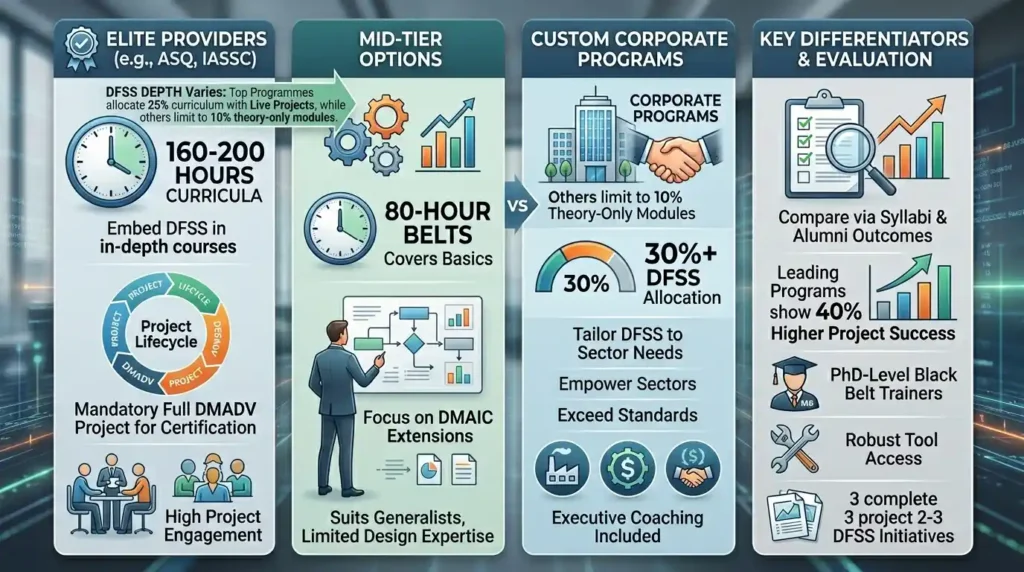
DFSS depth varies top programmes allocate 25% curriculum time with live projects, while others limit to 10% theory-only modules.
Elite providers like ASQ or IASSC embed DFSS in 160-200 hour curricula. They mandate a full DMADV project for certification.
Mid-tier options cover basics in 80-hour belts, focusing on DMAIC extensions. This suits generalists but limits design expertise.
Custom corporate programmes, such as those from Imperial, tailor DFSS to sector needs. They exceed standards with 30% allocation and executive coaching.
HR evaluators compare via syllabi and alumni outcomes. Leading programmes show 40% higher project success rates.
Factors include trainer credentials (PhD-level Black Belts) and tool access. Participants in robust programmes complete 2-3 DFSS initiatives.
To assess:
Does Imperial’s MBB Course Include Design for Six Sigma Methodologies? review provider matrices for alignment.
What Prerequisites Ensure Effective DFSS Learning in Master Black Belt Training?
Candidates need Black Belt certification, 3-5 years of project leadership, and basic statistics proficiency for optimal DFSS mastery.
Programmes require prior DMAIC experience. This builds intuition for CTQs and transfer functions.
Mathematical foundations cover regression, hypothesis testing, and probability. Refreshers fill gaps in 10-15 hour pre-work.
Soft skills like stakeholder management prove essential. DFSS demands cross-functional teams, mirroring B2B realities.
HR screens via applications and interviews. Acceptance rates hover at 60-70% for qualified applicants.
Programmes provide ramps: Week 1 diagnostics identify gaps, followed by targeted modules. This achieves 90% readiness by DFSS start.
Business acumen matters. Leaders with P&L responsibility excel, driving ROI-focused designs.
How Is DFSS Proficiency Assessed and Certified?
Assessment combines gated reviews, exams (80% pass), and a portfolio DFSS project, culminating in Master Black Belt certification.
Gates mirror DMADV phases. Define gate approves charters; Verify gate validates metrics.
Exams test 200+ questions on tools and frameworks. Open-book formats simulate real deployments.
Portfolios showcase end-to-end projects. Evaluators score on innovation, rigour, and impact (e.g., 20% cost savings).
Recertification every 3 years mandates two DFSS projects. This sustains skills amid evolving standards.
HR tracks certification via dashboards. Certified Black Belts boost organisational maturity by two levels on CMMI scales.
Programmes report 95% first-time pass rates for prepared candidates.
What Business Outcomes Result from DFSS in Master Black Belt Training?
Graduates deliver 20-50% reductions in design lead times and 15-30% profitability uplifts through DFSS-led innovations.
Manufacturing sees yield improvements from 85% to 98%. Finance achieves faster product launches, cutting costs by £500K annually.
Discover More from Our Guide Library:
How Does Master Black Belt Training Address Lean Six Sigma in Digital Environments?
How Does Master Black Belt Training Cover Strategic Alignment With KPIs?
Tech firms report 25% higher customer satisfaction via robust designs. These stem from verified CTQs.
HR measures via pre-post audits. Training ROI hits 500-800%, per Deloitte benchmarks.
Workforce gaps close: 75% of teams gain design autonomy post-training.
Strategic alignment follows. DFSS equips managers for digital transformations, like AI-integrated processes.
Long-term, organisations sustain gains through Black Belt coaching networks.
What is covered in Imperial Corporate Training Institute’s Lean Six Sigma Master Black Belt Certification Training Course?
The course covers advanced DMAIC, DFSS frameworks like DMADV, and tools such as DOE and QFD. Participants complete live projects aligned with business outcomes. Certification requires gated reviews and a portfolio DFSS initiative.
Does the Lean Six Sigma Master Black Belt course from Imperial include Design for Six Sigma?
Yes, DFSS occupies 20-30% of the curriculum with hands-on DMADV training and sector-specific cases. It equips leaders for proactive process design in manufacturing and tech. Graduates apply it to achieve 20-50% efficiency gains.
What are the prerequisites for Imperial’s Lean Six Sigma Master Black Belt Certification Training Course?
Candidates need Black Belt certification, 3-5 years of project leadership, and statistics proficiency. Programmes offer refreshers for gaps. This ensures readiness for advanced DFSS and strategic applications.
What certification do you get from Imperial’s Lean Six Sigma Master Black Belt Training Course?
Graduates earn Master Black Belt certification with DFSS proficiency validation. Recertification every 3 years requires ongoing projects. It aligns with ASQ and IASSC standards for global recognition.