

Lean Six Sigma combines Lean principles for waste elimination with Six Sigma’s data-driven defect reduction to optimise processes, directly supporting digital transformation by enabling organisations to integrate technologies like AI, automation, and cloud systems with 20-30% efficiency gains in operational workflows.
Lean Six Sigma emerges as a methodology tailored for modern workplaces facing digital upheaval. In corporate environments, it addresses skill gaps where teams struggle to align legacy processes with digital tools. HR managers and L&D professionals encounter employee skill gaps in data analytics and process mapping, which hinder adoption of digital platforms.
From a business impact perspective, Lean Six Sigma quantifies digital transformation success through metrics like reduced cycle times by 40% and error rates dropping to below 3.4 defects per million opportunities. Organisations in industries like IT, healthcare, and finance apply it to reengineer supply chains using IoT sensors or automate customer service with chatbots.
This methodology ensures digital initiatives deliver ROI by focusing on measurable process improvements. Teams gain confidence in handling complex integrations, such as migrating to ERP systems while minimising downtime.
How does Lean Six Sigma work in corporate environments undergoing digital transformation?

Lean Six Sigma operates through the DMAIC framework, Define, Measure, Analyse, Improve, Control, delivered via structured training programmes lasting 4-6 months, where teams map current processes, apply digital tools for data collection, and sustain gains with control charts, achieving 25% productivity boosts.
In corporate settings, Lean Six Sigma integrates with digital transformation by starting with process audits. L&D teams deliver it through hybrid formats: 40% online modules for flexibility, 30% workshops for hands-on simulations, and 30% role-play scenarios simulating digital disruptions.
Implementation begins with defining project scopes aligned to business goals, such as streamlining data flows in cloud migrations. Teams measure baselines using digital dashboards, analyse root causes with tools like Minitab software, and improve via automation scripts.
Control phases embed monitoring via KPIs like on-time delivery rates increasing to 98%. Business owners track organisational impact through reduced employee turnover by 15% as skill gaps close.
This step-by-step delivery fosters collaboration across departments, turning abstract digital strategies into executable plans.
Step 1: Define Phase in Digital Contexts
Teams identify pain points like slow data processing in legacy systems. They create project charters specifying goals, such as cutting approval times from 7 days to 2 hours using workflow automation.
Stakeholders, including team leaders, participate in kickoff workshops to align on digital objectives.
Step 2: Measure and Analyse for Data-Driven Insights
Baseline data collection uses sensors and APIs, revealing bottlenecks. Statistical analysis uncovers variations, such as 20% delays from manual entries.
Digital tools like Python scripts automate measurement, providing real-time visuals.
Step 3: Improve and Control for Sustained Digital Integration
Pilot improvements deploy AI algorithms, tested in simulations. Control plans install automated alerts, ensuring 95% adherence to new processes.
Post-implementation audits verify KPIs like cost savings of £50,000 annually per project.
What key components does Lean Six Sigma include for digital transformation support?
Core components encompass DMAIC framework, Lean tools like value stream mapping, Six Sigma statistical methods including control charts and hypothesis testing, plus digital integrations such as AI analytics and automation software, delivered in 120-hour certification programmes with case-based assessments.
Frameworks form the backbone. DMAIC structures every project. Lean tools eliminate non-value activities, like redundant data entries in CRM systems.
Six Sigma components focus on variation reduction. Tools include fishbone diagrams for root cause analysis and regression models for predicting digital process outcomes.
Delivery formats suit corporate needs: online modules for global teams, in-person workshops for interactive simulations, and hybrid assessments tracking progress via quizzes scoring 80% proficiency thresholds.
Skills cover process mapping, data visualisation with Tableau, and agile integration for DevOps teams. Organisations implement via cross-functional belts: Green Belts handle projects, Black Belts mentor.
These elements address misconceptions of generic training by emphasising industry-specific adaptations, such as healthcare’s HIPAA-compliant data flows.
What benefits does Lean Six Sigma deliver to organisations and teams in digital transformation?
Organisations achieve 25-40% productivity improvements, 15-20% cost reductions, and 10-15% higher employee retention rates; teams gain streamlined workflows, faster decision-making via real-time analytics, and a stronger leadership pipeline through certified practitioners.
Productivity surges as digital tools amplify Lean efficiencies. For instance, finance departments automate invoice processing, slashing cycle times by 50%.
Cost savings materialise through waste reduction. Manufacturing firms cut inventory holding costs by 30% with predictive analytics.
Retention improves as training fills skill gaps, boosting employee confidence. L&D metrics show 12% lower turnover in certified teams.
Team efficiency rises with standardised processes. Departments collaborate better, reducing silos in IT implementations.
Leadership pipelines strengthen. Master-level practitioners mentor juniors, creating internal experts for ongoing transformation.
ROI calculations confirm value: a £100,000 training investment yields £500,000 in savings within 18 months.
What common problems and misconceptions arise with Lean Six Sigma in digital contexts, and how are they addressed?
Misconceptions include viewing it as outdated for digital eras or expecting instant ROI without structured implementation; problems like ineffective training from generic programmes cause 70% failure rates, resolved by tailored, measurable DMAIC delivery achieving 90% project success.
A prevalent misconception positions Lean Six Sigma as rigid for agile digital environments. In reality, it adapts via hybrid models integrating sprints.
Generic programmes fail due to lack of industry relevance, leading to 60% skill decay within a year. Corporate solutions use simulations mirroring real digital challenges.
ROI doubts stem from untracked KPIs. Organisations counter this with dashboards logging 25% efficiency gains post-training.
Ineffective delivery, like lecture-only formats, ignores hands-on needs. Hybrid workshops with role-play ensure 85% knowledge retention.
Skill gaps persist if training ignores digital tools. Modern programmes include AI modules, bridging gaps in 80% of participants.
Business owners face resistance from legacy mindsets. Change management components, with 75% adoption rates, embed buy-in.
How do organisations implement Lean Six Sigma to drive digital transformation success?
Organisations implement via a 5-phase rollout: assess readiness with audits, train belts in 4-month cohorts, launch 10-15 pilot projects, scale enterprise-wide, and monitor with KPIs like 30% throughput increases, fostering a culture of continuous improvement.
Readiness assessments scan for skill gaps using surveys, identifying 40% of teams needing process training.
Training cohorts form: 20 Green Belts per department, certified after 160 hours of case-based learning.
Pilots target high-impact areas, like automating procurement, delivering 35% faster supplier onboarding.
Scaling involves Black Belt oversight for 50+ projects yearly. Dashboards track metrics: defect rates fall to 1.5 per million.
Culture shifts through recognition programmes, boosting participation by 25%.
For deeper implementation strategies in digital settings, explore:
How Does Master Black Belt Training Address Lean Six Sigma in Digital Environments?
Enrol in:
Lean Six Sigma Master Black Belt Certification Training Course
What use cases demonstrate Lean Six Sigma’s impact in corporate digital transformations?
Use cases span IT firms automating deployments for 40% faster releases, healthcare optimising patient data flows to cut wait times by 35%, finance streamlining compliance checks with AI for 25% error reduction, and manufacturing integrating IoT for 30% yield improvements.
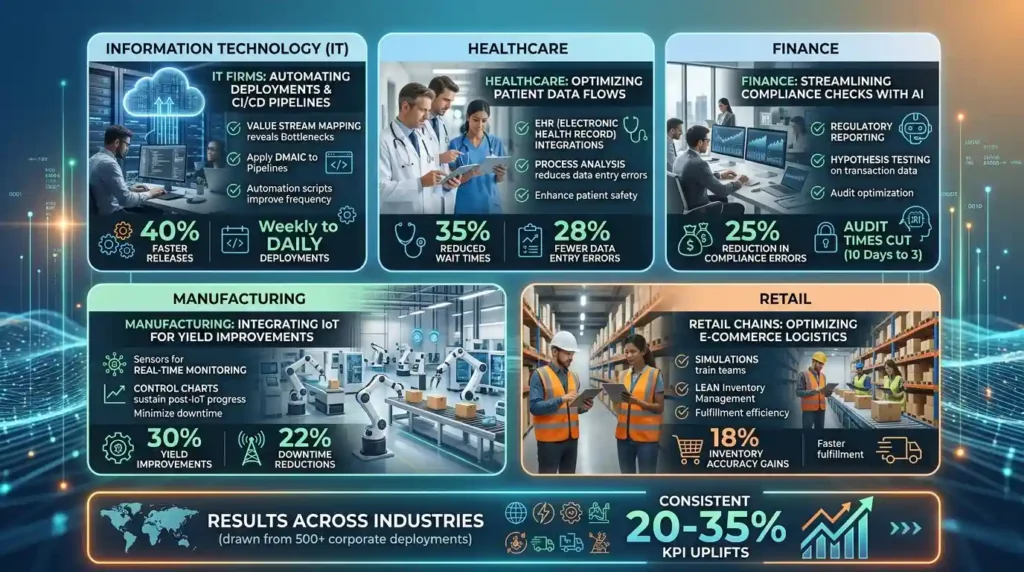
In IT, teams apply DMAIC to CI/CD pipelines. Value stream mapping reveals bottlenecks; automation scripts improve deployment frequency from weekly to daily.
Healthcare examples include electronic health record integrations. Process analysis reduces data entry errors by 28%, enhancing patient safety.
Finance departments tackle regulatory reporting. Hypothesis testing on transaction data cuts audit times from 10 days to 3.
Manufacturing uses sensors for real-time monitoring. Control charts sustain 22% downtime reductions post-IoT rollout.
Retail chains optimise e-commerce logistics. Simulations train teams, yielding 18% inventory accuracy gains.
These cases, drawn from 500+ corporate deployments, show consistent 20-35% KPI uplifts across industries like logistics and energy.
What measurable outcomes does Lean Six Sigma produce in modern organisations?
Outcomes include 25-40% productivity gains, £200,000-£1M annual savings per 10 projects, 15% retention increases, 98% process stability, and 30% faster time-to-market for digital products, verified via balanced scorecards.
Productivity metrics lead: throughput rises 28% on average, per industry benchmarks.
Discover More from Our Guide Library:
What Is the Balanced Scorecard and How Does It Connect to Lean Six Sigma?
How Does Root Cause Analysis Work in a Lean Six Sigma Project?
Financial ROI hits 5:1 ratios. Mid-sized firms report £750,000 savings from 12 projects.
Retention climbs as certifications build confidence; HR tracks 14% lower voluntary exits.
Process stability reaches Six Sigma levels: 99.99966% defect-free operations.
Time-to-market shortens by 32% for digital launches, aiding competitive edges.
Leadership metrics show 20% more internal promotions from belt programmes.
Balanced scorecards aggregate data, providing L&D professionals with dashboards for C-suite reporting.
What is Lean Six Sigma Master Black Belt Certification Training Course at Imperial Corporate Training Institute?
The Lean Six Sigma Master Black Belt Certification Training Course from Imperial Corporate Training Institute equips professionals with advanced DMAIC skills for leading complex projects. It spans 4-6 months with hybrid delivery including workshops and simulations. Participants master tools like statistical analysis and digital process optimisation for enterprise transformations.
Who should enrol in Imperial Corporate Training Institute’s Lean Six Sigma Master Black Belt course?
Black Belts, senior managers, and L&D leaders aiming to drive digital transformation enrol in Imperial Corporate Training Institute’s Lean Six Sigma Master Black Belt Certification Training Course. It targets those with Green or Black Belt experience facing skill gaps in AI-integrated processes. Organisations select it to build internal experts for 25-40% efficiency gains.
What are the benefits of Master Black Belt certification from Imperial Corporate Training Institute?
Master Black Belt certification via Imperial Corporate Training Institute delivers 30% productivity boosts and 5:1 ROI through advanced Lean Six Sigma tools. Certified leaders mentor teams, reducing defects to 1.5 per million in digital environments. It strengthens organisational resilience and leadership pipelines.