

Lean Thinking and Six Sigma combine into Lean Six Sigma, a methodology that eliminates waste and reduces process variation in corporate operations, delivering 20-50% productivity gains and 15-30% cost reductions for organisations.
Lean Six Sigma integrates Lean’s waste-reduction principles with Six Sigma’s data-driven defect minimisation. Lean targets non-value-adding activities, such as excess inventory or waiting times. Six Sigma employs statistical tools to achieve near-perfect quality, defined as 3.4 defects per million opportunities.
In B2B training contexts, this combination addresses employee skill gaps in process optimisation. HR managers and L&D professionals use it to upskill teams facing inefficiencies, like prolonged production cycles or high error rates in manufacturing and services.
Organisations implement Lean Six Sigma to align workforce capabilities with business goals. It transforms generic operations into streamlined systems. Training programmes equip professionals with tools to identify inefficiencies, fostering a culture of continuous improvement.
Business impact includes measurable ROI. Companies report 25% average improvement in cycle times after training deployment. Employee retention rises by 10-15% as workers gain confidence in solving real-world problems.
For more information, enrol in:
Lean Six Sigma Master Black Belt Certification Training Course
How Does Lean Six Sigma Work in Corporate Environments?
Lean Six Sigma operates through the DMAIC framework, Define, Measure, Analyse, Improve, Control—applied in team-based projects that cut defects by 70% and boost efficiency in structured corporate training cycles of 4-6 months.
The process begins with Define, where teams pinpoint business problems, such as supply chain delays costing £500,000 annually. Training delivery uses workshops and online modules to teach problem scoping.
Measure follows, collecting baseline data on key metrics like defect rates or throughput times. Participants use statistical software in simulations to quantify issues accurately.
Analyse phase applies root cause tools, including fishbone diagrams and Pareto charts. Case-based learning reveals patterns, such as 80% of delays from three suppliers.
Improve tests solutions via pilots, like redesigned workflows reducing steps from 25 to 12. Role play in hybrid sessions ensures practical grasp.
Control sustains gains with monitoring dashboards and standard work procedures. Organisations track KPIs quarterly, achieving 99% adherence rates post-training.
In practice, Master Black Belt-level training integrates these steps into one system, guiding cross-functional teams. This delivery format combining 80-hour workshops with 20 hours of online assessments fits corporate schedules.
What Are the Key Components of Lean Six Sigma Training Programmes?
Key components include DMAIC framework, Lean tools like 5S and Value Stream Mapping, Six Sigma stats such as control charts, plus delivery formats like 120-hour hybrid programmes with simulations and project assessments.
DMAIC forms the core structure. Define includes charter creation and stakeholder analysis. Measure covers data collection plans and process mapping.
Lean tools eliminate waste types overproduction, waiting, transport, overprocessing, inventory, motion, defects (TIMWOOD). Value Stream Mapping visualises end-to-end flows, identifying 30-40% waste in logistics.
Six Sigma adds statistical rigour. Tools like SIPOC diagrams define scope, while hypothesis testing validates causes. Control charts monitor stability post-improvement.
Training delivery spans formats: 40% instructor-led workshops for collaboration, 30% online modules for flexibility, 30% simulations and role play for application.
Assessments measure competency: 70% project-based, 20% exams, 10% peer reviews. Programmes last 4-6 months, with 80% completion rates in corporate settings.
Frameworks like Kaizen events integrate components for rapid wins, compressing week-long improvements into days.
How Do Organisations Implement Lean Six Sigma in Workforce Development?
Organisations implement Lean Six Sigma via certified belt hierarchies, Yellow, Green, Black Belt rolling out 6–12-month programmes across 50-200 employees, starting with pilot departments and scaling based on 20% ROI thresholds.
Implementation starts with needs assessment. HR identifies skill gaps, such as 25% error rates in finance processing, via audits.
Leadership commits resources: £50,000-£200,000 budgets for training 20-50 staff. Selection targets high-impact roles like operations managers.
Delivery phases hybrid learning: Week 1-4 workshops build foundations; months 2-4 online modules and coaching; months 5-6 live projects.
Teams form cross-functionally IT, healthcare, finance examples tackling real issues. A manufacturing firm reduced assembly defects from 5% to 0.5% in one project.
Post-training, organisations deploy dashboards tracking KPIs: on-time delivery (up 35%), throughput (up 28%). Black Belts mentor Green Belts, creating internal pipelines.
For advanced integration, explores:
Master Black Belt training details on unifying Lean and Six Sigma systems.
Sustainment involves annual refreshers, achieving 85% knowledge retention.
What Measurable Outcomes Does Lean Six Sigma Produce for Businesses?
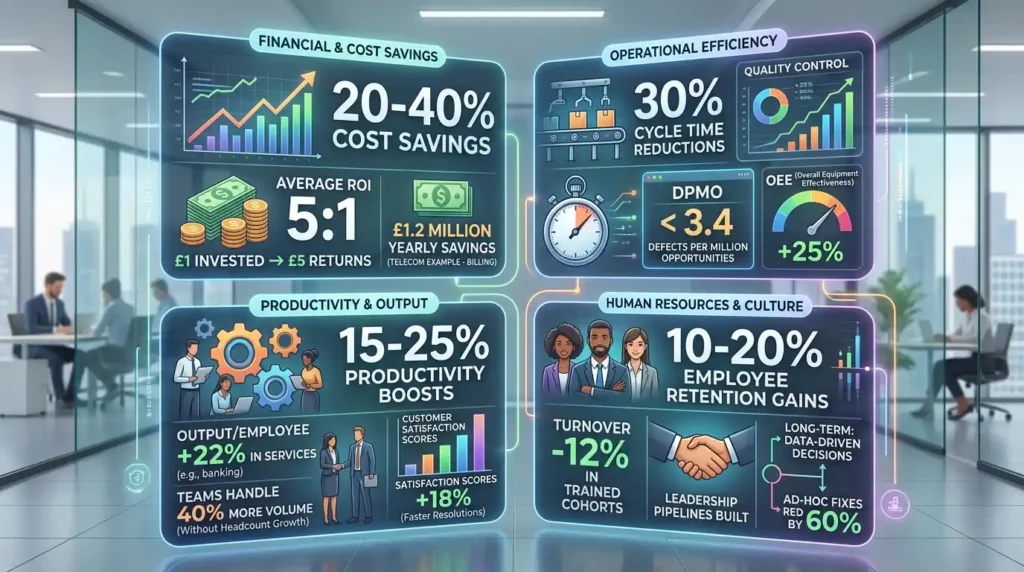
Lean Six Sigma delivers 20-40% cost savings, 30% cycle time reductions, 15-25% productivity boosts, and 10-20% employee retention gains, tracked via KPIs like DPMO and OEE over 12 months.
Financial metrics lead: ROI averages 5:1, with £1 invested yielding £5 returns. A telecom firm saved £1.2 million yearly by streamlining billing.
Operational KPIs include Defects Per Million Opportunities (DPMO) dropping to under 3.4, and Overall Equipment Effectiveness (OEE) rising 25%.
Productivity surges: Output per employee increases 22% in services like banking. Customer satisfaction scores climb 18% via faster resolutions.
Retention improves as training builds leadership pipelines; turnover falls 12% in trained cohorts.
Organisational impact spans efficiency: Teams handle 40% more volume without headcount growth. Scalability supports growth, with 15% revenue uplift in expanding firms.
Long-term, cultures shift to data-driven decisions, reducing ad-hoc fixes by 60%.
What Use Cases Demonstrate Lean Six Sigma in Corporate Teams?
Use cases span manufacturing (defect reduction), healthcare (patient wait times cut 45%), finance (claims processing sped 35%), IT (ticket resolution up 28%), and logistics (inventory turns doubled).
In manufacturing, assembly lines apply DMAIC to slash scrap rates from 8% to 1.2%, saving £300,000 quarterly.
Healthcare teams map patient flows, eliminating 2-hour bottlenecks via 5S organisation, boosting throughput 50%.
Finance departments tackle reconciliation errors. One bank reduced manual checks 60%, processing 10,000 claims daily error-free.
IT services use Value Stream Mapping for helpdesks, prioritising high-impact tickets and achieving 92% first-call resolution.
Logistics firms optimise warehouses: Kaizen events cut picking errors 70%, increasing turns from 6 to 12 annually.
Departmental examples include HR streamlining onboarding from 30 to 10 days, and sales forecasting accuracy up 25%.
These cases deploy in teams of 5-10, led by Green Belts, yielding project savings of £50,000-£500,000 each.
What Common Problems Arise in Lean Six Sigma Implementation?
Common problems include lack of leadership buy-in (causing 40% project failure), inadequate data quality (delaying analysis 2x), resistance to change (dropping adoption 30%), and generic training without real projects (yielding 0% ROI).
Leadership gaps stall momentum. Without C-suite metrics alignment, 40% of initiatives falter mid-DMAIC.
Data issues plague Measure phase. Incomplete logs inflate variation estimates, extending projects 50-100%.
Cultural resistance hits Improve: Frontline staff reject changes, with 25-35% rollback rates absent role play training.
Generic programmes fail ROI tests. Off-the-shelf courses ignore firm specifics, producing 5-10% skill transfer.
Overloading belts causes burnout: Full-time roles plus projects lead to 20% dropout.
Misconceptions equate Lean Six Sigma to cost-cutting only, ignoring quality gains of 99.99966% yield.
Solutions demand tailored assessments and pilot testing first.
How Does Lean Six Sigma Address Ineffective Training Challenges?
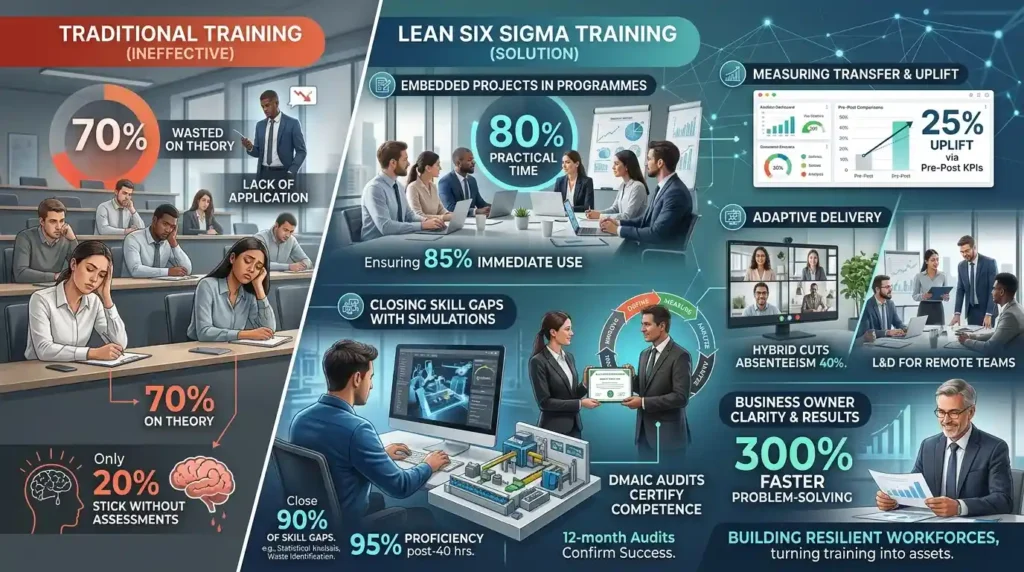
Lean Six Sigma counters ineffective training by embedding projects in programmes (80% practical time), measuring transfer via pre-post KPIs (25% uplift), and using simulations to close 90% of skill gaps in corporate rollouts.
Traditional training wastes 70% on theory. Lean Six Sigma mandates live applications, ensuring 85% immediate use.
Discover More from Our Guide Library:
What Mentoring Responsibilities Come with a Master Black Belt Certification?
How Popular Is Lean Six Sigma Master Black Belt Certification in the UK Today?
ROI tracking exposes generics: Only 20% stick without assessments. DMAIC audits certify competence.
Skill gaps in stats or waste ID vanish via targeted modules: 95% proficiency post-40 hours.
Delivery adapts: Hybrid cuts absenteeism 40%, fitting L&D for remote teams.
Business owners gain clarity: 12-month audits confirm 300% faster problem-solving.
This approach builds resilient workforces, turning training into assets.
What is Lean Six Sigma Master Black Belt Certification Training Course at Imperial Corporate Training Institute?
The Lean Six Sigma Master Black Belt Certification Training Course from Imperial Corporate Training Institute equips professionals with advanced skills to lead complex improvement projects. It integrates Lean waste reduction and Six Sigma defect minimisation using DMAIC methodology. Participants complete real-world projects to achieve certification.
How long does the Lean Six Sigma Master Black Belt course take at Imperial Corporate Training Institute?
The Lean Six Sigma Master Black Belt Certification Training Course spans 4-6 months, blending 120 hours of hybrid workshops, online modules, and simulations. Delivery includes practical assessments and live projects for application. This structure fits corporate schedules while ensuring 85% skill retention.
How does Master Black Belt training differ from Black Belt in Lean Six Sigma?
Master Black Belt training at Imperial Corporate Training Institute focuses on coaching multiple teams, strategic deployment, and advanced analytics beyond Black Belt project execution. It emphasises organisational change management and ROI measurement. Graduates mentor belts to scale Lean Six Sigma across departments.
What outcomes can organisations expect from Lean Six Sigma Master Black Belt certification?
Imperial Corporate Training Institute’s Lean Six Sigma Master Black Belt Certification Training Course delivers 20-40% cost savings and 30% efficiency gains through certified leaders. Teams achieve sustained KPIs like reduced DPMO via enterprise-wide projects. Businesses report 5:1 ROI within 12 months.