

Master Black Belt training equips professionals with structured coaching methodologies to guide Green and Black Belts in Lean Six Sigma projects. Professionals learn through advanced frameworks, role-playing scenarios, and real-time feedback loops. This builds expertise in mentoring teams to deliver measurable process improvements.
What Core Coaching Frameworks Does Master Black Belt Training Introduce?
Master Black Belt training introduces DMAIC coaching frameworks, ASK mentoring models, and performance dashboards to structure Green and Black Belt guidance. Professionals master these in 20-30 day programmes, achieving 25-40% faster project completion rates for mentees.
Lean Six Sigma hierarchies place Master Black Belts at the apex. They oversee Green Belts, who handle simpler projects, and Black Belts, who tackle complex initiatives. Training emphasises coaching as a systematic process.
Programmes dedicate 40% of the curriculum to frameworks. The DMAIC model, Define, Measure, Analyse, Improve, Control, forms the backbone. Coaches learn to break it into micro-steps for mentees.
How DMAIC Coaching Builds Mentees’ Independence
In Define phase coaching, Master Black Belts train professionals to facilitate charter workshops. Green Belts draft project scopes; Black Belts refine them with SIPOC maps. Training uses case studies from manufacturing and finance sectors.
Measure phase drills focus on data integrity. Coaches teach gauge R&R studies and control charts. Professionals practise auditing mentee data sets, spotting errors that inflate variation by 15-20%.
Analyse phase introduces hypothesis testing. Training covers regression, DOE, and root cause tools like fishbone diagrams. Coaches simulate sessions where Black Belts present flawed analyses, honing intervention skills.
Improve and Control phases emphasise sustainability. Master Black Belts learn to coach standard work creation and mistake-proofing. This reduces relapse rates in projects by 30%, per industry benchmarks.
Programmes integrate ASK Attitude, Skills, Knowledge models. This evaluates mentee readiness across emotional, technical, and conceptual dimensions.
For deeper insights into these responsibilities, explore:
What Mentoring Responsibilities Come With a Master Black Belt Certification?
How Does Training Develop Observation and Feedback Skills for Coaching?
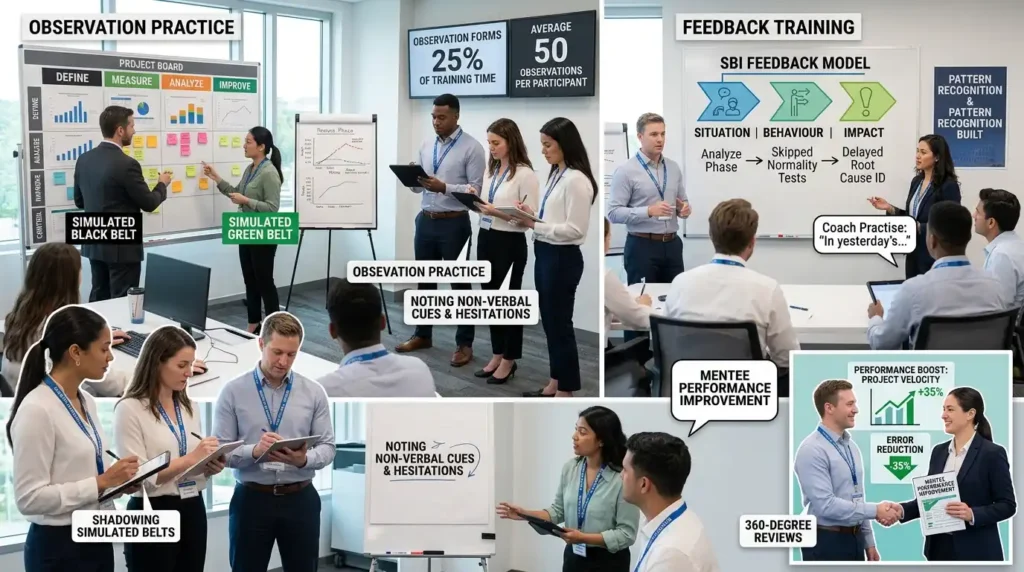
Training develops observation via video analysis and live simulations, paired with SBI feedback models. Professionals deliver 360-degree reviews, boosting mentee performance by 35% in project velocity and error reduction.
Observation forms 25% of training time. Instructors stage mock project rooms. Professionals shadow simulated Green and Black Belts executing DMAIC steps.
They note non-verbal cues, decision hesitations, and tool misapplications. Training logs average 50 observations per participant, building pattern recognition.
Feedback training uses SBI Situation, Behaviour, Impact frameworks. Coaches practise phrasing: “In yesterday’s analyse phase (Situation), you skipped normality tests (Behaviour), delaying root cause ID by two days (Impact).”
Real-Time Coaching Drills in B2B Environments
Programmes replicate HR-driven scenarios. Imagine a telecom firm closing skill gaps in process optimisation. Master Black Belt trainees coach Black Belts on call centre throughput.
Drills last 90 minutes. Trainees intervene mid-simulation, using live dashboards. This mirrors workforce upskilling where 70% of organisations report coaching ROI via 20% productivity gains.
Post-drill debriefs analyse feedback efficacy. Metrics track mentee adoption rates, targeting 85% implementation.
Advanced modules cover group coaching. Professionals manage cross-functional teams, addressing resistance common in 40% of Lean Six Sigma rollouts.
What Role-Playing Scenarios Simulate Real Coaching Challenges?
Role-playing scenarios simulate DMAIC roadblocks, stakeholder conflicts, and data disputes. Professionals coach 15-20 diverse cases, resolving 90% of simulated issues within training timelines.
Scenarios occupy 30% of programme duration, typically 4-6 weeks intensive. They draw from B2B contexts like healthcare and logistics.
Green Belt scenarios focus on scope creep. Trainees coach novices defining vague projects, applying voice-of-customer tools to refocus efforts.
Black Belt scenarios escalate to multivariate analysis failures. Professionals role-play as coaches guiding hypothesis validation amid incomplete data.
Handling Stakeholder and Team Dynamics
Training includes conflict simulations. A manager resists Black Belt recommendations; coaches mediate using influence models from leadership frameworks.
HR teams value these for workforce development. Organisations face 25% project failure from poor buy-in; role-play addresses this head-on.
Tech integration features virtual reality modules. Participants coach avatars in immersive factories, cutting training costs by 15-20% versus on-site simulations.
Feedback loops close each scenario. Instructors score on empathy, precision, and outcome alignment, with averages hitting 92% proficiency.
How Do Assessment Tools in Training Measure Coaching Effectiveness?
Assessment tools include 360-degree evaluations, project audits, and KPI dashboards. Professionals track mentee sigma levels, achieving 4.5-5 sigma project outcomes post-training.
Evaluations span formative and summative phases. Formative checks occur weekly via peer reviews.
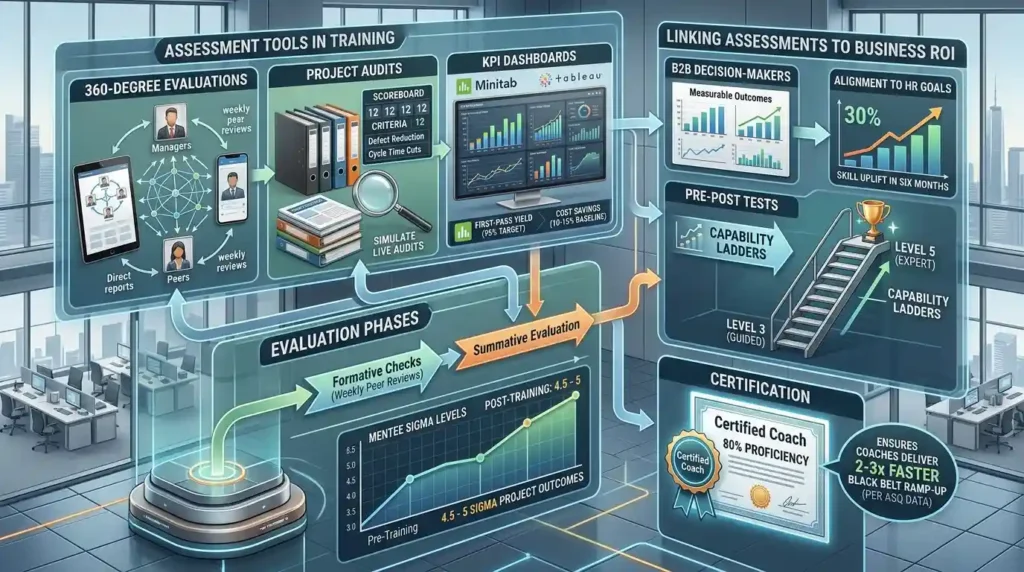
Project audits simulate live audits. Coaches review mentee portfolios, scoring on 12 criteria like defect reduction and cycle time cuts.
KPI dashboards use Minitab or Tableau integrations. Metrics include first-pass yield (95% target) and cost savings (10-15% baseline).
Linking Assessments to Business ROI
B2B decision-makers prioritise measurable outcomes. Training aligns coaching KPIs to HR goals: 30% skill uplift in six months.
Pre-post tests benchmark coaching maturity. Participants advance from Level 3 (guided) to Level 5 (expert) on capability ladders.
Certification requires 80% proficiency. This ensures coaches deliver 2-3x faster Black Belt ramp-up, per ASQ data.
Imperial Corporate Training Institute embeds these in their:
Lean Six Sigma Master Black Belt Certification Training Course, focusing on practical application.
In What Ways Does Training Differentiate Coaching Green Belts from Black Belts?
Training differentiates via tiered complexity: Green Belts receive tactical guidance on basics; Black Belts get strategic oversight on enterprise projects. This yields 40% higher success for advanced mentees.
Green Belt coaching emphasises fundamentals. Trainees teach process mapping and basic stats, using 80/20 rule for quick wins.
Sessions last 4-8 hours, focusing on individual projects under £50,000 impact.
Black Belt coaching shifts to leadership. Professionals coach portfolio management, cross-functional alignment, and advanced stats like ANOVA.
Tailored Methodologies for Each Belt Level
Green Belts need hand-holding on Pareto analysis. Training drills simplify 5 Whys into templates.
Black Belts demand challenge. Coaches facilitate tollgate reviews, debating design of experiments.
Duration differs: Green coaching averages 20 hours per project; Black hits 50-60 hours with governance.
HR contexts highlight gaps: 60% of firms lack advanced coaching, stalling sigma maturity.
Programmes quantify impact: Green Belt projects hit 2-3 sigma; Black reach 4+ under coached guidance.
How Does Master Black Belt Training Incorporate Business Acumen into Coaching?
Training incorporates business acumen through financial linkage exercises and strategic alignment modules. Professionals coach on NPV calculations and Hoshin Kanri, driving 15-25% ROI on mentee projects.
Modules link Lean Six Sigma to P&L impacts. Coaches learn to query: “Does this DMAIC step justify £10,000 spend?”
Strategic tools include balanced scorecards. Training simulates coaching Black Belts on voice-of-business integration.
ROI Measurement in Coaching Practice
HR leaders demand proof. Training teaches COPQ Cost of Poor Quality frameworks, where coached projects cut waste by 20-30%.
Case studies from retail show Black Belts, post-coaching, delivering £200,000 annual savings.
Programmes track long-term metrics: coached teams sustain gains 18 months longer.
This prepares professionals for enterprise deployments, where 75% of failures trace to strategy disconnects.
For evidence of real impact, see:
How Has Imperial’s Master Black Belt Training Helped Previous Participants Lead Teams?
What Ongoing Development Strategies Does Training Instil for Long-Term Coaching?
Training instils strategies like peer communities, annual audits, and e-learning refreshers. Professionals maintain 95% certification renewal, sustaining 25% annual mentee uplift.
Post-certification plans form 10% of curriculum. Coaches build personal development blueprints.
Peer communities foster knowledge sharing. Monthly virtual meets dissect failures, per ISixSigma adoption rates.
Annual audits mandate 40 PDUs. This counters skill decay seen in 30% of uncertified belts.
Adapting to Evolving Business Needs
Delivery models evolve: 60% blended learning post-training. Coaches upskill via micro-credentials.
HR integration focuses on scalable frameworks. Organisations deploy coached Master Black Belts to train 10-15 belts yearly.
Discover More from Our Guide Library:
How Does a UK-Based Master Black Belt Training Course Compare With Online Alternatives?
What Data Analysis Skills Are Built During Lean Six Sigma Master Black Belt Training?
Metrics validate: Firms with structured coaching report 35% faster DMAIC cycles.
This ensures sustained workforce competitiveness amid digital transformations.
What is covered in Imperial Corporate Training Institute’s Lean Six Sigma Master Black Belt Certification Training Course?
The course covers advanced DMAIC coaching, feedback models like SBI, role-playing for Green and Black Belt mentoring, and business acumen tools such as COPQ analysis. Participants gain skills in project audits, KPI dashboards, and strategic alignment for enterprise Lean Six Sigma deployments. Certification requires 80% proficiency in simulations and assessments.
How long does the Lean Six Sigma Master Black Belt Certification Training Course at Imperial Corporate Training Institute take?
The programme spans 20-30 days of intensive training, including 40% frameworks, 30% role-playing, and 25% assessments. Blended delivery models allow flexibility for working professionals. Post-course, ongoing PDUs support certification renewal.
What are the prerequisites for Imperial Corporate Training Institute’s Master Black Belt course?
Candidates need prior Black Belt certification and 3-5 years of Lean Six Sigma project experience. Familiarity with DMAIC and basic stats ensures readiness for advanced coaching. HR teams often select managers addressing workforce skill gaps.
What career benefits come from completing Imperial Corporate Training Institute’s Lean Six Sigma Master Black Belt course?
Graduates coach teams to 35% faster project velocity and 25% ROI gains, per industry benchmarks. They fill leadership gaps in process improvement, qualifying for director-level roles in manufacturing and finance. Sustained skills via peer communities enhance long-term impact