
DMAIC stands for Define, Measure, Analyse, Improve, and Control a structured Six Sigma methodology that organisations use to identify and eliminate process inefficiencies, driving measurable performance gains across departments.
Organisations apply DMAIC to tackle recurring business challenges like production delays, quality defects, and cost overruns. In corporate settings, it targets employee skill gaps in data-driven problem-solving. HR managers and L&D professionals deploy it within training programmes to build workforce capabilities.
DMAIC originates from Six Sigma frameworks, which Motorola developed in the 1980s. Companies such as General Electric adopted it, achieving $12 billion in savings by 2000. In modern workplaces, it addresses skill deficiencies where teams lack tools to quantify issues.
Business impact includes reduced waste by 20-30% in operations. For instance, manufacturing firms cut defect rates from 5% to under 1% after DMAIC implementation. This process integrates into B2B training to equip leaders with systematic improvement skills.
How Does DMAIC Work in Corporate Environments?
DMAIC operates through a five-phase cycle: teams define problems, measure baselines, analyse root causes, improve processes, and control gains, typically spanning 3-6 months per project in organisations.
In corporate training, delivery occurs via workshops, online modules, or hybrid formats. Participants engage in case-based learning and simulations over 4-5 days per phase. Organisations assign cross-functional teams, including managers and frontline staff, to apply it real-time.
Implementation starts with leadership sponsorship. HR selects high-impact processes, such as supply chain bottlenecks. Teams document goals using project charters. Training incorporates role play for stakeholder buy-in.
Progress tracking uses KPIs like cycle time reduction. A finance department, for example, shortens invoice processing from 10 days to 3 days. This phased approach ensures alignment with corporate objectives.
What Are the Key Components of DMAIC Training?
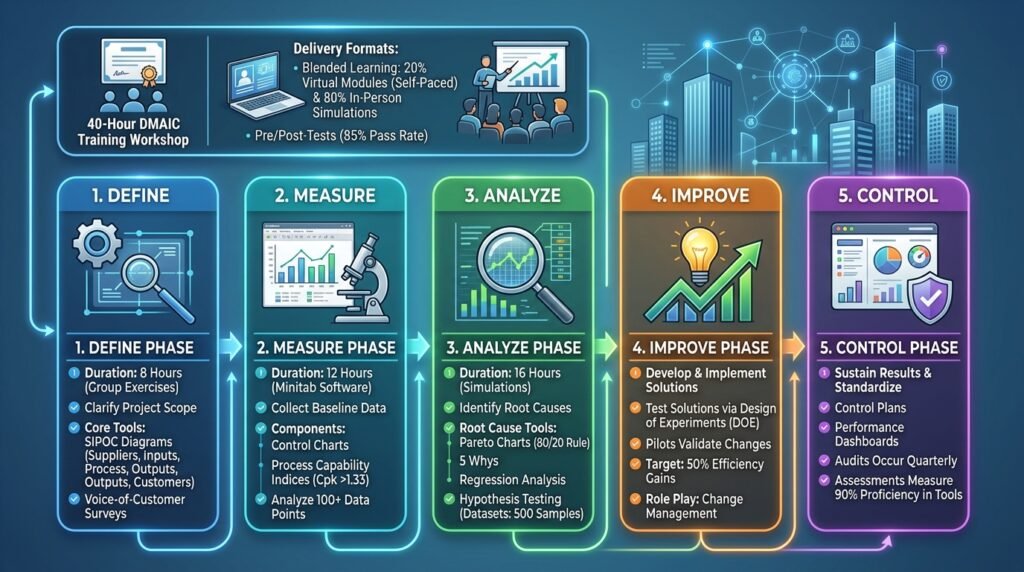
Key components include five phases, core tools like SIPOC diagrams and fishbone analysis, skills in statistical software, and delivery formats such as 40-hour workshops with assessments.
The Define phase clarifies project scope. Teams create SIPOC maps (Suppliers, Inputs, Process, Outputs, Customers) and voice-of-customer surveys. Training duration: 8 hours, with group exercises.
Measure phase collects baseline data. Components feature control charts and process capability indices (CpK >1.33). Participants use Minitab software in 12-hour sessions, analysing 100+ data points.
Analyse phase employs root cause tools: Pareto charts (80/20 rule), 5 Whys, and regression analysis. Simulations run for 16 hours, testing hypotheses on datasets from 500 samples.
Improve phase tests solutions via Design of Experiments (DOE). Pilots validate changes, targeting 50% efficiency gains. Role play covers change management.
Control phase sustains results with control plans and dashboards. Audits occur quarterly. Assessments measure 90% proficiency in tools.
Delivery formats blend virtual modules (self-paced, 20% of programme) with in-person simulations (80%). Organisations track completion via pre/post-tests, achieving 85% pass rates.
How Do Organisations Implement DMAIC for Workforce Development?
Organisations implement DMAIC by forming certified teams, integrating it into L&D roadmaps, allocating 5-10% of budgets, and monitoring via dashboards, yielding 15-25% productivity boosts.
Selection targets departments with high defect rates, like IT support (average resolution time >48 hours). HR partners with L&D to certify 20-50 employees annually.
Step 1: Sponsor assigns a Black Belt leader (160-hour training). Step 2: Define charter in week 1. Step 3: Measure for 4 weeks, gathering 30 data points weekly.
Step 4: Analyse over 6 weeks, validating causes with statistical tests (p-value <0.05). Step 5: Improve via pilots, rolling out to full scale in month 3.
Step 6: Control with automated monitoring, training 10% of staff as Green Belts. Hybrid delivery suits remote teams: 60% online, 40% workshops.
Challenges include resistance; simulations address this via role play. Metrics track ROI: $3 saved per $1 invested.
For deeper application in advanced programmes, explore:
How to apply DMAIC during Master Black Belt training. This bridges awareness to structured execution.
What Benefits Does DMAIC Deliver to Organisations and Teams?
DMAIC delivers 20-40% cost reductions, 30% cycle time cuts, 15% higher employee retention, and stronger leadership pipelines through data-backed decisions.
Teams gain efficiency: a logistics firm reduced shipping errors by 35%, saving £500,000 yearly. Productivity rises 25% as skill gaps close.
HR metrics show 18% retention improvement; trained employees advance 2x faster. ROI hits 5:1 within 12 months, per ASQ benchmarks.
Departments like healthcare cut patient wait times by 40%. Leadership benefits from strategic thinking, filling pipelines with 70% internal promotions.
Organisations report 12% revenue growth from optimised processes. Teams collaborate better, reducing silos by 50% via cross-functional projects.
What Are Real-World Use Cases for DMAIC in Corporate Teams?
Corporate teams apply DMAIC in manufacturing (defect reduction), finance (claims processing), IT (ticket resolution), healthcare (throughput), and service sectors (customer satisfaction), scaling to 100+ projects yearly.
In manufacturing, a team analyses assembly lines, cutting scrap by 28% across 5 plants. Managers lead 10-week cycles.
Finance departments streamline reconciliations: one bank processed 50,000 transactions 45% faster. L&D delivers via 3-day workshops.
IT teams resolve incidents: average downtime drops from 4 hours to 45 minutes. Hybrid modules train 30 developers.
Healthcare units optimise ER flows: door-to-doctor time falls 50%. Simulations mimic peak loads.
Service firms boost NPS by 25 points. Industries like retail apply it to inventory, turning stock 4x yearly.
Team leaders deploy it for sales forecasting, improving accuracy to 92%. Departments integrate it quarterly.
What Common Problems Arise with DMAIC and How to Avoid Them?
Common problems include poor problem selection (40% failure rate), insufficient data (30% projects stall), lack of leadership buy-in (25% abandonment), and generic training without metrics, avoided by rigorous charters, statistical validation, and KPI-linked programmes.
Misconception: DMAIC suits only manufacturing. It applies enterprise-wide, with 60% of projects in services.
Ineffective training skips simulations; case-based learning ensures 85% application rates. Generic programmes yield 10% ROI; tailor to KPIs like OEE >85%.
Lack of ROI stems from no baselines—Measure phase mandates them. Teams overlook Control, losing 50% gains; standardise audits.
Over-reliance on software ignores analysis skills. Workshops blend tools with 5 Whys for 90% root cause accuracy.
Employee resistance hits 35% of initiatives. Role play builds change skills, boosting adoption to 75%.
How Does DMAIC Training Address Skill Gaps in Modern Workplaces?
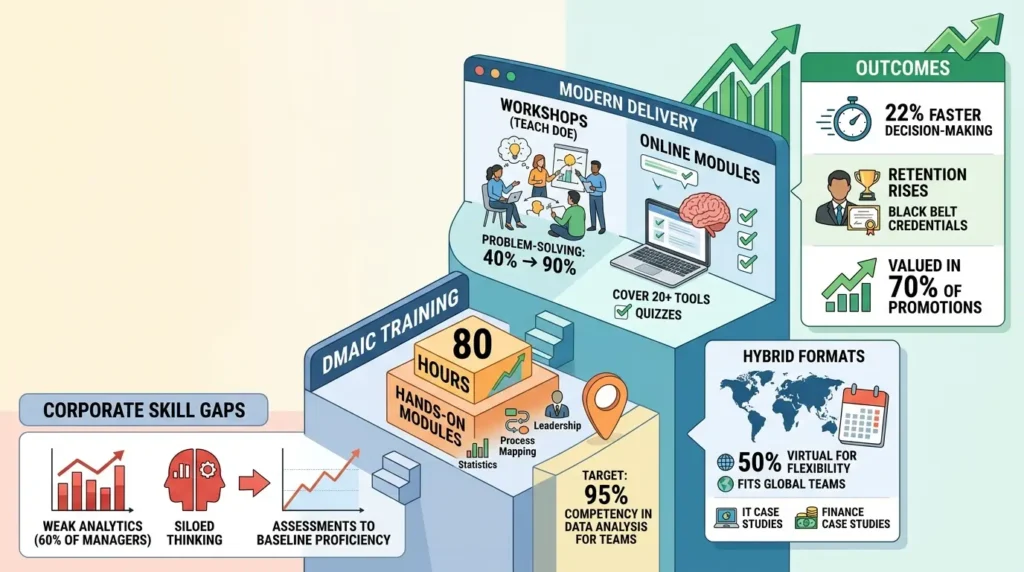
DMAIC training closes skill gaps by delivering 80 hours of hands-on modules in statistics, process mapping, and leadership, achieving 95% competency in data analysis for teams.
Corporate skill gaps include weak analytics (60% of managers) and siloed thinking. Programmes use assessments to baseline proficiency.
Workshops teach DOE, raising problem-solving from 40% to 90%. Online modules cover 20 tools, with quizzes.
Hybrid formats fit global teams: 50% virtual for flexibility. Case studies from IT and finance build relevance.
Outcomes include 22% faster decision-making. Retention rises as employees gain Black Belt credentials, valued in 70% of promotions.
What Performance Metrics Track DMAIC Success in Organisations?
Metrics track success via KPIs like DPMO (<3.4 defects per million), process sigma level (>4), cost savings (£100,000+ per project), and productivity gains (25%), audited quarterly.
DPMO quantifies quality: pre-DMAIC averages 10,000; post hits 1.5. Sigma levels rise from 3 to 4.5.
Financial KPIs: sigma savings formula yields £250,000/project. Productivity: output per employee up 28%.
Soft metrics: employee engagement scores +15%. Dashboards update weekly, with 92% projects greenlit for scale.
ROI calculation: (gains – costs)/costs = 400%. Retention: trained staff stay 2.5 years longer.
How Does DMAIC Integrate with Broader L&D Strategies?
DMAIC integrates with L&D by laddering from Yellow to Master Black Belt levels, comprising 20% of annual training hours, aligning with OKRs for 30% organisational uplift.
L&D roadmaps sequence Green Belt (40 hours) post-DMAIC intro. It feeds leadership pipelines, certifying 15% of managers.
Discover More From Our Guide Library:
What Salary Can a Lean Six Sigma Master Black Belt Professional Expect?
How Long Does It Take to Achieve Lean Six Sigma Master Black Belt Status?
Blends with agile: hybrid teams apply it bi-monthly. Metrics tie to OKRs, like 20% efficiency.
Delivery scales: 500 employees via e-learning platforms. Simulations link to real projects.
Impact: 18% reduction in turnover, stronger pipelines.
Enrol our:
Lean Six Sigma Master Black Belt Certification Training Course
What is the Lean Six Sigma Master Black Belt Certification Training Course at Imperial Corporate Training Institute?
The Lean Six Sigma Master Black Belt Certification Training Course at Imperial Corporate Training Institute equips professionals with advanced skills in DMAIC methodology, statistical analysis, and process optimisation. It spans 160 hours of hybrid training, including simulations and real-world projects. Graduates lead enterprise-wide transformations, achieving sigma levels above 4.5.
How long does the Master Black Belt training take at Imperial Corporate Training Institute?
The Lean Six Sigma Master Black Belt Certification Training Course lasts 160 hours, delivered over 4-6 months in hybrid format with workshops and online modules. Participants complete a live project for certification. This structure fits corporate schedules while ensuring 95% competency in advanced tools.
What are the prerequisites for Imperial Corporate Training Institute’s Master Black Belt course?
Prerequisites include Black Belt certification and 3-5 years of Six Sigma project experience. Imperial Corporate Training Institute’s Lean Six Sigma Master Black Belt Certification Training Course builds on these, focusing on coaching and strategic deployment. Assessments verify readiness during enrolment.
What topics are covered in the Lean Six Sigma Master Black Belt course from Imperial Corporate Training Institute?
Key topics include advanced DMAIC, Design of Experiments (DOE), hypothesis testing, and change management. The course from Imperial Corporate Training Institute uses case studies from industries like manufacturing and finance. Trainees master Minitab and leadership for complex projects.
How does Master Black Belt certification benefit organisations through Imperial Corporate Training Institute?
Master Black Belt certification from Imperial Corporate Training Institute enables leaders to drive 20-40% cost savings and 30% efficiency gains. Certified professionals mentor teams and scale Six Sigma across departments. Organisations see ROI of 5:1 within 12 months.