

Lean Six Sigma combines Lean principles for waste elimination with Six Sigma methods for variation reduction. In corporate environments, it targets supply chain and procurement inefficiencies to deliver measurable performance gains. Organisations deploy it through structured training to close skill gaps in process optimisation.
What Is Lean Six Sigma in Supply Chain and Procurement?
Lean Six Sigma defines a data-driven methodology that integrates Lean’s waste reduction with Six Sigma’s defect minimisation to streamline supply chain and procurement operations, achieving 20-30% cycle time reductions in B2B settings.
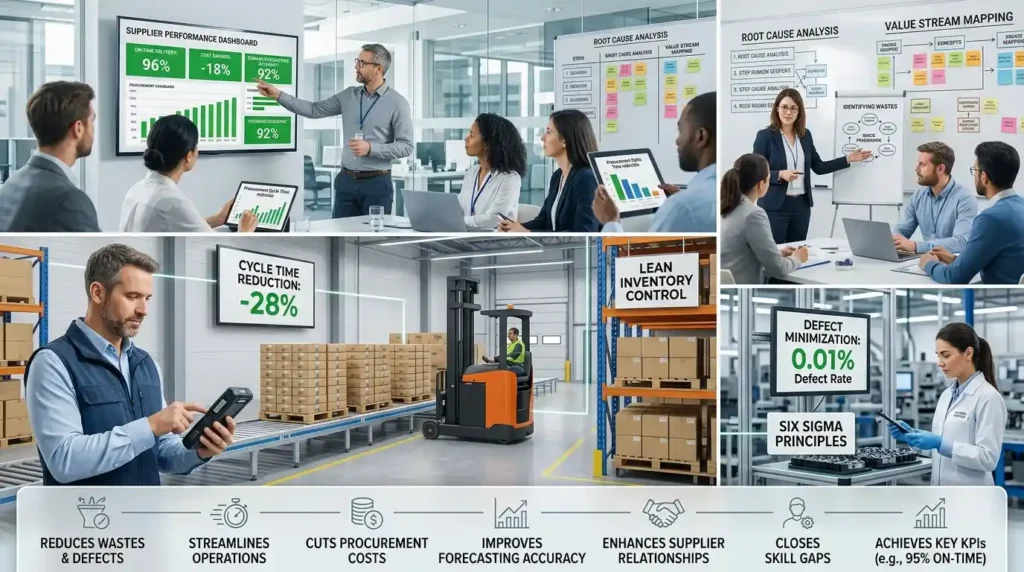
Supply chain managers face delays, excess inventory, and supplier variability. Lean Six Sigma addresses these by mapping value streams and applying statistical tools. Procurement teams use it to cut costs through demand forecasting accuracy.
In workplaces, it functions as a framework for cross-functional teams. HR and L&D professionals train staff via workshops and online modules to identify root causes. Industries like manufacturing, logistics, and retail report 15-25% procurement cost savings post-implementation.
Business impact includes stable supplier relationships and faster order fulfilment. Employee skill gaps in data analysis close with case-based learning. Teams measure success via KPIs such as on-time delivery rates rising to 95%.
How Does Lean Six Sigma Work in Corporate Environments?
Lean Six Sigma operates through the DMAIC cycle, Define, Measure, Analyse, Improve, Control, delivered in 4–6-month corporate programs with hybrid workshops, simulations, and assessments for supply chain teams.
Organisations start with Define: teams pinpoint procurement bottlenecks like delayed approvals. Measure phase collects data on lead times and inventory turns. L&D delivers this via 40-hour workshops blending role play and real data sets.
Analyse uncovers causes, such as 30% variation from poor forecasting. Improve tests solutions like Kanban systems, cutting stockouts by 40%. Control locks gains with dashboards tracking KPIs. Hybrid formats suit remote teams, with 80% completion rates in enterprises.
Implementation spans departments. Procurement analysts apply statistical process control. Supply chain leads run simulations on supplier risks. Training includes 20% pre-work via online modules for retention.
What Are the Key Components of Lean Six Sigma Training?
Key components encompass DMAIC framework, tools like SIPOC diagrams and control charts, plus delivery via 120-hour hybrid programs with case studies, simulations, and exams for procurement professionals.
Frameworks include DMAIC for structured problem-solving. Tools cover Value Stream Mapping for procurement flows and Fishbone diagrams for supplier issues. Skills build statistical analysis via Minitab software training.
Delivery formats mix 50% instructor-led workshops, 30% online modules, and 20% role play. Assessments test via projects reducing mock supply chain waste by 25%. Corporate programs span 16 weeks, with 90-minute weekly sessions.
Teams gain proficiency in 5S (Sort, Set, Shine, Standardise, Sustain) for warehouse efficiency. L&D tracks progress with pre/post quizzes showing 35% knowledge uplift. Components align with ISO 13053 standards.
How Do Organisations Implement Lean Six Sigma in Supply Chains?
Organisations implement via needs assessment, cross-functional team formation, 6-month DMAIC projects, and sustained coaching, yielding 25% inventory reductions in procurement-heavy sectors.
HR conducts skills audits revealing gaps in 40% of supply teams. L&D selects belts: Green for analysts, Black for managers. Projects launch with 10-person teams tackling real issues like 15% excess stock.
Step 1: Charter projects with executive sponsors. Step 2: Train via hybrid modules over 3 months. Step 3: Execute DMAIC on live data, simulating disruptions. Step 4: Monitor with scorecards.
Finance measures ROI at 4:1, with payback in 9 months. Industries like automotive achieve 98% first-pass yield. Challenges include resistance; overcome via leadership buy-in and 360 feedback.
For deeper application to supply chain hurdles, explore:
How Does Master Black Belt Training Apply Lean Six Sigma to Supply Chain Challenges? on Master Black Belt strategies.
Enrol in:
Lean Six Sigma Master Black Belt Certification Training Course
What Benefits Does Lean Six Sigma Deliver to Procurement Teams?
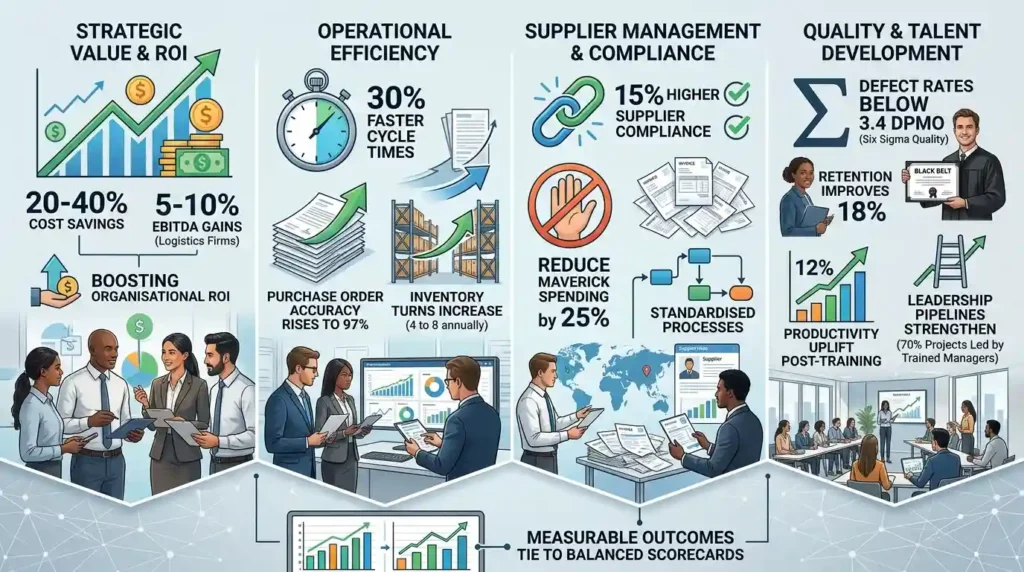
Lean Six Sigma delivers 20-40% cost savings, 30% faster cycle times, and 15% higher supplier compliance for procurement, boosting team efficiency and organisational ROI.
Procurement sees purchase order accuracy rise to 97%. Inventory turns increase from 4 to 8 annually. Teams reduce maverick spending by 25% through standardised processes.
KPIs track defect rates dropping below 3.4 DPMO (Defects Per Million Opportunities). Retention improves 18% as employees gain Black Belt certifications. L&D reports 12% productivity uplift post-training.
Business owners note 5-10% EBITDA gains in logistics firms. Leadership pipelines strengthen with 70% of projects led by trained managers. Measurable outcomes tie to balanced scorecards.
What Use Cases Show Lean Six Sigma in Corporate Supply Chains?
Use cases span manufacturing firms cutting lead times 35%, logistics providers lifting on-time delivery to 96%, and pharma companies trimming procurement variance 28%.
A manufacturing team mapped supplier flows, eliminating 22% non-value steps. Results: 18-week lead times halved. Healthcare procurement standardised contracts, saving £2.5m yearly.
Finance departments applied it to invoice processing, achieving 99% accuracy. Retail chains used simulations for demand planning, reducing stockouts 40%. IT supply teams optimised hardware procurement, cutting costs 27%.
Global enterprises run 50+ projects yearly. L&D scales via train-the-trainer models. Industries like oil and gas report 15% efficiency gains across 500 sites.
What Common Problems Arise in Lean Six Sigma Implementations?
Common problems include lack of leadership commitment causing 60% project failure, generic training yielding 10% ROI, and siloed teams ignoring 25% cross-department waste.
Ineffective programs skip needs assessments, leading to irrelevant tools. HR managers see 40% dropout in non-hybrid formats. Misconception: it suits only manufacturing; procurement gains match at 30% savings.
ROI falters without KPIs; only 35% track post-training metrics. Solutions demand executive dashboards and 6-month audits. Generic courses ignore industry data, dropping applicability to 50%.
Teams overcome via tailored simulations and 80/20 coaching focus. Retention dips 20% sans real projects. Address with 360 assessments and phased rollouts.
How Do Misconceptions Affect Lean Six Sigma Adoption?
Misconceptions like “it requires statisticians” block adoption, yet 80% of tools need basic Excel skills; “only for factories” ignores 25% procurement gains in services.
Decision-makers assume high costs; programs deliver 300% ROI in 12 months. Generic training myths persist, but hybrid models boost completion to 92%. L&D counters with pilot projects showing 18% yield jumps.
Discover More from Our Guide Library:
What Is Kaizen and How Does It Complement Lean Six Sigma Methodology?
What Are the Most Widely Used Six Sigma Certifying Bodies Globally?
Procurement views it as paperwork-heavy; DMAIC cuts meetings 40%. Businesses fear disruption; phased implementation limits downtime to 5%. Education via case studies shifts views, with 75% repeat programs.
Authorities clarify via benchmarks: 95% of Fortune 500 use it. Training dispels via hands-on modules proving accessibility.
What is Lean Six Sigma Master Black Belt Certification Training at Imperial Corporate Training Institute?
Lean Six Sigma Master Black Belt Certification Training from Imperial Corporate Training Institute equips professionals with advanced skills to lead complex process improvement projects. It covers DMAIC methodology, statistical analysis, and change management for supply chain and procurement optimisation. Participants complete real-world projects to achieve certification.
How does Master Black Belt training improve supply chain performance?
Master Black Belt training teaches advanced tools like Value Stream Mapping and Design of Experiments to reduce procurement cycle times by 30%. Imperial Corporate Training Institute’s course uses case studies from manufacturing and logistics. Teams achieve 20-40% cost savings through sustained KPI tracking.
What certification do you get from Imperial Corporate Training Institute’s Master Black Belt course?
Graduates earn ASQ-aligned Lean Six Sigma Master Black Belt certification from Imperial Corporate Training Institute. It requires passing exams, submitting a project with measurable ROI, and demonstrating leadership in cross-functional teams. The credential validates expertise in enterprise-wide process transformation.