

Kaizen represents continuous improvement practices that empower employees at all levels to identify and eliminate waste in daily operations, boosting productivity by 15-30% in corporate settings.
Kaizen originates from Japanese business philosophy. It translates to “change for the better.” In workplaces, teams apply it through small, incremental changes. These changes target inefficiencies in processes like manufacturing lines or office workflows.
Corporate training introduces Kaizen to address employee skill gaps in problem-solving. HR managers use it to foster a culture of ongoing refinement. Business owners see it reduce operational costs by 10-20% annually.
Kaizen complements Lean Six Sigma by providing the daily execution layer. Lean Six Sigma focuses on large-scale projects with DMAIC frameworks. Kaizen delivers quick wins that sustain those projects. Together, they create a holistic improvement system.
Industries like manufacturing, healthcare, and finance adopt Kaizen. Factories cut downtime by 25%. Hospitals streamline patient admissions. Banks optimise transaction processing.
How Does Kaizen Work in Corporate Environments?
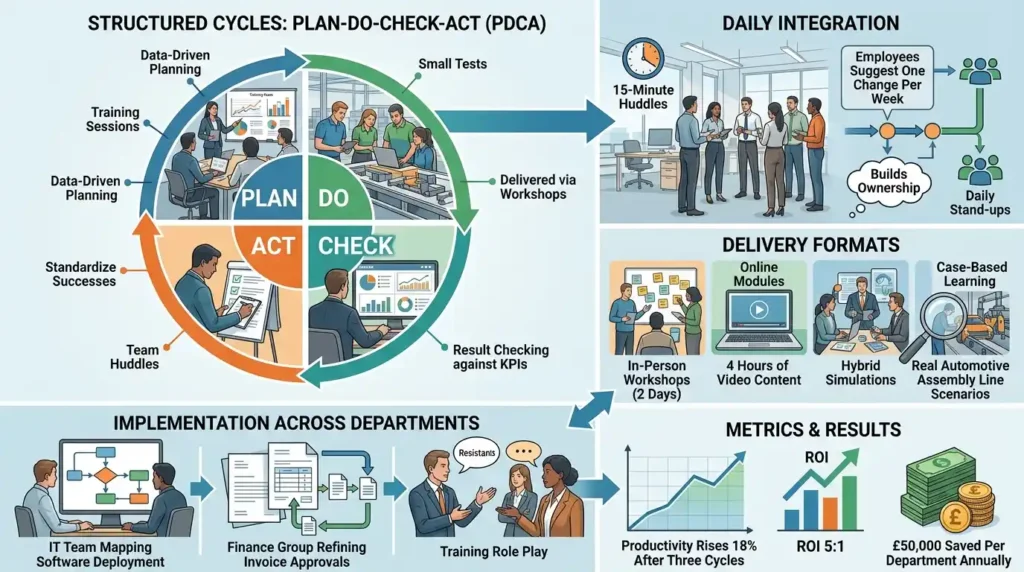
Kaizen operates through structured cycles of plan-do-check-act (PDCA), delivered via workshops and team huddles, where employees implement changes over 4-8 week periods to achieve 20% efficiency gains.
Teams start with PDCA cycles in training sessions. They plan improvements based on data. They do small tests. They check results against KPIs. They act to standardise successes.
In organisations, Kaizen integrates into daily stand-ups. Managers lead 15-minute huddles. Employees suggest one change per week. This builds ownership.
Delivery formats include in-person workshops lasting 2 days, online modules with 4 hours of video content, and hybrid simulations. Case-based learning reviews real scenarios from automotive assembly lines.
Implementation spans departments. IT teams map software deployment processes. Finance groups refine invoice approvals. Training uses role play to simulate resistance to change.
Metrics track progress. Productivity rises 18% after three cycles. ROI calculates at 5:1, with £50,000 saved per department annually.
What Are the Key Components of Kaizen Training?
Kaizen training includes PDCA frameworks, 5S tools for workplace organisation, Gemba walks for on-site observation, and visual management boards, delivered in 16-24 hour programs with assessments.
PDCA forms the core cycle. Plan identifies waste. Do tests solutions. Check measures via KPIs like cycle time reduction. Act embeds fixes.
5S tools organise spaces: Sort, Set in order, Shine, Standardise, Sustain. Factories apply them to tool benches, cutting search time by 40%.
Gemba walks involve leaders visiting work areas. They observe processes firsthand. Teams discuss issues on the spot.
Visual management uses Kanban boards and Andon lights. These signal problems instantly. Online modules teach digital versions for remote teams.
Delivery mixes formats. Workshops feature hands-on simulations. Hybrid learning adds virtual reality for process mapping. Assessments test application through project submissions.
Frameworks like value stream mapping visualise flows. Tools such as Pareto charts prioritise issues. Skills cover root cause analysis with fishbone diagrams.
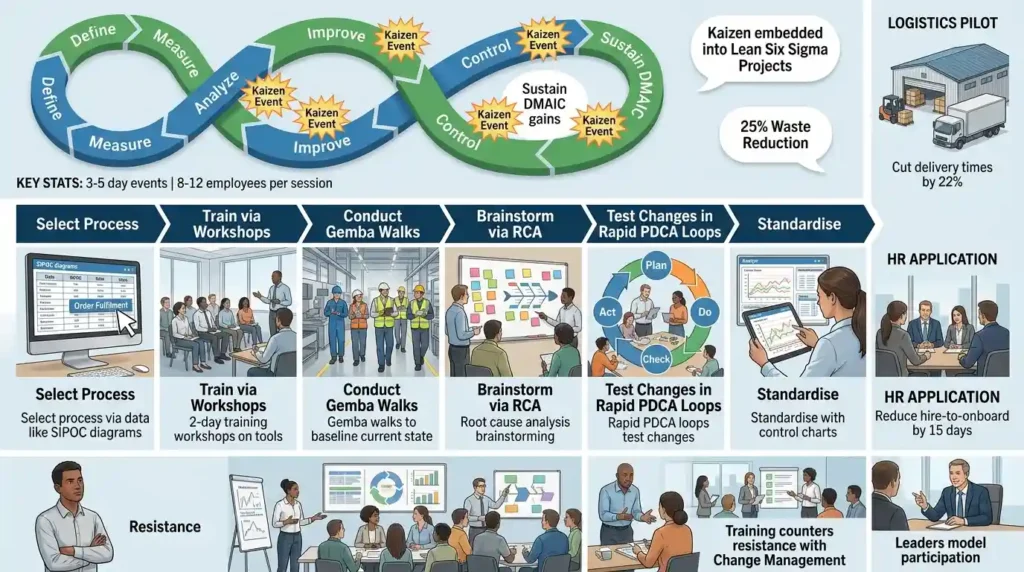
Organisations implement Kaizen by embedding it into Lean Six Sigma projects via dedicated events lasting 3-5 days, training 8-12 employees per session to sustain DMAIC gains with 25% waste reduction.
HR managers select cross-functional teams. They align Kaizen events with Lean Six Sigma belts. Green Belts lead initial PDCA cycles post-DMAIC.
Step 1: Select a process, like order fulfilment, using data from SIPOC diagrams.
Step 2: Train via 2-day workshops on tools.
Step 3: Conduct Gemba walks to baseline current state.
Step 4: Brainstorm via root cause analysis.
Step 5: Test changes in rapid PDCA loops.
Step 6: Standardise with control charts.
Departments roll out pilots. Logistics teams cut delivery times by 22%. HR applies to recruitment, reducing hire-to-onboard by 15 days.
Common challenges include resistance. Training counters this with change management modules. Leaders model participation.
For deeper integration, explore:
How Kaizen events fit into advanced Lean Six Sigma Master Black Belt training. This shift aids decision-makers evaluating structured programmes.
What Measurable Outcomes Does Kaizen Produce for Businesses?
Kaizen delivers 15-35% productivity increases, 20% cost reductions, and 12% higher employee retention rates, tracked via KPIs like defect rates and throughput in corporate dashboards.
Productivity metrics show gains. Assembly lines achieve 28% output rises after 6 months. Offices report 18% faster task completion.
Cost savings hit £100,000 per site yearly. Waste like excess inventory drops 30%. Energy use falls 15% in optimised facilities.
Retention improves as employees engage. Turnover decreases 12% in Kaizen-adopting firms. Surveys link this to empowerment.
KPIs include first-pass yield at 95%, on-time delivery at 98%. ROI reaches 4:1 within 12 months. Dashboards visualise trends.
Team efficiency surges. Cross-training reduces bottlenecks by 25%. Leadership pipelines strengthen as managers gain facilitation skills.
What Are Common Misconceptions About Kaizen Training?
Kaizen is not one-off workshops but sustained PDCA cycles; it delivers ROI through data, not generic programs, avoiding pitfalls like 70% failure rates from poor implementation.
Many view Kaizen as quick fixes. It requires ongoing cycles, not events alone. Firms see 70% relapse without standardisation.
Generic programs fail. Custom training aligns with industry KPIs, like healthcare’s patient wait times.
Lack of metrics dooms efforts. Successful programs mandate pre-post audits, showing 22% gains.
Misconception: Only for manufacturing. IT uses it for code deployment, cutting bugs 35%. Finance applies to audits.
Ineffective training skips simulations. Proper formats yield 90% skill retention at 6 months.
What Use Cases Demonstrate Kaizen in Corporate Teams?
Kaizen transforms corporate teams in manufacturing (25% downtime cuts), healthcare (18% admission efficiency), finance (20% process speed), and IT (30% deployment cycles), via department-specific events.
Manufacturing teams run 5S on lines. Downtime drops 25%. A automotive plant saved £200,000 yearly.
Healthcare departments streamline triage. Admissions speed up 18%. Hospitals reduce wait times from 45 to 30 minutes.
Finance groups refine approvals. Processing accelerates 20%. Banks handle 15% more transactions.
IT applies to DevOps. Deployment cycles shorten 30%. Software firms release updates weekly.
Team leaders facilitate. Sales teams map lead funnels, boosting conversion 22%. HR uses for onboarding, cutting time 40%.
L&D professionals design hybrid programs. Online modules precede workshops. Role play handles objections.
How Does Kaizen Address Employee Skill Gaps in Workforce Development?
Kaizen training closes skill gaps in problem-solving and waste identification through 20-hour programs with 80% hands-on practice, raising team competency scores by 35 points.
Employees lack process observation skills. Gemba training builds them. Competency rises from 45% to 80%.
Workshops teach tools. Participants score 90% on assessments. Simulations mimic real bottlenecks.
Hybrid formats suit shifts. Online modules cover theory; in-person role play applies it.
Business owners track via pre-training audits. Post-program, error rates fall 28%.
Departments gain uniformity. New hires onboard faster, reducing ramp-up from 90 to 60 days.
Why Integrate Kaizen with Lean Six Sigma for Organisational Impact?
Integrating Kaizen with Lean Six Sigma sustains project gains, combining DMAIC’s structure with daily PDCA for 40% overall efficiency, building resilient processes across teams.
Lean Six Sigma handles big projects. Kaizen maintains them daily. DMAIC defines; PDCA refines.
Organisations train belts together. Master Black Belts oversee events. Green Belts execute.
Discover More from Our Guide Library:
What Are the Most Widely Used Six Sigma Certifying Bodies Globally?
How Are Hypothesis Tests Used in Lean Six Sigma Data Analysis?
For deeper information enrol in:
Lean Six Sigma Master Black Belt Certification Training Course
Impact hits leadership pipelines. Managers develop facilitation, improving succession rates 15%.
Retention climbs as culture shifts. Engaged teams stay 18% longer.
Metrics confirm: 40% throughput gains in integrated firms versus 20% standalone.
Industries scale it. Logistics firms cut costs 25%. Retail optimises stocking 22%.
What are the prerequisites for enrolling in Imperial Corporate Training Institute’s Lean Six Sigma Master Black Belt course?
Candidates need prior Lean Six Sigma Black Belt certification and 3-5 years of project leadership experience. Imperial Corporate Training Institute requires a completed project portfolio demonstrating measurable ROI. This ensures readiness for Master Black Belt-level strategic roles.
How long does the Lean Six Sigma Master Black Belt Certification Training Course take at Imperial Corporate Training Institute?
The course spans 10-12 weeks with hybrid delivery, including 120 hours of live workshops, online modules, and applied projects. Imperial Corporate Training Institute structures it for working professionals, with weekly sessions and flexible assessments. Completion leads to internationally recognised certification.
What topics are covered in Imperial Corporate Training Institute’s Lean Six Sigma Master Black Belt training?
Key topics include advanced statistical analysis, Design for Six Sigma (DFSS), change management, and Lean integration. Imperial Corporate Training Institute emphasises tools like Minitab for hypothesis testing and value stream mapping at enterprise scale. Practical elements feature Kaizen events and leadership simulations.
How does Imperial Corporate Training Institute’s Lean Six Sigma Master Black Belt Certification Training Course benefit organisations?
It builds internal experts who drive 20-40% efficiency gains and £100,000+ annual savings per project. Graduates from Imperial Corporate Training Institute coach teams, reducing waste and improving KPIs like defect rates. Organisations see stronger process governance and sustained Lean Six Sigma culture.