

Lean Six Sigma combines Lean principles for waste elimination with Six Sigma methods for defect reduction. Businesses adopt it to cut operational costs by 20-30%, boost productivity by 15-25%, and improve customer satisfaction scores by 10-20%. HR managers and L&D professionals implement it to address skill gaps in process optimisation across departments.
Organizations face rising demands for efficiency amid talent shortages and competitive pressures. Lean Six Sigma equips teams with data-driven tools to streamline workflows. It targets variability in processes that erode profits.
In corporate settings, employee skill gaps emerge in areas like process mapping and root cause analysis. Lean Six Sigma training fills these gaps through structured programs. Delivery occurs via workshops, online modules, or hybrid formats lasting 4-6 weeks.
Businesses need it because generic training fails to deliver ROI. Lean Six Sigma produces measurable outcomes like 25% cycle time reductions. Teams apply it to real-world challenges, such as supply chain delays or quality control issues.
What Is Lean Six Sigma in a Corporate Context?
Lean Six Sigma is a methodology that integrates Lean’s waste reduction with Six Sigma’s statistical process control to achieve operational excellence. In workplaces, it reduces defects to 3.4 per million opportunities and eliminates non-value-adding activities, driving 20-40% efficiency gains.
Lean originated from Toyota’s production system in the 1950s. It focuses on flow efficiency by removing eight wastes: overproduction, waiting, transport, overprocessing, inventory, motion, defects, and unused talent. Six Sigma, developed by Motorola in 1986, uses DMAIC—Define, Measure, Analyze, Improve, Control—to minimize variation through data analysis.
In B2B environments, Lean Six Sigma addresses employee skill gaps in data interpretation and process redesign. HR teams deploy it to transform underperforming departments. For instance, manufacturing firms cut downtime by 30% after training operators in value stream mapping.
Corporate training defines it as a belt system: White, Yellow, Green, Black, and Master Black Belt. Each level builds proficiency. Organizations assign roles based on project complexity—Green Belts handle small initiatives, Black Belts lead cross-functional teams.
Business impact includes standardized processes that scale across sites. Finance departments apply it to invoice processing, reducing errors by 50%. IT teams use it for software deployment, shortening release cycles from weeks to days.
How Does Lean Six Sigma Work in Business Operations?
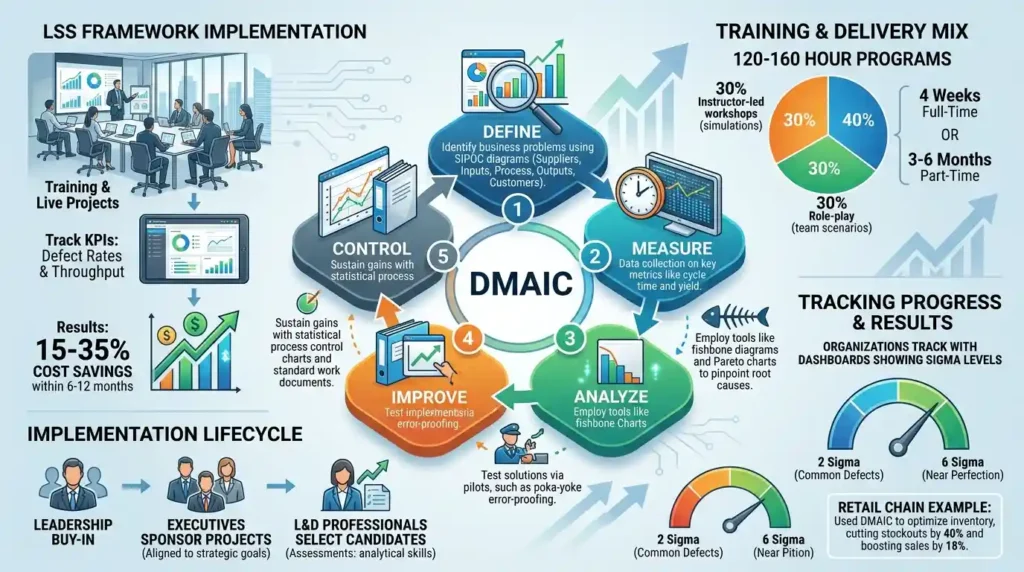
Lean Six Sigma works through the DMAIC framework applied in training and projects. Organizations train employees in 120-160 hour programs, deploy them on live projects, and track KPIs like defect rates and throughput, yielding 15-35% cost savings within 6-12 months.
Training begins with Define: Teams identify business problems using SIPOC diagrams (Suppliers, Inputs, Process, Outputs, Customers). Measure follows with data collection on key metrics like cycle time and yield.
Analyze phase employs tools like fishbone diagrams and Pareto charts to pinpoint root causes. Improve tests solutions via pilots, such as poka-yoke error-proofing. Control sustains gains with statistical process control charts and standard work documents.
In corporate environments, delivery mixes formats: 40% instructor-led workshops for simulations, 30% online modules for theory, 30% role-play for team scenarios. Programs span 4 weeks full-time or 3-6 months part-time.
Implementation starts with leadership buy-in. Executives sponsor projects aligned to strategic goals. L&D professionals select candidates via assessments measuring analytical skills.
Organizations track progress with dashboards showing sigma levels—from 2 sigma (common defects) to 6 sigma (near perfection). A retail chain, for example, used DMAIC to optimize inventory, cutting stockouts by 40% and boosting sales by 18%.
What Are the Key Components of Lean Six Sigma Training?
Key components include DMAIC framework, Lean tools (value stream mapping, 5S), Six Sigma stats (hypothesis testing, DOE), and delivery via 120-hour hybrid programs with case studies, simulations, and project coaching.
DMAIC forms the core structure. Define sharpens problem statements with voice of customer data. Measure baselines performance using process capability indices like Cp and Cpk.
Analyze dives into regression analysis and failure mode effects analysis (FMEA). Improve covers design of experiments (DOE) and lean techniques like kaizen events. Control deploys control plans and audits.
Lean tools target waste: 5S organizes workplaces (Sort, Set in order, Shine, Standardize, Sustain); kanban manages flow. Six Sigma adds Minitab software for control charts and ANOVA tests.
Training delivery integrates methodologies: Case-based learning dissects real failures in industries like IT, healthcare, finance. Simulations mimic production lines. Role-play handles stakeholder resistance. Assessments via exams (80% pass rate) and project gates ensure mastery.
Programs last 120-160 hours, blending 50 hours virtual lectures, 40 hours workshops, 30 hours projects. Prerequisites include Green Belt certification for Black Belt levels.
How Do Organizations Implement Lean Six Sigma Effectively?
Organizations implement Lean Six Sigma by forming project teams, allocating 20% employee time to training and projects, integrating it into KPIs, and scaling via 10-20 belts per department over 12 months.
Step 1: Assess needs. HR audits processes for sigma levels below 4. Step 2: Select trainers certified at Black Belt level. Step 3: Enroll 15-25 employees per cohort in hybrid programs.
Step 4: Launch pilots. Green Belts tackle department issues; Black Belts cross-functions. Step 5: Coach with mentors reviewing charters weekly. Step 6: Review ROI quarterly—target 3-5x training costs in savings.
Delivery formats adapt to corporate needs: Onsite workshops for hands-on 5S; online modules for global teams. Hybrid learning combines both, with 70% completion rates.
Metrics guide success: Track OEE (overall equipment effectiveness) rising 20%; DPMO (defects per million opportunities) dropping 50%. A logistics firm trained 50 staff, implemented 12 projects, and saved $2.5 million annually.
Challenges arise in change management. Organizations counter with communication plans and quick wins.
Here are discussed:
What Topics Are Covered in a Lean Six Sigma Master Black Belt Training Course
As it details advanced topics like those in a:
Lean Six Sigma Master Black Belt Certification Training Course, helping decision-makers evaluate deeper training options when scaling programs.
What Benefits Does Lean Six Sigma Deliver to Businesses and Teams?
Lean Six Sigma delivers 20-40% cost reductions, 15-30% productivity gains, 10-25% improved employee retention, and stronger leadership pipelines through data-driven decision-making and process standardization.
Organizations gain predictable outputs. Defect rates fall to 3.4 DPMO, freeing resources for innovation. Productivity surges as cycle times shrink call centers report 25% faster resolutions.
Team efficiency rises with cross-functional collaboration. Departments align via shared metrics, reducing silos. Leadership pipelines strengthen as Black Belts mentor juniors, filling 30% more internal promotions.
Retention improves by 15-20%. Employees value skill-building in hypothesis testing and kaizen, boosting engagement scores. ROI hits 4-7x within one year, per project savings logs.
Performance metrics include KPIs like first-pass yield (95% target) and throughput (30% increase). Finance tracks reduced rework costs; sales sees higher customer NPS (Net Promoter Score) by 12 points.
What Are Real-World Use Cases for Lean Six Sigma in Corporations?
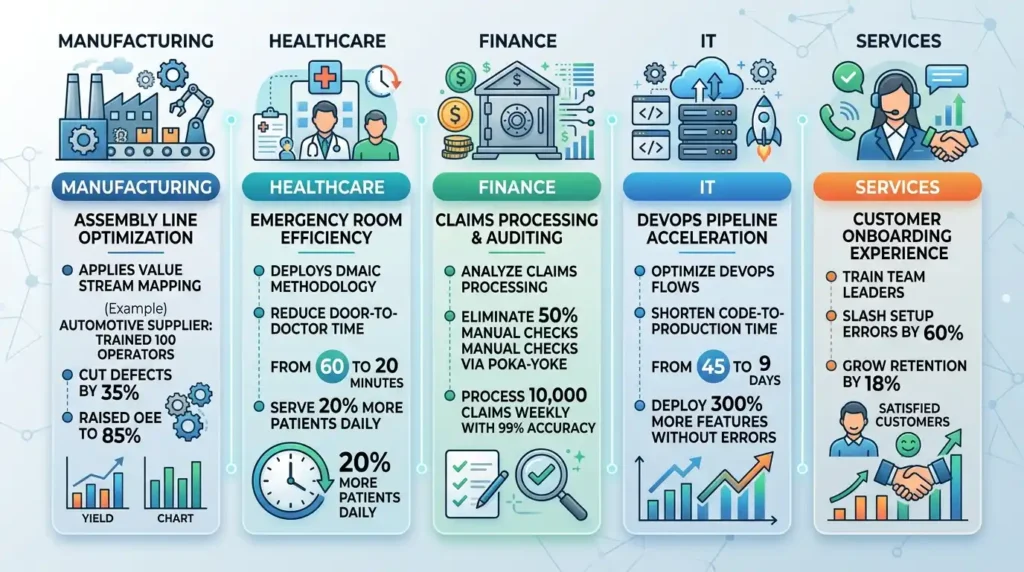
Corporate teams use Lean Six Sigma in manufacturing for 30% yield improvements, healthcare for 25% patient wait reductions, finance for 40% faster audits, and IT for 50% deployment speed-ups across 500+ employee projects.
Manufacturing applies value stream mapping to assembly lines. A automotive supplier trained 100 operators, cut defects by 35%, and raised OEE to 85%.
Healthcare deploys DMAIC in emergency rooms. Hospitals reduce door-to-doctor time from 60 to 20 minutes, serving 20% more patients daily.
Finance teams analyze claims processing. Banks eliminate 50% manual checks via poka-yoke, processing 10,000 claims weekly with 99% accuracy.
IT departments optimize DevOps. Firms shorten code-to-production from 45 to 9 days, deploying 300% more features without errors.
Team leaders in services use it for customer onboarding. A telecom trained managers, slashed setup errors by 60%, and grew retention by 18%.
What Common Problems Arise with Lean Six Sigma and How to Avoid Them?
Common problems include lack of leadership support causing 40% project failure, generic training yielding 20% ROI shortfalls, and ignoring cultural fit leading to 25% low adoption; avoid by tying to business KPIs, customizing programs, and piloting small.
Ineffective training stems from off-the-shelf courses ignoring industry needs. Solution: Tailor with sector cases—IT modules on agile integration, healthcare on HIPAA-compliant analysis.
No ROI occurs when projects lack charters. Organizations mandate $50,000+ savings targets per Black Belt project.
Misconception: It’s only for manufacturing. Reality: 60% of deployments now in services, per ASQ data.
Lack of follow-up erodes gains. Counter with annual audits and refresher workshops (20 hours yearly).
Generic programs fail skill gaps. Use pre-assessments to customize—80% of tailored cohorts hit sigma targets vs. 50% generic.
Cultural resistance slows rollout. Address via role-play training 70% of leaders first, securing buy-in.
What is covered in the Lean Six Sigma Master Black Belt Certification Training Course at Imperial Corporate Training Institute?
The course covers advanced DMAIC applications, design of experiments (DOE), advanced statistical analysis, and leadership in enterprise-wide deployments. It includes 160 hours of hybrid training with simulations, case studies from industries like manufacturing and healthcare, and a live project capstone. Participants master tools like Minitab for complex hypothesis testing and change management strategies.
How long does the Lean Six Sigma Master Black Belt Certification Training Course take at Imperial Corporate Training Institute?
The program spans 4-6 weeks full-time or 3-6 months part-time, totaling 160 instructional hours. It blends online modules, workshops, and project coaching to fit corporate schedules. Completion requires passing exams and submitting a high-impact project demonstrating 5-6 sigma improvements.
What are the prerequisites for the Lean Six Sigma Master Black Belt Certification Training Course from Imperial Corporate Training Institute?
Candidates need prior Lean Six Sigma Black Belt certification and experience leading 2-3 projects with measurable ROI. Basic proficiency in statistics and Minitab is required. Imperial Corporate Training Institute assesses applicants via skills audits to ensure readiness for advanced topics like tollgate reviews.
What certification do you get after completing Imperial Corporate Training Institute’s Lean Six Sigma Master Black Belt course?
Graduates receive a Master Black Belt certification recognized by bodies like ASQ and IASSC, plus Imperial Corporate Training Institute’s credential. It verifies expertise in coaching Green/Black Belts and scaling Lean Six Sigma across organizations. The cert supports roles in process excellence and yields average salary increases of 20-30%