

Imperial Corporate Training Institute delivers the Lean Six Sigma Master Black Belt Certification Training Course as a one-week intensive program. Senior professionals address enterprise-wide inefficiencies through this structured training. Participants gain tools to lead transformations, mentor teams, and align processes with corporate goals.
This course targets skill gaps in managing large-scale improvements. Organisations face challenges like fragmented process excellence, inconsistent project outcomes, and limited strategic integration of Lean Six Sigma. HR teams and leaders struggle to scale Black Belt initiatives across departments. The programme solves these by providing advanced frameworks for sustainable deployment.
For foundational context on belt levels, explore:
What Are the Different Belt Levels in Lean Six Sigma Certification
What Is Included in the Programme?
Imperial’s One-Week Lean Six Sigma Master Black Belt Programme includes 10 core modules, hands-on simulations, advanced statistical tools training, a capstone project, and certification assessment, delivered onsite or hybrid over 40 instructional hours.
The programme equips participants with enterprise-level expertise. It covers strategic deployment to financial impact. Delivery spans five days, with 8 hours daily.
Content focuses on practical application. Modules build from strategy to sustainability. Participants apply tools to real corporate scenarios.
Core Modules and Skill Progression
Module 1 addresses the strategic role of the Master Black Belt. Participants learn enterprise-wide deployment. They align Lean Six Sigma with corporate strategy. Governance structures ensure programme success.
Module 2 dives into advanced analytical tools. Trainees master multivariate analysis and regression models. Design of Experiments (DOE) supports corporate projects. Software like Minitab and JMP handles complex data.
Module 3 focuses on enterprise Lean transformation. End-to-end value stream mapping identifies waste. ROI measurement quantifies Lean benefits. Frameworks optimise costs in manufacturing and services.
Module 4 covers change leadership. Participants build performance cultures. They manage cross-functional teams and resistance. Strategies align with HR initiatives.
Module 5 explores business process reengineering. Agile processes integrate with digital transformation. Lean Six Sigma combines with AI and automation. Innovation pipelines drive improvements.
Module 6 handles project portfolio management. Selection criteria prioritise projects—tracking balances short-term and strategic goals. Financial justifications support executive buy-in.
Module 7 emphasizes coaching and mentoring. Trainees coach Black Belts and Green Belts. Training methodologies assess competencies. Internal academies build leadership pipelines.
Module 8 designs advanced control systems. Dashboards track KPIs. Audits ensure continuous improvement. Maturity assessments sustain gains.
Module 9 links to financial value. Participants calculate efficiency gains. Cost-benefit analysis aligns with KPIs. Shareholder value ties to operational metrics.
Module 10 culminates in a capstone project. Real-world presentations receive executive feedback. Documentation meets Imperial Corporate Training Institute standards. Certification follows evaluation.
Assessment and Certification Process
Assessments include module quizzes, simulations, and peer reviews. The capstone project tests the full application. Imperial Corporate Training Institute evaluators score based on strategic impact and execution. Passing requires 80% proficiency across tools and leadership.
Certification verifies Master Black Belt status. It includes digital badges and transcripts. Recertification every three years maintains credibility.
Why Is the Course Structured This Way?
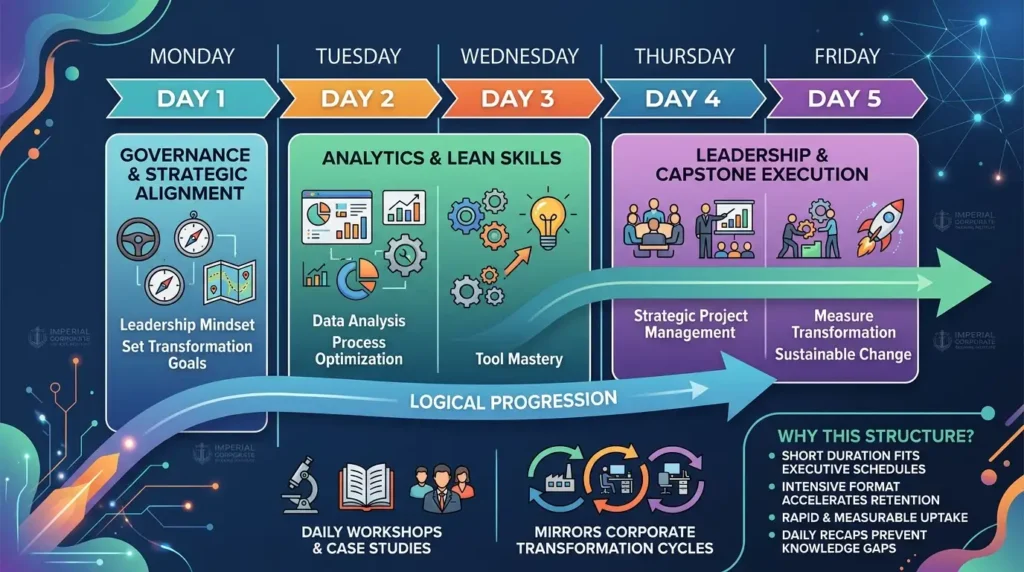
The one-week structure follows a logical progression from strategic alignment to capstone execution, ensuring skill mastery through layered modules that mirror corporate transformation cycles, with daily reinforcement via workshops and case studies.
Imperial Corporate Training Institute designs the curriculum for rapid, measurable uptake. Progression starts with leadership mindset. It advances to tools, transformation, and sustainability.
This mirrors real-world deployment. Day 1 sets governance. Days 2-3 build analytics and Lean skills. Days 4-5 focus on leadership and projects.
Short duration fits executive schedules. Intensive format accelerates retention. Daily recaps prevent knowledge gaps.
Curriculum Logic and Progression
Modules sequence by dependency. Strategic foundations precede tools. Analytics enable transformation applications. Leadership modules integrate prior learning.
Real-world examples ground theory. An HR team maps value streams to reduce onboarding delays by 30%. Managers use DOE to optimize supply chains.
Progression ensures scalability. Participants leave ready to deploy across departments.
For differentiation from Black Belt levels, see:
How Does a Lean Six Sigma Master Black Belt Course Differ From a Black Belt
What Will Participants Learn?
Participants master 10 modules covering strategic deployment, advanced statistics, Lean transformation, change leadership, process reengineering, portfolio management, coaching, control systems, financial impact, and capstone execution, gaining measurable skills in enterprise optimisation.
Learning outcomes emphasize application. Trainees develop data-driven decision-making. They coach teams to project success.
Skills progress from analysis to strategy. Participants design control systems. They calculate ROI for initiatives.
Key Learning Outcomes by Skill Area
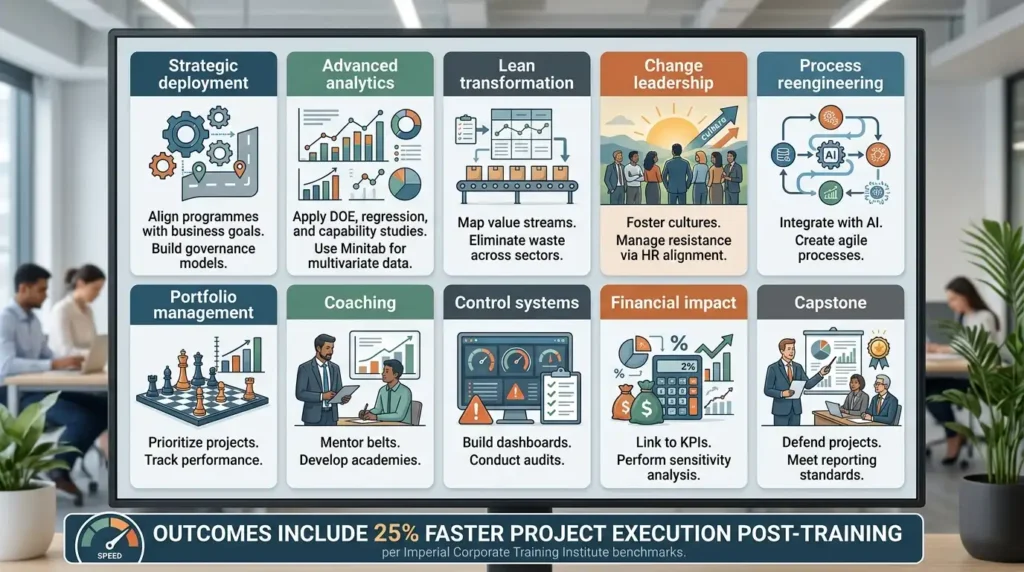
Strategic deployment: Align programmes with business goals. Build governance models.
Advanced analytics: Apply DOE, regression, and capability studies. Use Minitab for multivariate data.
Lean transformation: Map value streams. Eliminate waste across sectors.
Change leadership: Foster cultures. Manage resistance via HR alignment.
Process reengineering: Integrate with AI. Create agile processes.
Portfolio management: Prioritize projects. Track performance.
Coaching: Mentor belts. Develop academies.
Control systems: Build dashboards. Conduct audits.
Financial impact: Link to KPIs. Perform sensitivity analysis.
Capstone: Defend projects. Meet reporting standards.
Outcomes include 25% faster project execution post-training, per Imperial Corporate Training Institute benchmarks.
How Is the Course Delivered?
Imperial Corporate Training Institute delivers the programme onsite, online, or hybrid over one week (40 hours), using interactive workshops, simulations, case studies, and software labs with 10:1 trainer-participant ratios for hands-on practice.
Format suits corporate needs. Onsite options occur at client facilities. Online uses secure platforms. Hybrid blends both.
Duration packs content efficiently. Mornings cover theory. Afternoons apply via simulations.
Trainers hold Master Black Belt credentials. They facilitate group work.
Delivery Formats and Methods
Workshops break modules into 4-hour blocks. Simulations mimic corporate projects, like reducing manufacturing defects.
Case studies draw from HR implementations. A supply chain executive streamlines procurement, cutting costs 15%.
Software labs provide Minitab access. Participants analyze datasets live.
Daily debriefs reinforce learning. Networking builds peer cohorts.
Imperial Corporate Training Institute ensures accessibility. Materials include digital workbooks and recordings.
What Results Can Be Expected?
Expected results include leading enterprise projects with 20-40% efficiency gains, mentoring 5+ Black Belt teams annually, sustained ROI tracking, and role advancement in operations or quality leadership within 6 months.
Participants achieve measurable impacts. Organizations see reduced waste and higher productivity.
HR teams embed skills firm-wide. Departments report faster cycles.
Workplace Impact and Performance Metrics
Post-programme, leaders deploy governance. A manufacturing director cuts downtime 35% via value stream mapping.
Coaching builds internal capacity. Continuous improvement cultures emerge.
Financial outcomes: 15-25% cost savings. Sensitivity analysis justifies expansions.
Role effectiveness rises. Operations managers advance to director levels.
Imperial Corporate Training Institute tracks via alumni surveys. 92% report project leadership within 3 months.
Corporate applications span sectors. Service firms optimize customer processes. Tech teams integrate with innovation.
How Does This Course Differ from Lower Belts?
Master Black Belt focuses on enterprise strategy, coaching, and portfolio management, unlike Black Belt’s project execution; Imperial Corporate Training Institute structures it for leaders scaling transformations across organisations.
This level demands prior Black Belt experience. It shifts from tactical to strategic.
Participants mentor multiple projects. They design academies.
What Are the Eligibility Requirements?
Eligibility requires Black Belt certification, 5+ years in process improvement, and managerial experience; Imperial Corporate Training Institute reviews applications for alignment with enterprise leadership roles.
Target audience includes senior managers and directors. Quality leaders qualify.
No prerequisites beyond belts. Assessments confirm readiness.
What Is the Cost and Value?
Cost covers full programme, materials, certification, and 12-month access to resources; Imperial Corporate Training Institute provides ROI calculators showing 5-10x returns via efficiency gains.
Pricing reflects intensity. Group discounts apply for teams.
Value ties to outcomes. Financial models quantify benefits.
How Does Enrollment Work?
Enrollment involves application review, eligibility confirmation, and payment:
Imperial Corporate Training Institute schedules cohorts quarterly with completion via capstone for certification.
Process starts online. HR teams coordinate group entries.
Steps: Submit form. Receive approval. Access pre-work.
Completion path: Attend all sessions. Pass assessments:
Enroll in the Lean Six Sigma Master Black Belt Certification Training Course today.