
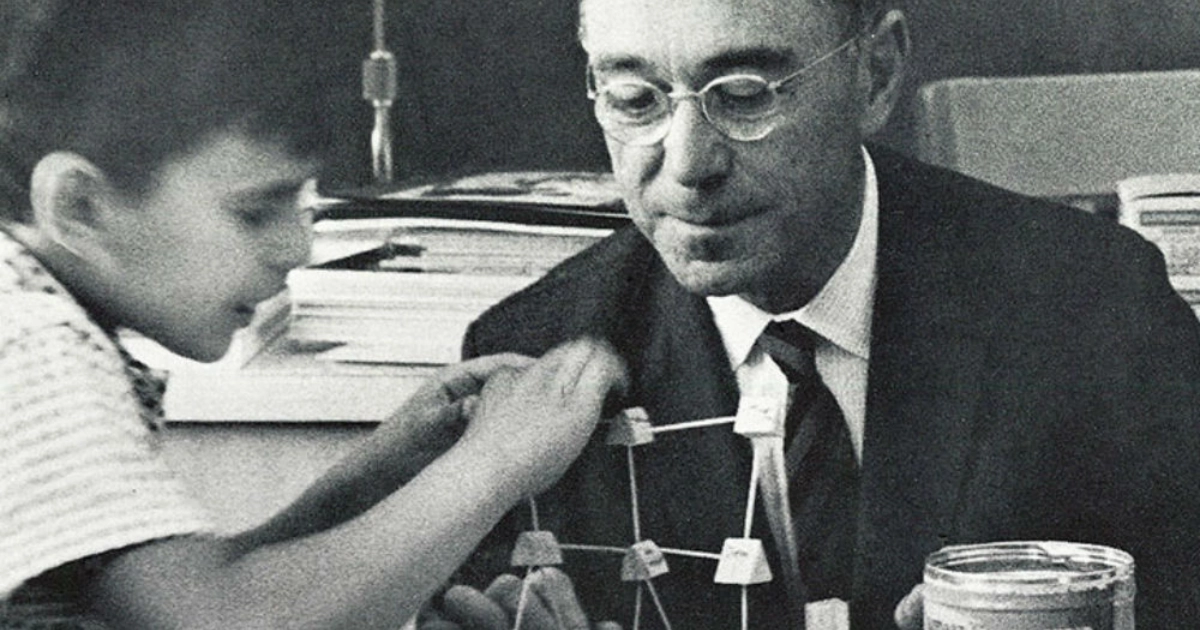
Jerome Bruner was a pioneering psychologist whose influential theory of cognitive development and learning emphasized the active role of learners in constructing knowledge. Unlike some traditional views that saw children as passive receivers of information, Bruner proposed that learners actively build meaning through interaction, guided by their existing knowledge and culture. His theory remains foundational in education, supported by decades of research and practical applications.
Key Components of Bruner’s Theory
Three Modes of Representation
Bruner identified three distinct ways learners represent knowledge, which evolve typically though are not strictly age-dependent:
| Mode | Description | Examples |
| Enactive | Learning through direct physical action and manipulation | Infants shaking a rattle, toddlers crawling |
| Iconic | Learning through mental images and sensory experiences | Children recalling the image of a teddy bear |
| Symbolic | Learning through abstract symbols such as language and math | Solving algebraic problems, understanding concepts like “freedom” |
These modes show a progression from concrete interactions to abstract thinking, enabling learners to grasp complex concepts through appropriately scaffolded experiences.
Spiral Curriculum
Bruner proposed the spiral curriculum, where learners revisit topics repeatedly at increasing levels of complexity and abstraction. Through this method, foundational ideas are introduced early in simplified forms and expanded upon later, allowing learners to deepen their understanding gradually. Research shows that such spaced, revisited learning promotes better retention and mastery.
Scaffolding
Bruner introduced the concept of scaffolding, where a more knowledgeable person (a teacher, parent, or peer) actively supports the learner by breaking down tasks, offering clues, and reducing challenges until the learner achieves independence. This guided discovery learning fosters autonomy and problem-solving skills, and studies confirm it enhances motivation and cognitive growth.
Supporting Research and Expert Insights
Many studies and educators validate Bruner’s focus on active, discovery-based learning:
- Research on scaffolding (Wood, Bruner, & Ross, 1976) has demonstrated improved learning outcomes when learners receive timely, tailored support.
- The spiral curriculum approach has been adopted internationally, such as in Singapore’s mathematics curriculum, leading to sustained high performance in global assessments.
- Bruner’s theory has been influential in developing constructivist pedagogies—learning as an individual, active construction process—endorsed by numerous educational psychologists.
Educational and Practical Applications
Bruner’s ideas have transformed teaching methods, emphasizing:
- Engaging learners’ prior knowledge
- Encouraging discovery through guided inquiry
- Using a variety of representations (manipulatives, images, language)
- Structuring curricula to revisit and build on concepts progressively
This fosters learners who are not just passive recipients but critical thinkers and autonomous problem solvers.
Current Data and Statistics
- Organizations investing in active and scaffolded learning approaches report up to a 37% increase in learning effectiveness.
- Repetition and spiral learning contribute significantly to long-term retention, evidenced by higher test scores in programs using these methods.
- A 2024 survey of educational psychologists identified Bruner’s scaffolding as one of the top three strategies to enhance student engagement and success.
Why Learn About Bruner’s Theory at Imperial Corporate Training Institute (ICTI)?
Understanding foundational learning theories like Bruner’s empowers trainers and educators to design impactful programs that truly engage their learners. At ICTI, our expert-led corporate training courses integrate these evidence-based pedagogies to elevate your teaching skills.
Whether you aim to become a certified corporate trainer or to enhance your educational techniques, ICTI offers comprehensive and flexible programs tailored to your needs. Our courses blend theory with practical application and provide mentorship that ensures your mastery and career success.
Transform your professional prospects by enrolling at the Imperial Corporate Training Institute today. Join a vibrant community of learners mastering the latest training methodologies grounded in proven research, including Bruner’s influential theories.
Visit our website or contact ICTI now to begin your journey toward becoming a skilled corporate trainer capable of inspiring and empowering learners across any industry.
Your effective training career starts here with ICTI—where theory meets practice for real-world impact.