
Lean Six Sigma certification organises professionals into belt levels that match their roles in process improvement projects. These levels range from White Belt to Master Black Belt. Organisations use them to build structured teams that drive efficiency, reduce waste, and deliver measurable ROI in corporate settings.
Why Do Organizations Adopt Lean Six Sigma Belt Levels for Workforce Development?
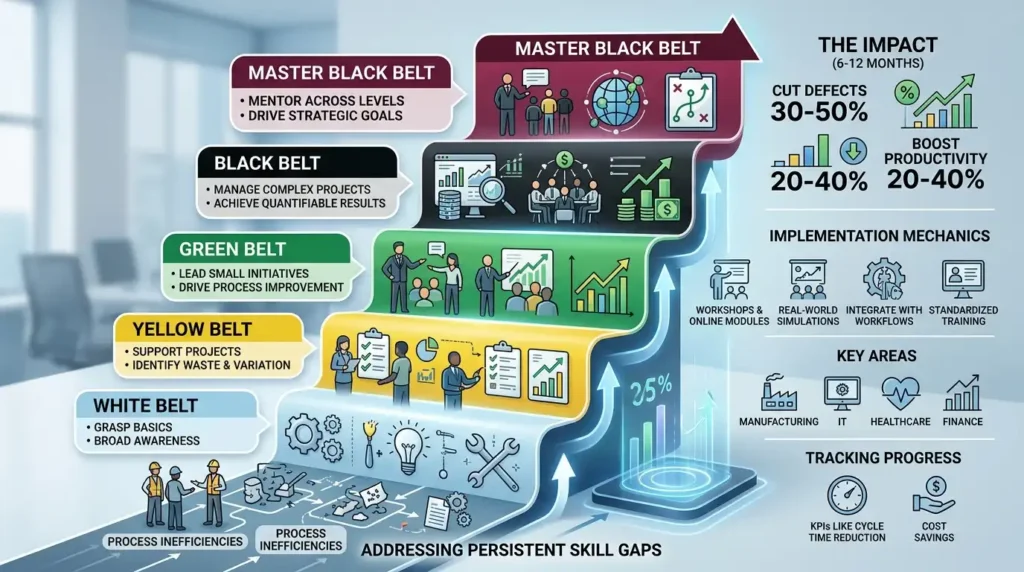
Organisations adopt Lean Six Sigma belt levels to address skill gaps in process optimisation, enabling teams to cut defects by 30-50% and boost productivity by 20-40% within 6-12 months.
HR managers and L&D professionals face persistent employee skill gaps in handling inefficiencies. Lean Six Sigma belt levels provide a clear hierarchy. This hierarchy assigns roles based on expertise.
White Belts grasp basics. Yellow Belts support projects. Green Belts lead small initiatives. Black Belts manage complex projects. Master Black Belts mentor across levels.
In corporate environments, this structure integrates with existing workflows. Teams form around projects targeting high-impact areas like supply chain delays or quality control failures.
Delivery occurs through workshops, online modules, and hybrid formats. Participants complete assessments and real-world simulations. Organisations track progress via KPIs such as cycle time reduction and cost savings.
Business owners implement belt levels to standardise training. They start with entry-level belts for broad awareness. Advanced belts target leaders. This approach fills gaps in departments like manufacturing, IT, healthcare, and finance.
What Defines Each Lean Six Sigma Belt Level in Corporate Training?
Lean Six Sigma belts define five levels: White (awareness), Yellow (support), Green (project lead), Black (expert execution), and Master Black Belt (strategic oversight), each with specific training durations and project requirements.
White Belt training lasts 4-8 hours. It covers DMAIC basics—Define, Measure, Analyze, Improve, Control. Employees learn to identify waste in daily tasks.
Yellow Belt requires 16-20 hours. Trainees support data collection and basic analysis. They participate in kaizen events, reducing process variations by 10-15%.
Green Belt spans 40-80 hours. Green Belts lead projects under supervision. They apply statistical tools to achieve 20-30% efficiency gains. Training includes case-based learning and simulations.
Black Belt certification demands 120-160 hours. Black Belts handle full-scale projects, mentoring Green Belts. They deliver 40-70% improvements in metrics like throughput.
Master Black Belt involves 200+ hours plus coaching experience. They design programs and train Black Belts. Organisations deploy them for enterprise-wide transformations.
Each level includes exams, projects, and recertification every 3 years. Training formats mix virtual classrooms, role plays, and on-site workshops.
How Does Lean Six Sigma Training Progress Across Belt Levels?
Training progresses from foundational awareness in White Belt to strategic leadership in Master Black Belt through phased DMAIC application, hands-on projects, and escalating statistical rigor over 4 hours to 200+ hours.
Organisations structure programs sequentially. White and Yellow Belts build awareness via online modules. These last 1-2 days.
Green Belt training introduces full DMAIC cycles. Participants analyze real data sets from their industry. Sessions last 1-2 weeks, blending workshops and assessments.
Black Belt dives into advanced tools like Design of Experiments (DOE) and hypothesis testing. Trainees complete two projects, each saving $50,000-$250,000.
Master Black Belt adds programme management. Candidates coach 5-10 Black Belts and develop roadmaps. Hybrid delivery combines e-learning with 4-week intensives.
Implementation starts with needs assessments. HR identifies gaps via audits. Teams train in cohorts, applying skills immediately.
Metrics track completion rates (target 85%) and project ROI (minimum 3:1). Recertification ensures ongoing application.
How Do Organisations Implement Lean Six Sigma Belt Levels Effectively?
Organisations implement belt levels by conducting skill audits, forming cross-functional teams, delivering phased training, and measuring ROI through 25-50% defect reductions within 12 months.
Step 1: Audit current processes. Identify gaps using value stream mapping. Target areas with 15-20% waste.
Step 2: Build teams. Assign White/Yellow Belts for support, Green/Black for execution, Master Black Belts for oversight.
Step 3: Roll out training. Start with 20-50% of staff at entry levels. Use hybrid formats: 60% virtual, 40% in-person.
Step 4: Launch projects. Green/Black Belts tackle 3-6 month initiatives. Track via dashboards showing OEE (Overall Equipment Effectiveness) gains.
Step 5: Scale enterprise-wide. Master Black Belts certify internal trainers, reducing external costs by 40%.
Common delivery: Quarterly cohorts with 10-15 participants. Budget $2,000-$10,000 per belt.
For deeper insights Enrol in the:
Lean Six Sigma Master Black Belt Certification Training Course on advanced execution.
Explore:
How a Lean Six Sigma Master Black Belt course differs from a Black Belt. This shift aids decision-makers evaluating high-level options.
What Measurable Outcomes Do Lean Six Sigma Belt Levels Produce for Businesses?

Belt levels produce 20-60% productivity increases, 30-70% defect reductions, 15-25% cost savings, and 10-20% retention improvements, tracked via KPIs like sigma levels and ROI over 6-24 months.
Organizations measure success through standardized metrics. Productivity rises as cycle times drop 25-40%. Defects fall from 3.4 per million opportunities (4 sigma) to 0.8 (5 sigma).
Cost savings hit $100,000-$1M per project. Black Belt initiatives yield 4-7x ROI.
Team efficiency improves with faster decision-making. Leadership pipelines strengthen as Green/Black Belts advance.
Retention climbs 12-18% via skill development. Absenteeism decreases 15%.
Examples: IT firms cut deployment errors 45%; healthcare reduces patient wait times 35%; manufacturing boosts throughput 28%.
Annual audits confirm sustained gains. Sigma levels track long-term maturity.
What Use Cases Demonstrate Lean Six Sigma Belts in Corporate Teams?
Use cases span manufacturing (line balancing), healthcare (patient flow), finance (claims processing), IT (ticket resolution), and services (order fulfillment), with teams achieving 25-50% efficiency gains.
Manufacturing deploys Green/Black Belts for kaizen events. They reduce setup times 40%, increasing output.
Healthcare uses Yellow/Green Belts for triage optimization. Wait times drop 30%, improving satisfaction scores.
Finance applies Black Belts to audit processes. Error rates fall 50%, saving $500K yearly.
IT teams with Master Black Belt oversight resolve incidents 35% faster via root cause analysis.
Service departments train White Belts for daily improvements. Order accuracy rises 20%.
Cross-industry teams collaborate on shared projects, like supply chain in retail and logistics.
What Common Problems Arise with Lean Six Sigma Belt Training, and How to Avoid Them?
Common problems include lack of leadership buy-in (delaying ROI by 6-12 months), generic programs (yielding <10% gains), poor project selection, and no sustainment, avoided by executive sponsorship, customized training, and control phases.
Leadership resistance stalls 40% of programs. Solution: Involve C-suite in White Belt sessions, tying to 20% profit goals.
Generic training ignores industry needs. Customize with simulations for IT backlogs or healthcare protocols.
Poor project selection wastes 30% of efforts. Use prioritization matrices for high-ROI targets.
No sustainment erodes 25% of gains. Embed control plans and audits.
Inadequate measurement skips ROI tracking. Define KPIs upfront: 3:1 minimum return.
Misconception: Belts alone fix culture. Pair with change management for 85% adoption.
Overcoming these ensures 90% project success rates.
What career benefits come from Imperial Corporate Training Institute’s Lean Six Sigma Master Black Belt course?
Completing the Lean Six Sigma Master Black Belt Certification Training Course from Imperial Corporate Training Institute positions professionals for roles like process excellence directors, with average salary increases of 20-30%. It builds skills in coaching Black Belts and driving 40-70% efficiency gains. Organizations value the certification for leadership in Six Sigma deployments.
How long does it take to complete the Master Black Belt certification from Imperial Corporate Training Institute?
The Lean Six Sigma Master Black Belt Certification Training Course at Imperial Corporate Training Institute takes 200-300 hours over 4-8 weeks, including training, projects, and exams. Recertification occurs every 3 years with continuing education units. Completion timelines vary based on hybrid pacing and project demands.
What are the prerequisites for the Lean Six Sigma Master Black Belt Certification Training Course?
Prerequisites for the Lean Six Sigma Master Black Belt Certification Training Course at Imperial Corporate Training Institute include Black Belt certification and 2-3 years of project leadership experience. Candidates must complete at least five Green or Black Belt projects with documented ROI. This ensures readiness for advanced strategic roles.
How does Imperial Corporate Training Institute deliver the Lean Six Sigma Master Black Belt course?
Imperial Corporate Training Institute delivers the Lean Six Sigma Master Black Belt Certification Training Course through hybrid formats including online modules, live workshops, and hands-on simulations. Training emphasizes real-world projects with mentoring from certified experts. Delivery accommodates corporate schedules with flexible cohorts lasting 4-6 weeks.