
Key Points
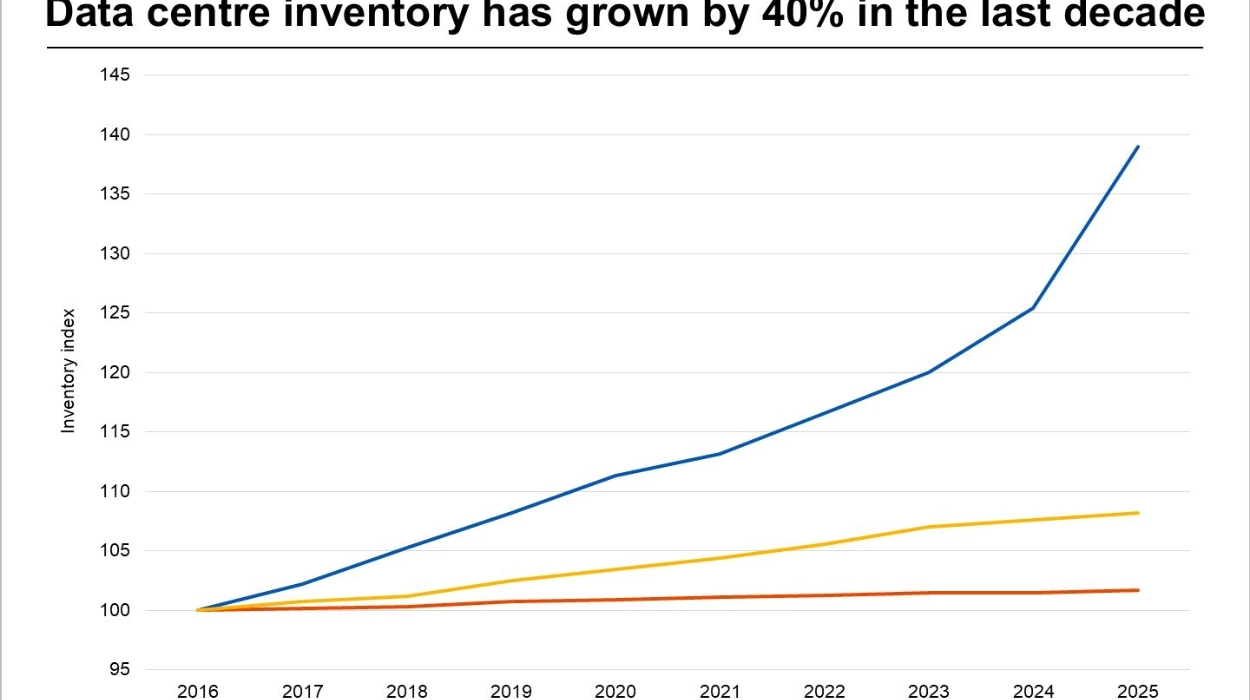
- UK data centre inventory is accelerating with nearly 100 new facilities in the pipeline, representing a 20% increase by 2030, driven by surging AI demand.
- The UK ranks as the world’s third-largest data centre market with 477 facilities currently operational, shifting towards AI-first, high-density campuses in regions like London, South East, Wales, Scotland, and Greater Manchester.
- Major investments include Google’s £5bn data centre programme, Microsoft’s $15bn capital expenditures featuring the UK’s largest supercomputer with Nscale in Loughton, Blackstone’s £10bn AI campus in Blyth, AWS’s USD 10bn over five years, and Nscale’s £2bn commitment including a 50MW scalable to 90MW site housing 23,040 NVIDIA GB300 GPUs for Azure from 2027.
- Government’s AI Opportunities Action Plan announces £14bn in data centre projects, AI Growth Zones (AIGZs) in Oxfordshire, North East England, Greater Manchester, North Wales, with five designated to unlock power access, planning support, and investments creating over 13,250 jobs.
- Market projections: UK data centre market to reach USD 22.65bn by 2030 at 13.33% CAGR; spending to soar to £10bn annually by 2029 (five-fold increase); IT load to nearly double from 3,485MW to 8,382MW by 2031.
- Regional expansions: Latos Data Centres plans 40 new sites including hyperscale in Cardiff; upcoming projects like Elsham Tech Park (1GW), Cambois (720MW), East Havering (600MW); Scotland’s Argyll (100MW to 2GW renewable-powered), DataVita with CoreWeave’s £1.5bn; Microsoft’s four sites (£330m) in Leeds, Wales, Acton; Google’s £740m in Hertfordshire.
- London supply growth: 180MW in 2026 (second-highest on record), 373MW combined 2025-2026.
- Challenges: Energy demand up to 71 TWh extra by 2050; new substations like Uxbridge Moor (1.8GW); water scrutiny in Thames Valley; push for liquid cooling, renewables, SF6-free tech.
- Quotes: Matthew Baynes of Schneider Electric predicts 2026 as full acceleration year; UK PM Sir Keir Starmer states “Artificial Intelligence will drive incredible change…Our plan will make Britain the world leader”; Claire Keelan of Onnec notes need for five times capacity by 2029.
The UK data centre sector is experiencing unprecedented growth, fuelled by artificial intelligence demands from global tech giants, with nearly 100 new facilities planned for a 20% inventory rise by 2030. Investments exceeding tens of billions from Microsoft, Google, Blackstone, Nscale, and AWS underscore the shift to AI-ready infrastructure, supported by government AI Growth Zones. This expansion promises economic boosts through thousands of jobs but raises concerns over energy and sustainability.
What is driving the acceleration in UK data centre inventory?
As reported by Matthew Baynes, Vice President of Strategic Partners, Cloud and Service Provider at Schneider Electric, in Data Centre Insight, “The UK’s AI data centre infrastructure will move into full acceleration” in 2026, marking the most rapid phase of digital infrastructure expansion in history. Baynes highlights that AI adoption across sectors is rewriting the data centre map, with the UK—already the world’s third-largest market boasting 477 facilities—now pursuing a strategically distributed network of AI factories. This growth is propelled by soaring demand from hyperscalers, as noted in a BBC report where global tech giants like Microsoft, Google, and Blackstone commit billions amid plans for around 100 new sites by 2030.
The government’s AI Opportunities Action Plan, launched in January 2025, outlines a £14 billion ambition to position the UK at the forefront of digital innovation, announcing data centre projects worth £14bn and pledging AI Growth Zones to fast-track approvals and grid access. Downing Street stated these initiatives, involving Vantage, Nscale, and Kyndryl, will create 13,250 jobs. By December 2025, five AI Growth Zones were designated, with the Delivery Unit brokering power and planning for further buildout, as per the UK government’s one-year update.
Which global tech firms are investing heavily in UK data centres?
Microsoft is at the forefront, partnering with Nscale on the UK’s largest AI supercomputer at Loughton AI Campus—a 50MW site scalable to 90MW housing 23,040 NVIDIA GB300 GPUs for Azure services from Q1 2027, part of its $15bn capex and separate £330m for four new centres in Leeds (two), Wales, and Acton, slated for 2027-2029. As per Nscale’s press release, this aligns with the UK-US Technology Partnership, with Nscale committing £2bn over three years.
Google pledges a £5bn data centre programme, including £740m in Hertfordshire using air cooling instead of water, per BBC reporting. Blackstone leads a £10bn AI campus in Blyth, backed by $13.5bn investment near wind power sites with solar and battery plans. AWS announced USD 10bn for infrastructure over five years in September 2024. Nscale also partners with Microsoft, NVIDIA, and OpenAI, importing tens of thousands of NVIDIA GPUs, with OpenAI offtaking up to 8,000 in Q1 2026 scalable to 31,000.
How is the UK data centre market projected to grow?
Barbour ABI analysis projects the market to quadruple in value by 2029, with spending soaring to £10bn annually—a five-fold rise from 2024—driven by AI and cloud computing. Arizton forecasts USD 22.65bn by 2030 at 13.33% CAGR, while IMARC predicts USD 12,237.47m by 2034 at 5.65% from 2026. Mordor Intelligence sees IT load doubling from 3,485MW to 8,382MW by 2031. CBRE anticipates 180MW new supply in London for 2026, following a 193MW record in 2025, totalling 373MW over two years—more than double the prior period. Conservative estimates suggest five times more capacity needed by 2029, as per Claire Keelan, Managing Director UK at Onnec.
Where are the new data centres being built?
Expansion spans regions: Latos Data Centres unveiled 40 new sites, including hyperscale in Cardiff. Upcoming projects include Elsham Tech Park (1GW, North Lincolnshire, construction 2027), Cambois (720MW, Northumberland near Blyth), East Havering (600MW, London Borough of Havering), per BlackRidge Research. Scotland leads with Argyll Data Development’s renewable-powered sovereign AI cloud (100MW to 2GW at Killellan) partnering SambaNova and Schneider Electric, and DataVita’s expansion via CoreWeave’s £1.5bn. AI Growth Zones target Oxfordshire (first), North East England (over 5,000 jobs in healthcare, clean energy), Greater Manchester, North Wales (3,400 jobs, £100bn potential with small modular reactor at Wylfa), as welcomed by Jon Healy, Managing Director EMEA at Salute. National Grid’s Uxbridge Moor substation (1.8GW) supports Thames Valley sites.
What challenges do these expansions face?
Energy demands could add 71 TWh over 25 years, per National Energy System Operator, prompting microgrids, battery storage, private wires, and £35bn National Grid investment 2026-2031. Water usage draws scrutiny, with 28 sites in Thames Water areas and Anglian Water concerns, accelerating liquid cooling adoption. Sustainability pressures emphasise renewables, waste heat reuse, SF6-free GIS (70% lower impact at Uxbridge Moor), as Michael Dall, economist at Barbour ABI, notes increasing demands for energy-efficient facilities. Chris Carreiro, CTO at Park Place Technologies, warns of balancing scalability with environmental responsibilities.
How will this impact the UK economy and jobs?
Prime Minister Sir Keir Starmer declared, “Artificial Intelligence will drive incredible change in our country…Our plan will make Britain the world leader,” tying AI to £400bn productivity gains. Zones promise thousands of jobs—13,250 from £14bn projects, 5,000+ in North East, 3,400 in North Wales—regenerating communities. Regional diversification beyond London/South East anticipates significant inward investment over five years.
In this dynamic landscape of digital transformation, professionals seeking to capitalise on AI-driven infrastructure booms can enhance their expertise through our Data Centre Infrastructure and Cloud Computing courses, equipping you with skills for hyperscale operations and sustainable tech deployments.